
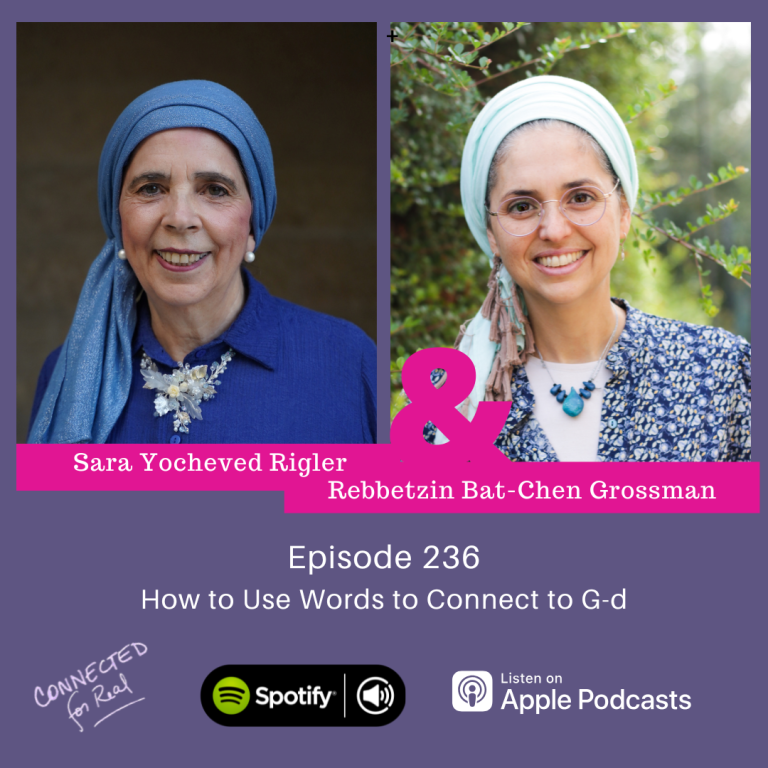
236. How to Use Words to Connect to G-d
Sara Yoheved Rigler is a highly acclaimed international lecturer on Jewish spirituality. She has lectured in five continents and over 35 American cities. She is the author of seven bestselling books including: Holy Woman; Battle Plans: How to Fight the Yetzer Hara; Emunah with Love and Chicken Soup; I’ve Been Here Before: When Souls of the Holocaust Return. Her latest project is leading the 8 Sec Connect Circle and helping women bond with Hashem without taking on anything extra. Rebbetzin Bat-Chen Grossman is a marriage coach for women in business. Join them as they talk about how to use words to connect with G-d.
Transcript:
Welcome to the Connected For Real podcast. I’m Rebbetzin Bat-Chen Grossman, a marriage coach for women in business. And my mission is to bring God’s presence into your life, into your marriage and into your business. Let’s get started. And we are live. Welcome everyone to the Connected for Real podcast. I’m Rebbetzin Bat-Chen Grossman, and today is a beautiful, special day because we have Rebbetzin Sara Yocheved Rigler, right? Please introduce yourself for all those who don’t know who you are, and then we’ll get right into our topic of words and God introduce myself or define myself. Yeah. I’m a writer. I’ve written, I’ve published eight books on Jewish spirituality, starting with a book that was a big bestseller called Holy Woman: A Biography of a Tzadikis, a hidden Tzadikis, a hidden righteous woman who lived from 1924 to 2005, and uh, was, according to Judaism, there are 36 hidden Tzadikim, righteous people whose merit sustains the world. So her husband was acknowledged as one of them by big rabbis, and I believe she was one of them. But all of my books are books about how to work on yourself to become your highest self, actualize your greatest potential. So in that book, for example, there are fork in the road signs. She, she was born somebody who could bless somebody and it would come true, and curse somebody. Once when she was a child of eight years old, she cursed this non-Jewish child who was in their village in Czechoslovakia or Hungary, in Munkacs, and in Europe, in the, before the Holocaust. This bigger non-Jewish kid was hitting her, and she was little or she couldn’t hit back, but she cursed him that he should die today and his body should be in the ground, and the worms should eat him, whatever. Anyway, the kid died that day. He was playing with a a gun, his father’s gun, he and his younger brother, and of course, and the gun was loaded and he ended up shooting himself and he died that day. So then the whole village was saying, “It’s because little Chaya Sara.” be- because the other kids heard her curse him, and now he’s dead. And her father said to her, “If you have the power to curse, you have the power to bless,” which is about, has to do about words. We have the power to curse, and not everybody has as much power as she had, but words can curse and they can bless. She spent the rest of her life blessing- But although the rest of us are not born with as much power, we all can become spiritually great. So throughout the book there’s, there are what I call fork-in-the-road signs, like you see on the highway, a fork in the road. ’cause all of us face tests and choices. We don’t face choices on her level, but on our own level. For example, the giver/taker test. She spent 20 years of her life taking care of multiply handicapped children for which she was not paid, and she never had a vacation, and she never had a day off. So her level of giving is beyond, I think, all of us. But the giver/taker test comes up every day for us on our own level. So the book was pointing out how you… And all of my books are what, how can you become your highest self? Yeah. I remember reading one of your books in a, we had like, a learning group here in our town. And at the end of every chapter, it really brings it back to you. It brings it back very practical. It’s very doable, and that’s really what I love about your books. And now that you’ve brought up this book, I really see it that it’s a pattern that you have, that you don’t just teach or talk at people. You bring it to them and really make it very accessible I’m gonna redefine myself. I started off by saying I’m a writer. Sometimes I’m asked to speak to some group of people who aspire to be, writers, c- creative writers. And uh, I always say, “I’m not the one to speak. I don’t have techniques, because I’m not really a writer, I’m a polemicist.” I only write, I only put pen to paper, which of course nobody does that. I only put fingers on keyboard to get people to do something. To get people… And I write for Aish.com, the website. I used to be a columnist for Ami Magazine. But it wasn’t just to express myself or to express the human condition. No, I want everybody who listens to me to do something, to take one step up in their own spiritual journey. I’ve been, for the last 11 years, I’ve been giving a weekly marriage webinar based on my, I had a w- workshop. I used to go all around the world. Yeah, gave it on five continents. Yeah, not Australia, but North America, South America, Europe, Asia, and Africa. I was in South Africa. Five continents I gave this marriage workshop, which was t- teaching spiritual, not psychological, but spiritual tools in how to have a better marriage. And eventually i- instead of going all over the world doing it, I s- started giving uh, with Jewish workshops, a weekly marriage webinar. It’s called the Kesher Wife workshop or webinar. It’s pe- anybody who’s interested, is- who’s married, and wants wants to go into can find it on my website, sarareigler.com. But the idea was to not just ins- when people read a book, they’re inspired for as long as the book sits on their bedside table. But otherwise, you know, a month later it’s gone. Whereas I love the idea of pe- people being in a group where you’re constantly working on yourself. And I was, for 16 years, in a Mussar Vad with Rabbi Leib Keleman. A Mussar Vad is based on the teachings of Rav Yisroel Salanter, who lived about 200 years ago, who… This is the Jewish method of self-improvement And there are specific methods of working on yourself. And part of the whole idea, which means you have daily exercises that you have to do and you have to chart and reward the body. It’s very important. You have to chart, means you have to keep track of what you’re doing because otherwise we don’t rec- And you have to reward yourself because I find this particularly true of women. They don’t pat themselves on the back. They keep waiting for their husband to give them compliments and encouragement and tell them, “Oh, that was great” And they can wait till hell freezes over, and that’s not gonna happen in most marriages. But they have to be able to compliment themselves. They have to be able to pat themselves on the back when they do something good. Good means something that aligns with their highest self and their highest aspirations. So one way in standard Mussar of doing that is to have a chart, and every time you do the exercise, you give yourself a check. And when you get a certain amount of checks, you give yourself a reward, not for the soul, but for the body. In other words, we’re talking chocolate. We’re talking ice cream. We’re talking a massage. We’re talking reflexology treatment. We’re talking new earrings. We’re talking, this beautiful necklace you’re wearing. We’re talking beautiful… Give yourself a necklace. So because that’s how you get the yetzer hara, your lower self, to be on board with this self-improvement program. So Sara Peltz, who is promoting my new book, this is my new book, Eight Seconds to Connect with Hashem: Mitzvot Mindfulness for Women. Sara Peltz came up with this great idea. She made a website. It’s called 8secconnect.com, 8secconnect.com, where women who go on it, and they do what I’ll explain later, is what the book is suggesting. The way they’ve charted is they get themselves a virtual charm on a virtual charm bracelet. And that’s both a way of charting and a way of rewarding the body, ’cause you get this virtual charm bracelet, and you feel like you’ve done something. It’s so important. Women are so hard on themselves. And to be able to say to yourself, “No, I’m good. I did my, the exercise I’m supposed to do today” You know- … it’s so important for women to give themselves that self-validation. I love that. So I want… I said, introduce yourself. I really wanna start from the beginning on your entire journey, or give us a little bit of an idea of who you are and where you came from How you became this great, you’re I think one of the biggest names I had on my podcast, and I’ve been podcasting for five years. So this is very exciting for me. But I think people who don’t know you and maybe aren’t aware of the greatness should really know, like a little bit of background. Okay, so I can’t talk about my whole journey ’cause it’s very long. But I started I would say when I was 20 years old, I went to India. It- I didn’t drop out. I was a student at Brandeis University, which is a secular Jewish university. And for my junior year, I got college credit for it, I went to India, and there I found a guru who taught me to meditate. And that completely changed my life because he also talked to me about… He told me something that really changed my life. He told me that there are different levels of reality. There’s the physical level, which I, of course I knew. There’s the mental level, which is, which includes the emotional level, which I also knew because I was in a good college, which I had worked very hard. I was a straight A student, worked very hard on the mental level. And the highest level is the spiritual level, which is about God and the soul. And I was like, “What? I never heard of the spiritual level.” I went to Hebrew school. We were conservative Jews and I grew up outside of Philadelphia, and the Jersey side of the Delaware River, 20 minutes from Philadelphia. And, I went to synagogue every Friday night and every Shabbos morning, and I was president of our synagogue youth group, and I went to Hebrew school two nights a week until I was 18 years old and went away to college. So you can imagine that I was very into Judaism the way that I was… But the Judaism that I learned had nothing to do with the spiritual level, nothing to do with God and the soul. Yes, we prayed from a book. We prayed ostensibly we prayed to God, but God was never mentioned in my Jewish education. It was never mentioned by the rabbi in the pulpit. And so this was a real revelation to me, that there are three levels of reality: physical, mental, which includes emotional, and spiritual, which is the high- the highest level means it’s causal. It’s the spiritual level that causes everything else in the world to happen. Wow, that completely changed my life. And from then on, all I wanted was the spiritual. I wanted God. I wanted God-consciousness. I came back, finished, after a year, finished my degree at Brandeis, and then I joined an ashram. An ashram is like a Indian spiritual retreat where people meditate and practice different kinds of yoga. People in A- in America may think of yoga as just doing exercises, but no, yoga means to join with God. And so there are different paths, and the path that we followed was the path of devotion to God So I wanted God-consciousness all I wanted God-consciousness all the time because what I found, I had really jolting experience once. Meditation is hard. To keep your mind focused is hard, but if you can do it, it’s possible to enter into an, like an altered state, a higher state of consciousness where you really can have a spiritual experience. Sometimes, not half the time, not a quarter of the time, but sometimes I had it, and one time I h- was leading the meditation in the community meditation place and somehow, like it went, and I was like, I experienced the oneness behind all reality. It was like, oh, it was so high, it was like, ah, I’d never… I’m seeing everything differently, and I was there for so long that the other community members, like just g- the requisite time for meditation was over, and I wasn’t coming out, and they just got up and left. And finally, I came out, came down, I uncrossed my legs, I s- stood up, I left the meditation room, and two minutes later, one of the members of the community, who was my best friend in the community, came up and asked me about the cooking schedule. And I was in charge of the schedules in the ashram. And I just, I yelled at her, ” don’t talk to me now.” And I thought, wait a second. Two minutes ago I was experiencing the oneness behind all reality, and now I’m yelling at another person, who was actually my best friend? That doesn’t go. God-consciousness has to be something you have throughout the day. So cutting short my story, which is in my book God Winked uh, which is out of print now, but you might have a friend who has a copy. I hope to bring it back into print soon. Anyway, I ended up coming to Jerusalem at the age of 37, leaving the ashram, coming to Jerusalem at the age of 37, and learning Torah at Neve Yerushalayim, a place that billed themselves as teaching Judaism to people with little or no Jewish background. The fact is, I thought I had a lot of Jewish background. I went to Hebrew school till I was 18 years old, but the fact is I knew zilch about real Torah. So I started learning with Rebbetzin Tzpora Heller, who was, like, the most brilliant person I had ever met, much more brilliant than any of my professors at college. And I found my rebbi, the rebbi of Amshinov. I met them both the first night I was in Israel in 1985. So I’ve been on the path of Torah and mitzvot very seriously for over 40 years. But there too, there was a disconnect between… I’m some- because I don’t work in an office, I never had a nine-to-five job, so I tell you, I didn’t… There’s no point at which I have to start working in the morning. I can make my own hours. So I spend a lot of time in the morning praying, meditating, doing what’s called hisbodedus, which it means talking to Hashem out loud in my own words, in my own language, which is English. And I spend a lot of time doing that, and then I’m very peaceful and, I really feel connected to G-d. And then life starts. There’s the laundry, there’s the shopping for groceries, there’s the cooking, there’s the eating breakfast, there’s preparing for my webinar, which has many technical things, the emails and all these things. And Hashem, G-d, is just lost just because- Because I was forgetting G-d. This was the big problem of my whole life, forgetting G-d. And then about two years ago, I… Three years ago, I started listening to Rabbi Asher Baruch Wegbreit, who is a teacher here in Jerusalem, a rabbi, who was teaching this idea that you can make the ordinary mundane tasks of your life into mitzvot. The Torah has 613 mitzvot, things that G-d commanded us. There are, there are 613 ways to connect with G-d. That’s what a mitzvah is. It comes f- there’s an Aramaic word, tvita, which means to connect. Mitzvahs are ways of connecting ourselves to G-d But you have to have what’s called kavanah, conscious intention. You have to know that when you’re doing a mitzvah, you’re doing a mitzvah that co-commanded you to G-d. But the whole idea of a commandment is if I do your will, then I’m connecting to you. If my husband says he wants something for his birthday, and I had thought of something else to give him for his birthday that would be very nice, but he says he wants a blue terrycloth bathrobe, so then if I go and get him a blue terrycloth bathrobe, because that’s what his will is, then I’m connecting to him. When we do the will of another, we connect to them. When we do the will of G-d, do… in a mitzvah, we connect to G-d. So Rabbi Wegbright’s novel teaching, which he… It was based on a book called Kashat Zu Hashem that came from a rabbi in Lakewood, Rabbi Daniel Garfinkel. The idea was there are so many mitzvahs that if you just have conscious intention, you could be performing a mitzvah. For example, that’s why there’s a glass of water on the front of my book, this very dramatic representation of a glass of water. When we drink water, we are hydrating ourselves. It’s good for our health, very important for our health. There’s a lot, there’s a lot of studies about how important it is to drink enough, both mentally and physically. It’s good for us. So there’s a mitzvah of the Torah, V’nishmartem me’od lenafshoteichem, to take very good care of guarding your health. So anything you do to guard your health, whether it’s drinking a glass of water, going to the gym, doing Pilates, doing Zumba, walking, running, eating a healthy meal, going to the doctors, going for a mammogram, going g-going… taking vitamins. Whatever you do that potentially can fulfill that commandment can become a way of connecting with G-d, but you have to use words. I know that’s the theme of this month in your podcast, words. You have to use words to focus your intention. You have to say And this is the words, which you can say out loud or think, but it always is helpful, as Rabbi Nachman taught with doing hisbodedus, that when you talk out loud, your mind doesn’t wander. Like I’m talking out loud now, my mind’s not wandering. If I’m thinking, my mind wanders. Okay. So you could… By saying or thinking, “I’m doing this mitzvah,” and to name the mitzvah. I’m doing the mitzvah of taking very good care of my health as you commanded me, Hashem, in order to bond with you.” And then when I drink the water, of course I said a blessing before I start drinking, but then when I drink the water I’m connecting to Hashem because in my consciousness I realize that this is Hashem’s will that I do things that are healthy for you. You can do it too right now. You can say, try it Bat-Chen. Say, I’m drinking this glass of water bec- ” say the words, “I’m drinking this glass of water- Drinking this glass of water to fulfill the mitzvah of taking good care of my health- To fulfill the mitzvah of taking good care of my health … as you commanded me, Hashem. As you commanded me, Hashem. In order to bond with you. In order to bond with you Okay, now you’re bonded with Hashem in those moments the water tastes better. Yeah, because you’re conscious now. You’re c- you’re conscious. You’re not just, absentmindedly drinking water. The Chofetz Chaim, who was the great the greatest rabbi in Europe in the first half of… He died in 1935, so the first 35 years of the 20th century who, speaking of words he wrote the books on not speaking Lashon Hara, negative words, Shmiras Halashon, guarding your speech. So he lamented that Jews were taking carriage rides, and at the end of… The taxi of those days. And and at the end of the ride, they were paying the carriage driver because they were honest, and they were losing out on a mitzvah. They were losing out on an opportunity to, to bond with Hashem. It was, why? Because there’s a mitzvah of the Torah to pay the worker on time So if you pay the carriage driver or the taxi driver because you’re fulfilling the mitzvah of paying the worker on time you’re not only doing something that’s honest, you’re connecting with the God of the universe, the God who created the whole universe, the God who controls the whole universe. You’re connecting with him by having the consciousness which you state in words I’m doing this…” this mitzvah applies for paying the house cleaner, the babysitter, the sheitel macher if you wear a sheitel. The plumber when he comes to fix something. Any worker who comes, or you go to them, and they do something for you. You go somewhere to, to cut… You have your hair cut, so anywhere you go where somebody does something, and then you pay them when they’ve done something for you, or it could be in your own home. If you have the consciousness, “I’m fulfilling…” You have to say the words, “I’m fulfilling the mitzvah of paying the worker on time as you commanded me, Hashem, in order to bond with you,” then Hashem is in your picture. And then Hashem, instead of just being in your mind, if you… When you pray to Hashem in the morning, or you pray the Mincha a- afternoon prayer, or you say blessings over food, which most of us just blah, blah, blah, blah, blah, blah, and we don’t really have conscious intention when we say the blessings on our food. But you can be connecting with God throughout the day. And so for example in this book, I have a chapter on hesed. So hes- hesed is, Rabbi Akiva called the main principle of the Torah is the mitzvah to love your neighbor as yourself. The Rambam, Maimonides, says that you fulfill this mitzvah in three ways. We are not like, “Oh, just love.” what is love? It’s vague. It’s nebulous. No. What is the action that ex- that is love? Judaism is a very concrete, action-oriented religion where you have to do it. Don’t say, “I love,” the Christians preached love and ended up, killing thousands and thousands of people in wars and the Inquisition. And, you can preach love and believe in love, but how do you do love? So the Rambam, Maimonides, says you, that you fulfill the mitzvah of loving your neighbor as yourself in three ways. Hey, before we continue the episode, I want to ask you something. Are you ready to get answers from G-d directly? Feel more in love with your husband and more supported than ever? Run the business of your dreams without having to sacrifice any other part of your life? That is exactly what my one-on-one private coaching is for, and I want to invite you, just you and me, for a free deep dive discovery call. This is a 60-minute free call where I ask you lots of questions, and we extract the three main things that are holding you back. I then put together a personalized plan for you where I create a roadmap of recommendations with practical steps. The call is free and so valuable in itself, so go book yours today. Now, back to the show The first way is hesed. Any act of giving And I’m gonna get back to that. Second way is by treating the other person with honor, and the third way is by speaking well of them. So of course, these have a … Speaking well of them is all about words. Treating them with honor is mostly about words. The first one, hesed. So when we think of hesed, we think of giving. I give my husband a meal. I give my children an allowance. I give my friend a present on her birthday. They’re giving physical things, but giving includes giving an encouraging word, giving a listening ear to a person who wants to tell you about their problems, giving a compliment. All these are acts of giving. So before you do you say something to somebody, the salesperson in a store, like really takes good care of you and helps you find what you were looking for. Giving words of appreciation and gratitude is an act of Chesed that connects you with God if you have the intention. So when you say to the salesperson who helped you in the store, “Thank you so much for taking the time to really help me find what I was looking for,” is m- you might be doing that just because you’re a nice person. But if you could say before you think, because you wouldn’t be saying it out loud in, in the store, but you think, “I’m doing the mitzvah of Chesed as you commanded me, Hashem, in order to bond with you,” then you’re not only connecting with the sales girl, you’re connecting with the God of the universe. So in all those ways. So here’s, in the chapter on Chesed, a woman’s bonanza. Women are really the Chesed queens giving. So I divide it into three sections. For a married woman, for a woman who has children, and for a single woman. So for the married women section there’s a list. Can you s- can you see the list that, on to this list goes on to the another page. And so you could be fulfilling the mitzvah of Chesed if you’re conscious and mindful every time you prepare breakfast for your… I put in the third person here. So she prepares breakfast for her husband. She prepares lunch for her husband. She makes a shopping list for the supermarket. She shops for food. She shops for household items. She puts a load of laundry into the washing machine. She puts a load of laundry into the dryer. She folds the laundry. She puts the clean laundry into drawers and closets. She takes the shirts to the laundry or suits to the dry cleaner. She picks up shirts in dry cleaning. She washes dishes or loads the dishwasher. She unloads the dishwasher. She wipes the kitchen counters. She works at a paying job to add to the family income. She cleans the bathroom or any part of it. She vacuums. She washes the floors. Even the floor, even just a few spots off the floor. She prepares dinner. She sets the table. She turns on the heater or air conditioner. She changes the bed linen. It goes… the list goes on and on, and each of these activities, which are the things that fill our lives- Can be the mitzvah of Chesed. If only we spent eight seconds, that’s why the book is called It Just Takes Eight Seconds, to say, “I’m doing this, Hashem, as you c- this mitzvah. Name the mitzvah. Mitzvah of Chesed, as you commanded me, Hashem, in order to bond with you. Somebody asked me, “Is that a kabbalistic thing? Is that like a mystical thing, eight seconds?” no. Eight is a, the number of transcendence in Judaism. But no, I timed how long it takes to say, “I’m doing… I’m eating this, I’m eating this salad to to take very good care of my body, as you commanded me, Hashem, in order to bond with you.” I timed it. It takes eight seconds. That’s all it takes. So you’re not adding anything. But women are too busy. We have too much to do. And so this just takes eight seconds, and it turns every action. So there’s also a whole list of of for anybody who’s a mother. All day long mothers are doing Chesed. Bathing a baby or young child, dressing a baby or young child, preparing the meal, taking a child to God daycare or school, buying clothes for the child, putting on their shoes, teaching a child how to tie their own shoes or fasten the Velcro, buying food. It goes on and on. And then for single women I asked a single woman here in Jerusalem who is a social worker, clinical social worker with her own practice “What Chesed do you do during the day?” Because for her, doing the laundry, since she’s only doing it for herself, is not… She can’t say she’s doing a Chesed. But she… I have a list of things here. Lending objects, giving gifts, giving tzedakah giving good advice. Even as part of your profession. She’s a social worker, right? There are therapists, there are lawyers, there are real estate agents. Even if you’re paid for it, if you give good advice, you are fulfilling the mitzvah of Chesed. A real estate agent, before she shows somebody a house, assuming she’s gonna give them true advice and not tell them to buy, that they should buy the house without telling them what’s wrong with it. But if you give good advice, you can preface it by saying “I’m doing the mitzvah of Chesed as you commanded me, Hashem.” You know something? I should do it right now. I’m giving, doing this podcast because I wanna help the women who listen to it to go higher in their spiritual lives and in their relationship with God. I’m just gonna say the words. Hashem, I’m doing the mitzvah of Chesed by doing this podcast as you commanded me, in order to bond with you. Now every minute of this podcast from now on I’m doing a mitzvah So that’s the, the thing I noticed while you’re talking- Oh, excuse me. I just wanna say, I was gonna say what my single friend did for… Because single women have to also know that they do. So she said, this is the hesed she did in one day. She said, ” my friend asked for the address of the mikveh for immersing vessels. I didn’t know the address, so I walked over there to find out. I helped plan part of my friend’s Shabbos Kallah. A friend is moving, so I went to help her move some of the boxes. I tried to get a friend who’s visiting from America onto a tour she would enjoy. I introduced a friend with a baby, moved into the area to another friend with a baby who lives in the area. I invited my friend to sleep over because the noisy protest near the Prime Minister’s house, it’s hard for her to sleep at home.” This was during the judicial reform protests here in Israel. She wrote this. “A friend who’s having a hard time reached out to me. I spoke with her on the phone. It was my father’s birthday, so I called him.” just on and on. Single people, m- married people, we all have endless opportunities for hesed. Okay. Now, what were you gonna ask me about, Chanie? No, I love it. I think that what I’m hearing from what you’re saying is that a person could be just a nice person, or they could be doing hesed, doing, mitzvahs because G-d commanded them. So the mitzvahs are here to really refine us as humans- … and become good people. But if you don’t connect it to G-d, then you’re just losing the point. And I wonder if… You know, You were saying like, oh, so then you’re just a nice person. But like, really a lot of people do connect it to their relationship with G-d. I don’t start every podcast episode by saying, “Welcome, everyone, to the Connected for Real podcast. I’m doing this podcast so that you can, hear words of encouragement and, connect to G-d as G-d commanded me.” But I do it for G-d’s sake, you know, 100%. And I’m wondering, like, where is the line between being intentional all the way or being unintentional and unconscious and just being nice? You know what I mean? Yes, I know exactly what you mean. So Rav Dessler explains, Rav Eliyahu Dessler, Dessler, who was a great mussar teacher in the 20th century, let’s say mid-20th century. He taught, and this is such an important thing to understand, that everybody has their own point of choice. Rebbetzin Heller calls it, expands it in from a point to what she calls a choice box And in the end, when we d- leave this body and go to the next world, we are only judged by our choices. What does this mean? Let’s take the giver-taker choice that I mentioned before in, in regard to Rebbetzin Chaya Sarah Kramer, who I wrote the book Holy Woman about. So she spent 20 years of her life, taking care of multiply handicapped children in the days before there were disposable diapers, and most of them were incontinent. In the shack where she lived, they were very poor, had no money. Just a level of giving that is beyond the beyond. So let’s imagine the giver-taker s- like a spectrum thing, where the… her ki- her giving is all the way up here. At the bottom of that spectrum is the thief. The thief takes and doesn’t give at all. The… Where we are on that spectrum in giver-taker depends on how we were raised, what we’ve been exposed to, and what choices we have made in our life. Our choice box moves up and down according to… When you make good choices, your choice box moves up. So on the o- doing what Rebbetzin Hayyar Kramer did, taking care of multiply handicapped children is, without being paid for it, and ag- or without ever getting a day off, is beyond… It’s not my, it’s not in my choice box. I’m not gonna be judged negatively ’cause I didn’t do it, no. It was never in my choice box. Stealing is also not in my choice box. I was… My parents raised me to be extremely honest. I won’t even taste a grape in a store that… Or a piece of chocolate more likely would tempt me, in a store where they have open bins to taste the… I wouldn’t even do that because it’s, it violates my sense of honesty. So it’s not in my choice box. I’m not tempted. Rav Dessler says a ch- a choice is where you can go either way. You could do it or you could not do it, and there’s an internal struggle should you or should you. So if you are in a situation where let’s say a friend asks you to help them. They’re moving and they ne- they need to be, they need help moving And, you wanna help them, but you have something else that you planned to do that day. Something like, something for yourself, and so you’re caught in what the Musar rabbis call an ordeal, where you could go either way. You could say yes to her and forgo your plans, or you could say, “No, I’m sorry, but I already made plans a month ago to do whatever I’m doing,” and you and you have this conflict. That defines your choice box. The choice box is where you have a conflict. So if in the, under those circumstances, if you choose to help your friend and forgo what you were gonna do that you would’ve enjoyed then you have chosen up, and that’s the type of thing where the next world we’re only gonna be judged by our choices means where you had a conflict. Because so most things in life, they’re just givens. I’m not gonna steal. I’m not gonna take care of multiply handicapped children. Those are givens. We don’t get any reward. We don’t, nobody will, listening to this podcast will get a reward when they get to the next world for fulfilling the one of the 10 Commandments, do not murder. Nobody will get a reward for that, because it was never in our choice box. But the things that are in our choice box, we become elevated by. So you’re asking, what if you do it just ’cause you’re a nice person? First of all, it’s not a just. Being a nice person is a really important thing. It’s the will of Hashem that we be nice people. There are mitzvahs that connect us to other people and mitzvahs connect us to G-d, and the mitzvahs that connect us to other people are extremely binding. They’re compulsory. So if you do something, that you, you know, just nice because you wanna do it, or it’s an expression of yourself- And you’re not connecting to Hashem by it. The question you’re really asking is, am I getting elevated spiritually by giving this podcast? Or not. If I don’t have the intention before I do it, that I’m doing it, I’m thinking intentionally, mindfully, that I’m doing it for G-d. So the answer is are you doing it j- because, because this is an expression of your creative there’s an a creative outlet for you? Are you doing it because it’s an ego boost because people look to Bat-Chen Grossman for, “Oh, she has such wisdom. I go to her advice.” Are you doing it because it help your private practice where people pay you to guide them? If you’re doing it for any of those reasons, obviously you’re not being elevated by it and connecting you to G-d. But if you and only you and Hashem know the truth, if you’re really doing it because you really want women to be guided by wisdom that they can get on this podcast, and you’re taking time out of your day, which nobody has, and you’re taking your energy and your time and you’re really doing it for… Then really doing it for G-d, whether or not you express it i- it is binding you to G-d. So that’s the difference between just being a nice person, I’m putting just in quotation points, a mark, because being a nice person is a valuable thing. But it depends on your choice box. If you’re j- just being a good person and G-d is nowhere in the picture because you’ve never been exposed to the true teachings of Judaism and Torah, then yeah, then it’s enough to be a good person. But if you’re a Jew who has ever heard any of the teachings of the Torah, then you know that there is a G-d. You know the will of G-d. You know it’s the will of G-d for Jews to keep the mitzvahs of the Torah. And then your choice box is on a whole different level. So what I’m hearing from you is that even if a person is a therapist, a social worker, a coach, and they’re doing it because it does fill their, private practice or they’re able to help people within their work, even if they’re being paid, it’s still a mitzvah, it’s still chesed. So it’s not necessarily about, is this, a nurture tool in my business? It’s more am I conscious that this is the way I wanna connect to G-d, or that this, that these actions connect me to Hashem. Yes. ‘Cause if you’re not consciously connecting to Hashem, you’re not connecting to Hashem Right It’s all a question of mindfulness. I start every podcast, nobody hears this ’cause we press record after, but every single time before we start a podcast, we say, “Be’ezrat Hashem naase v’natsliach,” with G-d’s help, we will succeed. And I feel like it really goes into the podcast- Mm …… in a different light, i- Yes … I as the host, but also the guests, and, when even the guests who aren’t Jewish, they, it moves them. It’s like, “Oh, she’s intentional about why she’s doing this,” and the conversation goes in a completely different way because we started that way. It’s really powerful. Yes, it is. And I prayed this morning. When I was praying, there’s one of the 19 benedictions in the Shemoneh Esrei, the main prayer of Jewish, the Jewish prayer service. There’s one for da’as, which is w- knowledge, wisdom- I pray to Hashem that he give me the daas to say what the women who will be listening to this podcast today, they give me the words, and gives me the daas today for the women who will be living to… listening to this podcast whenever they’re listening to it that come from him. And so, uh, yes. So the more you put Hashem into your consciousness the more he will be in your life, and the stronger will be your connection to Hashem. Yeah. So we’re talking about words, the power of words, the way that you can use words to elevate the regular things that we do, and even the actions that we take for granted. Oh, I’m just moving the laundry from washer to dryer. Most people don’t sit around thinking, “I am serving G-d right now and connecting to him in the way that he commanded me.” But when you do, you really elevate it. I love that. I think it’s really powerful. Tell me more about your book. When is it coming out? How can we use it? How can we connect to Hashem more deeply? So the book is already out in in Israel. It’ll be out in America June 1st. It will be possible in another few days to pre-order it. I would recommend going on this great website, eightsecconnect.com, that Sara Peltz made. Eightsecconnect.com. I’ve been on the podcast, and it is so cute. It’s well- Oh, you mean the, you, the… You mean… You don’t mean the podcast. You mean the the website. I went on the website. The website. Yeah. I went on the website. It is so cute. It is so well-designed. I loved it. I thought it was magical. It’s fascinating. By the way, by the time this podcast episode drops for everyone to hear, then your book will be out everywhere. Oh, good. And, yeah. And that’s not a worry. And the website will be up and running. I highly recommend everybody go check it out. What can they expect when they go- when they go to the website? Yeah. So they can expect to be introduced to me and to this concept of doing the ordinary mundane tasks of their li- of their lives with kavanah, the kava- with the conscious intention of just saying this eight-second formula. Which, by the way, I d- I don’t like to use the word formula, ’cause you can put it in any way you want. Sometimes I, I say to Hashem, “So I’m doing, I’m eating this healthy meal now as you commanded me to take very good care of my health in order to bond with you.” Or sometimes I say, “I’m eating this very, this healthy meal now because you want me to to take very good care of my health.” Or, “You want me to take very good care of my body.” I like it, I, d- ’cause w- we don’t wanna get into a, like a formula which, again, becomes rote. But- Would you say that… I have another question that I’m gonna throw at you. Would you say that the blessings themselves are this formula, and that we just lost consciousness of it when we’re saying the words mumbly, we don’t know what we’re saying, we don’t know what we mean? Have we lost something that already was- Yes. I think the intention of the rabbis when they made saying blessings before food was that, to put Hashem into… I was once at a, oh, this was maybe 30 years ago, I went to something in Tel Aviv. There was a, a guru who happened to be Jewish named Andrew Cohen. He had a- quite a following in Tel Aviv. He, but he was not in touch with his Jewish identity at all, and the people that came to him came because he was mamasha guru. He had a whole following, and he taught meditation and and somebody took me to hear him. So he led a meditation, and it was great. Everybody l- loves meditation. And during the Q&A at the end, one of the men, a dude from Tel Aviv, I never use the word secular Jew. They’re… All Jews are holy. But uh, let’s say a non religiously observant man from Tel Aviv he raised his hand. He asked the question this is great, doing meditation, but how do you stay conscious of… How do you stay conscious of G-d throughout the day?” And Andrew Cohen, the guru, did not have an answer for him. But afterwards, I went up to him and I said, “The way you stay conscious of G-d throughout the day is to say blessings on food.” And- Yeah … he asked me where he could find those blessings. And I told him. So you are right that was the intention of the rabbis, but the truth is that we just… that most of the time we’re in such a rush we just mumble through our blessings and we’re not conscious. But if you can say a blessing on food, then do you also have to be conscious that this food is healthy and it’s therefore fulfilling the mitzvah of taking very good care of my health? Probably not, because if you’re connected I once heard an athlete who used to be very conscious of meditating in the morning and preparing for his whatever it was that he was doing. I don’t remember if it was, like, judo or something, whatever it was. And he became religious, and he said, “I love the morning me- blessings,” every single thing I- “You opened my eyes. I can now see,” and all, and in the beginning, he was so excited about them because they were so aligned with preparing so consciously into the day. But then he became like all of us, and he just bloop, say them and run, and I think that there is something in what we already have that is so powerful that if we can connect to the words that we’re already saying is going to help us shift our consciousness. But also, your eight-second connection to Hashem formula or, a new way of looking at it is that exciting new shiny thing that all of us are looking for. Yes, help me bring Hashem back into my life in the little things. Help me learn about my actions and how they connect to G-d’s will. Like I said, a lot of things we’re doing we take for granted, and we think that they’re not connected. We don’t put the dots together. Absolutely. That’s why I recommend buying the book and putting it next on your bedside table. And even after you’ve read the book through once- To keep it on your bedside table and every day pick it up and read one page, ’cause that will c- continually keep this in your consciousness. And and if, especially if you go on the website, eightsetconnect.com, which we start to talk about, they, with this charm bracelet idea. So you’re you put in the la- you put the laundry into the washing machine with the proper mindfulness, and you get to give yourself on the website, you give yourself the little washing machine charm. Or you go grocery shopping with the mindfulness that it’s connecting you with the Hashem through the mitzvah of chesed, and you get to give yourself the little forget what this is, the shopping cart charm or there’s a bag full of groceries charm. There are different charms for different mitzvahs. There’s a m- there’s a charm for a toothbrush. So if you ch- if you have in mind before you brush your teeth, but you have to do it outside the bathroom, ’cause we don’t think about holding things in the bathroom. But if you have the mind, I’m brushing my teeth because it’s very important, oral hygiene is very important for your health. I’m brushing my teeth in order to fulfill the mitzvah of taking good care of my health, then you get the little toothbrush charm. So it’s a way of keeping it going and with this method that I described before of charting and rewarding the body. So the website will definitely help everyone who goes on the website, and it’s free. Just sign in and it’ll help them to keep this alive in your life. Thank you so much- Wow … Bat-Chen. I really enjoyed talking with you. And, Ah … Hashem should bless you with more and more, reach to more and more people who can really benefit from all that you offer them. Amen. Thank you for being here. This was a blessing. Really such a wonderful thing to be able to open up the month of words with such a powerful way of using words. You know, Because now we’re going into words in marriage, words in business, words in you, and we’re gonna talk about how you could use your words in marriage, and how you could use your words in business. And we might get into things that don’t feel as holy, you know, like marketing words or copywriting words. But it’s really important to remember that in any of those situations, it’s for God’s sake. There is no disconnect. Yes. Yes. Great. Yeah. So thank you. Thank you. You’re very welcome. This was really a blessing. You’re welcome. Such a gift. You’re very welcome. I enjoyed it. Thank you. And everybody go check out the website. We’ll have all the links down below in the show notes, and don’t forget to come back for all the other episodes that are coming up for words. I am so grateful. This was amazing, and I’ll see you next time. Don’t forget to be connected for real. And that’s it! Thank you for listening to the very end. I would love if you can leave a review and subscribe to the podcast. Those are things that tell the algorithm this is a good podcast and make sure to suggest it to others. Wouldn’t it be amazing if more people became more connected for real? And now take a moment and think of someone who might benefit from this episode. Can you share it with them? I am Rebbetzin Bat-Chen Grossman from connectedforreal. com. Thank you so much for listening and don’t forget you can be connected for real.