
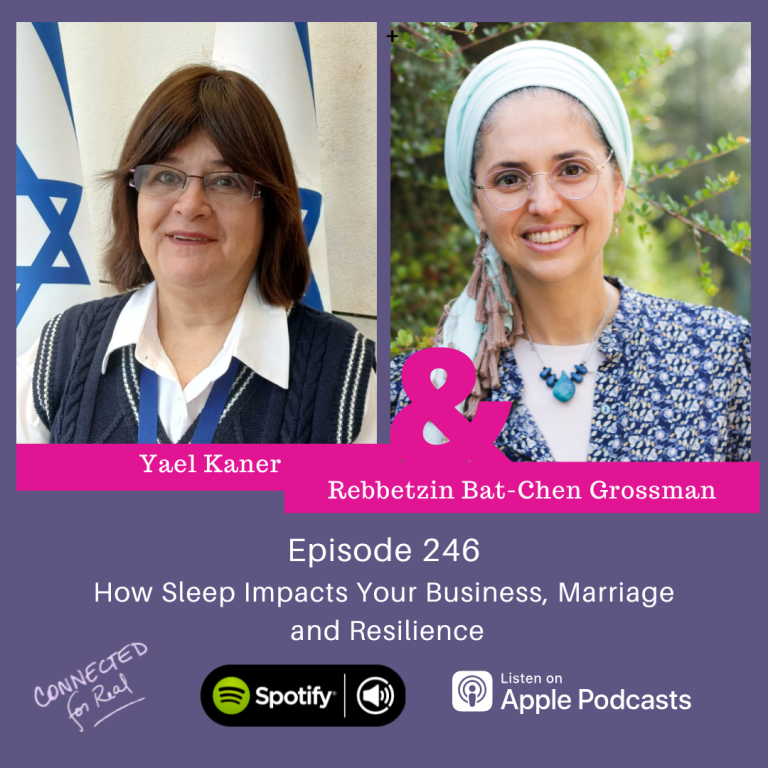
246. How Sleep Impacts Your Business, Marriage and Resilience
What does sleep have to do with your business, your marriage, and your ability to handle life’s challenges?
In this episode of Connected For Real, Rebbetzin Bat-Chen Grossman sits down with Yael Kanner to explore the connection between sleep, emotional regulation, resilience, and the way we show up for the people who matter most. Together, they talk about building routines that support better rest, setting boundaries between work and home, and learning to care for yourself without feeling guilty about it.
You’ll discover why pushing through exhaustion can affect your decisions, how small changes to your daily habits can support a healthier rhythm, and why connection and community are such an important part of getting through difficult seasons.
Because taking care of yourself isn’t selfish. It’s part of being able to show up for your family, your business, and the life you’re here to live.
Transcript:
Welcome to the Connected For Real podcast. I’m Rebbetzin Bat-Chen Grossman, a marriage coach for women in business. And my mission is to bring God’s presence into your life, into your marriage and into your business. Let’s get started.
And we are live. Welcome everyone to the Connected for Real podcast. I’m Rebbetzin Bat-Chen Grossman, and I’m so happy ’cause today we’re talking about sleep and business. What a topic. And with us today is Yael Kanner. Yael, introduce yourself. Tell everyone why I love you so much. Ah. I know Yael in person. I know her daughter-in-law. I’m so happy. Thank you. Thank you for welcoming me so warmly. I appreciate it. I am a former rebbetzin. I have been a chef, a doula, and a mashgiacha for the Star-K and for the Vaad Hakashrut in Washington, DC. And I made Aliyah from Baltimore in 2011. And when I came, I came as a doula, and was able to fulfill like a lot of different dreams. But along came so many things that just hit me. I came in 2011, and everything was great until 2020. The first week of COVID in 2020 one of our seven children, ’cause we’re a blended family, so one of our seven children ended his life, and that set me off on a journey I never saw coming. So I decided that I would study coaching, and for some reason, resilience was really something that just grabbed me, and I needed to know more about it and learn all about it because I needed it. So all that happens, and, Along comes the war After COVID, no sooner did we stand up, but were punched back down again. So, my son had been a soldier in the US Army, and I decided that I would take my cooking skills, because I’d been a chef and a mashgiha. So I decided I would cook for soldiers. So I raised a lot of money. I mean, a lot of money. I shouldn’t even mention how much. But I was able to serve 30,000 meals with my team and every week we would send stuff to Lebanon and to Gaza and then the war started to, you know, go down a little bit and I could breathe and think about doing things for myself. And I leaned back into my coaching interests and I said… I didn’t sleep during the war for three years because either I slept underneath where the planes were coming in or I’m living over 3 Shahad, uh, the first- the number one highway in Israel. So I’m- I’m living literally right over the interchange for that. So every siren that goes by and every truck that goes by and every… You know, I was just so hypervigilant that I said to my husband that I’m gonna go study sleep, because there’s a sleep coaching academy run by Rabbi Doron Lazaroff, and he’s been amazing. He gave me a curriculum and now I’m in basically what’s called the stage. It’s an internship. So I’m basically taking clients now. But I’ve learned a lot since May. I mean, I’ve been pedal to the metal the way I did soldiers is the, uh, pretty much… They always say the way you do something is the way you do everything. Well, that’s me, with blinders- Yeah … and that’s it. So yeah, so sleep coaching. So in order to help myself I have a whole kit here. I have a sleep log where ev- if you can see that. Uh, well, at any rate, I’ll tell you about it. I have a log where I track all my sleep. Every morning I wake up, I go out into the garden, because if you go into the garden in the morning or go out into sunlight in the morning, it helps reset your melatonin and it helps your cortisol in- as the day, you know, builds up. So that’s very helpful. Previously, before I could solve the sleep problem, I would go into the doctor and they would hand me lorazepam. They would basically hand me benzo- whatever. So that wasn’t a solution. So then I started looking for melatonin. Turns out if you take melatonin, your body stops producing it, it’s not a good, it’s not a good mood. So, I started taking things like ashwagandha and magnesium glycinate, which really knocks me out very well. You know, relaxes all my muscles. Not knocks me out. It- that’s not what it does. I have- Earphones for over my eyes and over my ears so that I can block light. And I also have the kind with the, with the, where you can put your eyelids in, and this is very helpful. And I went around and I bought them for all of our guests. So anybody who comes to our house, even though all the rooms, you know, once you close the blinds, it’s very quiet. I start using Simin Naeven products and she has some beautiful natural things that are very calming. And badger balm sleep balm. And if you have aches and pains, which people at my age do I use nicotine because it turns out there are receptors in your body, so if you have pain, you take a seven milligram, you cut in half the smoker patch, and you paste it onto wherever the pain is. Ah, Mahaya. You can sleep. You know? And then I’ve tried anything that’s labeled sleep, I’ve tried it all. There’s some wonderful sticks that you can put on. Anybody wants to know about any of this stuff, sleep gummies, you know, if that’s your, your bend. And by nightfall, I usually look like Jabotinsky or Freud. I’m not sure. So I put these on. These … I put them on at 8:00 at night and I feel much better. The reason why I’m doing this is because obviously I want to make a business, right? Obviously this is what I want to do with my life. So when you’re in business and you’re not sleeping well, you’re not making good decisions. You’re very emotionally unregulated. You’re kind of a mess. You’re tired. You don’t have energy. You’re distracted. You miss appointments. You don’t bring your full self to the meeting. So learning emotional regulation, this really helps. Do you hear this in your practice when you’re talking to people? I find that people are emotionally drained, and then they can’t sleep because they’re exhausted. There’s this like, you know how a baby, gets over their sleep window and then they’re like hyper crazy ’cause you’re like- Yes … I just, they’re crying. They won’t put themselves to sleep, but they can’t relax. Like, there’s nothing to do except just like hold them down and try to help them regulate by co-regulating I feel like that’s what a lot of the people who are around me are experiencing. The, there’s, you know, like you were saying, the war created this hypervigilance thing. You’re always on your phones. You’re not really relaxed. And then you’re, you know, every little noise brings you to, like, thoughts and, and images. And, you know, your brain’s just going all over the place. It’s- Not to mention the dopamine hits from the phone, you know? Right. Yeah. Like, just one more, just one more. It’s, it’s like playing Las Vegas or something, you know? You, you’re looking for that next hit- Right … to relax. Yeah. And it doesn’t work that way. And also- Yeah … It, the light from the phone, the, the, uh, blue light, that’s what those glasses are meant to block. So 8:00 on, I’m wearing those glasses because I wanna start tamping down my brain, calming it down with things like meditation journaling. I mean, the, you know, the, there’s natural fixes, and that’s what I’m interested in. I’m interested in a more holistic approach. Obviously, you can see medication. That box is still full, so I did not touch that. It was really interesting for me that you were showing all those things. First of all, I did not know that when you start taking melatonin, then your body stops making it. I did not know that. And for some reason, I always had a feeling that there’s something weird about it, you know. I have a friend who has a whole gamach for melatonin for kids, for adults, so that if you ever lose out or, like, run out or, you know, need or you have a guest who needs, you could go to her, ’cause she made it her whole life mission to make sure that people have what they need. But it never sat right with me. Like, I felt like I didn’t want my kids or myself to be dependent on an external thing for something that’s so natural, like sleep. And when you start taking that every single day, what happens when you don’t have it, you know? Then you have to go running for this gamach or, you know, looking for people who have it. So I, I had, I always had this feeling that something was off with it. Now, when you said it, it, like, all clicked into place for me in my mind. Like, oh, wow. Like, I was right. I’m also really into finding all-natural solutions, and that’s why I love that you said go outside, because the sun is the best way to wake up, you know? The sun. Re- I also sleep on a grounding sheet that’s connected to the Earth. My husband, you know, wove this, you know, cable or whatever it is through our, our apartment, out the window, and I’m connected to Earth while I’m sleeping. I’m grounding. For those of you who don’t know, look it up. It’s really cool. That is cool. I actually I’ve only grounded by walking barefoot and sitting on the ground and just laying on the grass, things like that. I find it very grounding to go up to the Temple Mount, you know, bare- Because, you know, that is the place to ground, and the fact that you are completely connected is a very grounding experience. I never tried the grounding wire thing. I don’t know if my husband would go along with it, so I’m just gonna, like, you know, be happy with what I have. Well, we each have our own. Yeah, yeah. You know? It’s all good. I think also some listeners would be like, “You know, I, I need the medication,” or, “I need…” whatever it is. And it’s like, that’s fine, ’cause you do you, and you know your body best, and you know what you need, and you know how you function, and you know whatever. Like, there is no judgment in our conversation of is there something- Nope … good or bad. I think just awareness. Like you said, you become addicted to it because you stop making your own, is awareness of, “Oh, wait a minute, I could make my own without needing external melatonin. How do I do that?” And I think that could be a really interesting conversation to take this into. And because we’re talking about business so much, it makes me also interested in, you know, how are you finding that women are relating to you in that way, that like they have so many things they wanna do and sleep is just not working? The minute I announced that I was taking stage clients, there was a line out the door. I keep it on my phone, a long line of people that just wanna talk over what’s happening, either because of what’s been the last three years or what I also have done is, if you know Jacqueline Rose, the menopause expert, I took training with her about understanding the phases of a woman’s life, the fertility phase, the perimenopause phase, the menopause phase, and then post-menopause. And if you don’t know where you are on the spectrum or you don’t have an awareness of where you are in that journey it’s gonna be tougher. Because each part of that has something… You know, we have something else to offer. We have more… I mean, this is… I’m just giving you, like, the first 30 things I tried with myself that I’m experimenting on and learning about. There- So yeah, just a heads up, Jacqueline is on my podcast, but she’s scheduled for a couple months from now about menopause. We’re having a whole month, about menopause. And she goes- Wonderful … yeah, she goes into all of it. And it… I think it’s really fascinating that you’re bringing that in. Just getting to know yourself. Where am I on this timeline? What’s going on with my body? How am I handling these changes? ‘Cause I think just being in transition and trying to make it normal, like you’re supposed to be normal. Why are you changing, you know? It’s like, wait a minute. Chill out. Just a thought that comes to me is a girl who’s pregnant is telling me, “I have just, like, everything changed. I can’t sleep the right way. I can’t eat the right way. I’m trying to concentrate and I can’t concentrate the right way, and I keep distracting myself with different things.” Like, one second. Do you realize that you are pregnant, you know? Mm-hmm. Can I remind you that you are in a transition state? So if you are maybe subconsciously fighting reality, not really sure what’s coming, afraid of what to expect, that’s going to show up in a lot of ways, too. So- Well, with sleep, the more you try to hold on and hold it off or hold it together or force it to come, that’s why they call it sleep pressure. It builds up during the day, and then you have to recognize and pay attention to those inner signals. The other thing that I am loving is learning about meditation. And for example, someone asked me to do a meditation tape for her son, who’s a bed wetter. And so there are things that obviously in the sleep coaching world we can do about this or support You know, his journey. That’s just one example. But meditation, uh, in general is, like, amazing, just this awareness. I’m also dabbling in EMDR and hypnosis, which in Israel is not legal, so my acupuncturist said to me, “Now you make sure.” Deep relaxation promised. You know, I’m not practicing hypnosis though, because that’s only for doctors, dentists, and psychiatrists, and I have found none that will do that. But- I know. I, I also have not found anybody who does hypnosis here in Israel, but I do find that NLP practitioners and meditation practitioners, like there’s a lot of the same type of skill that shows up in Israel in other ways. November 25th, I start with Aviva Sarengay in her NLP program because- Nice Michal, Michal spoke so highly about it, and, and I’ve known Aviva for many years, and it never synced up. I said, “Okay. Even though I have a lot on my plate right now, this is my learning season.” Yeah. “So I’m gonna do this, as long as I don’t-” I love that … “stay up late.” Yeah. Yeah. As long as you don’t stay up late. I love that. I love that you know what season you’re in and where your brain is at right now is, is really fun, and also that you have boundaries that you’re not gonna let it make you stay up late. This is great. Exactly. Exactly. But what I’m seeing is the synergy. Like, I’ve had business coaches… Talk about showing up for your business. I had business coaches, a very famous one who’s no longer here, but is in LA. She said to me, “You need to pick one thing.” And I said, “I can’t.” the… I’m interested in so many things, and I see the synergy between the EMDR and the hypnosis and the NLP and the sleep coaching. I think it all supports it, and the more tools I’m gonna bring and I’m gonna deploy in the spring, I’m gonna be so much more ready to help. And I’ll tell you I read something yesterday that was very disturbing. Yesterday Klalit came out with a study from, with the Brookdale Institute about one in five women in my country, in, in Israel are struggling with anxiety, depression PTSD, and those all affect sleep. So the more skills that I can bring to the situation, the more helpful I can be. Women particularly in the ages of, like, 25 to 50 area. I mean, you have to read the study if you, if you’re interested. it’s everywhere now, ’cause it just came out yesterday. So, the point is- Women are so impacted by this, and it’s so painful to hear. And we just heard about another woman who had actually ended her life last week because of the pain from all of this. And I’m sure she wasn’t sleeping. I’m sure of it, you know? You know what I love? I am also a business coach, and when people say to me, “I love everything I do, and I don’t wanna pick,” I say, “You don’t actually have to pick one thing that you do. You need to pick the umbrella.” Like, what is the result that you give people? And for you, I would say it’s resilience. You know, a woman can come to you, and it doesn’t matter if you’re helping her with her sleep or if you’re helping her with how she could run her kitchen or if you’re helping her with, you know, whatever other things you can help her with ’cause you are so talented, and I know you in person, and- If you live long enough, you try everything. Exactly. But like- I’m 67, as the kids say. 67. Ah, 67. I’m having fun all year. Oh my gosh. My kids are gonna love that. I’m gonna make my kids watch this, uh, YouTube video just so that they can crack up at this moment. Okay. I love it that you’re 67, and I love it that you’re so motivated to help women. And I wanted to reflect that to you, that a woman who comes to you is always going to get resilience. She’s going to get it by sleeping better and then having more energy during the day, having more focus, having more calm. There’s going to be so many ways that you could help her, but the bottom line is that sh- this is what she’s getting. And as soon as you’re re- you’re very clear on the result that a woman gets with you, you’ve just, sold it, and it’s, it’s very powerful. God willing. God willing, this is what I’m hoping for. Because we want people to be productive and use their time, especially in business. I mean, I want my business to be successful, and I want women, you know, ’cause I’m hanging out, as you probably noticed this week, I’m hanging out at all the networking events because it’s been years since we’ve been able to see each other, hug each other, be with each other. So it’s like I made a commitment that this is my season to go to every networking event and see my friends, catch up with people. Yes. So I’ll be seeing you in two weeks. Twice. Yes, yes. Yeah. And actually, here’s a self-care tip. I’m sleeping overnight because it’s really hard to get back and forth to out where I live. So I said, I’m gonna, you know, I’m gonna take a hotel. It’s practically one step above, like, a hostel practically, and I’m gonna spend the night, and I’m gonna go and I’m gonna eat in the shuk, those of you who know what a shuk is in the marketplace. And then I’m gonna go and pray either the evening or the morning prayer, I’m not sure which one, with my granddaughter, which is a dream come true to have a girl here for seminary for the year. That’s really fantastic. So, yeah. So y- that’s carving out time for yourself, and I’m sure I’m gonna sleep really well from all of this running around. It’s really… It, yeah. I love the sound of it. And so, yeah. So the cost of not sleeping when you’re in business is that you have decision fatigue s- and you don’t have the self-discipline, and, you know, you’re irritable, and you make snap decisions, and they’re probably not the most well-considered ones. And some of that is just learning regulation of your emotions, regulation of your schedule, you know, really grabbing hold and doing some habit formation, you know, that’s gonna support what you’re doing. Yeah. So- I feel like a lot of women are in that loop of not sleeping well and then making bad decisions and then making bad decisions that cause them to not sleep well and, you know, all that good stuff And they blame it on themselves. It’s like, “There’s something wrong with me. I’m the thing that’s broken ’cause I can’t get myself to fall asleep. I can’t get myself to relax. I can’t get myself to do the thing I’m supposed to do.” You know, I have the Guide to Unravel Overwhelm, which is my freebie if you guys want, connectedforreal.com/guide. But a lot of people who go through it say, “Well, sleep is my marble. Sleep is the one thing I need to do that will move everything forward.” You know, sort of like in that game where the marble goes and, like, throws everything into motion. “But I just can’t. I can’t. I can’t sleep enough. I can’t wake up on time enough. I can’t, I can’t relax. I don’t have any time to nap.” Like, there’s all the excuses. So what do we do? Let’s get practical. Hey, before we continue the episode, I want to ask you something. Are you ready to get answers from God directly? Feel more in love with your husband and more supported than ever? Run the business of your dreams without having to sacrifice any other part of your life? That is exactly what my one-on-one private coaching is for, and I want to invite you, just you and me, for a free deep dive discovery call. This is a 60-minute free call where I ask you lots of questions, and we extract the three main things that are holding you back. I then put together a personalized plan for you where I create a roadmap of recommendations with practical steps. The call is free and so valuable in itself, so go book yours today. Now back to the show Well you have to make sure that you’re getting up at the same time every day, even though it’s so tempting to wanna sleep in, you know, on a weekend. Can’t do it. It’s a detriment ’cause then it’ll make your, your Sundays or Mondays much worse. You know, I have to really limit. Like, last week I did not take a spot nap. I’m like, “Do not fall asleep. Do not fall asleep,” because I wanted to sleep really well because we had something to do on Sunday. You have to figure out what your best hours are. I mean, obviously night owls and, and, you know, morning birds are, are… it’s a real thing. But you have to, within that, the type of chronograph, you know, that you are. And make some strategic moves. You have to just take control of yourself, self-management, you know? Actually- I’ll tell you what, when I, when I was young, I am totally a night owl. I was a graphic designer, so I would stay up late, do the design, and then, you know, eventually get to school for the 12 o’clock class, so it wasn’t so bad. But then I got married and I had kids, and you can’t be a night owl with kids. The kids will just wake you up. So I’ve learned to wake up early and to just get out of bed and not snooze and all the good stuff. I think in one of the podcast episodes, I don’t remember if it was Sleep and God or Sleep and You, but you guys can look it up. It’s either next week or it’s two weeks ago. I spoke about snoozing and my funny story about snoozing. But, like, I used to snooze a lot. I stopped snoozing. I had this hate relationship with m- my alarm clock, and then I decided I don’t want any alarm clocks anymore because my kids are waking me up anyway, so what’s the point of having an alarm clock? I’m just gonna… I always felt like, you know, this alarm clock was very limiting ’cause it also, if I woke up, if the kids woke me up 10 minutes before the alarm, I’d be annoyed, and I don’t wanna be annoyed at my kids. So without an alarm clock, I’m like, “Okay, so they woke me up.” You know, there’s this like Anytime between this and that feels normal, so I’m not fighting it as much. I’m not angry as much. I’m not annoyed about it. So like there’s things I was able to adjust. But what I realized is because I’m a night owl and I’ve just become a morning person because I was forced to, I still nap in order to get my second wind. And in this season of my life, it’s working really well. I can’t promise it will work forever, but it’s been really good for me because I work nights with my clients. So I wanna be at my best when the gap- What time is your last American client scheduled? 10:30. Like, we go from … I have from 8:00 to 10:00 or 8:30 to 10:30, depending on the hours, ’cause LA has difficult hours. Yes. So I have Israeli clients. I work with them in the morning. I love it. But the ones in America, they can’t come in the morning, and so I make sure to be at my best for them with a nap and get a second wind, and it really works for me. As long as the nap doesn’t go on Like, if it’s 20 minutes or 45 minutes, that’s reasonable, but longer than that, it’s gonna mess you up. Believe me, I was able to fall asleep fine last night even though I napped. Oh, good. And I think it’s because thank God having so much going on and so many things and kids and, you know, life, there’s enough muchness that’s filling up, my brain that, you know- So how did you navigate with your husband this schedule? He made so much fun of me when we first got married when I went to snooze. He was like, “Did you just see what you did? Like, you got out of bed to snooze to go back into bed. That’s ridiculous.” And I just never s- I never saw it from his perspective. I only just thought it was normal. Like, nobody ever showed me any other way. And so it was … It took me a while to come to peace with the fact that he’s right, and then he’s always right. It’s so annoying. But it’s, it’s basically it’s a negotiation- It is … when you have to both decide on a sleep schedule. Right. You know? And, and so there are times where he says, “I really need to go to sleep early tonight,” and I say, “That’s fine. I’m gonna be finished at whatever time.” Like, I look at my schedule to see what’s scheduled there. Sometimes if nobody is scheduled for the night, then I try to go to sleep early, too, so that it works for both of us. If I have a scheduled meeting and, you know, there’s nothing I could do about it, then he goes to sleep, and then I come in later. I think it’s nice that you say, like, negotiate because really it’s like- we’re both a team working towards the same goal. So he’s supporting me in the way that he’s just being okay with me not being in bed until 10:30. But what I did have to do, I have to be honest, is not let it drag. Like, I could close the computer at 10:30 and say, “Okay, lady is done.” Okay. But then I start doing other things ’cause I wanna do stuff for myself, and that’s when I think it gets out of alignment. When it- it gets more complicated when I feel guilty that I didn’t go to sleep right away. Like, I bought time. I wasted it here. I did this. I sat down with this person. I talked. You know, like also, uh, thank God I have teenagers, so it’s like there’s so much great stuff that’s going on at 10:30 at night. Yeah. Sometimes you just don’t wanna miss out, and I’m very FOMO about things that happen with my teenagers. So I’m trying to find the balance, but I found that as long as I’m not getting sucked into some, like, you know, scrolling or something that is just stealing my time, I’m usually pretty good about closing, going to bed, and then, making it as smooth of a transition as possible. Also, what I found is if I have to go to sleep at 10:30 after a client, then I make sure to shower early. Like, when my kids are showering, I shower them all, like the younger ones, and I’m anyway all wet, so then I go and I shower also. So then I’m… Like, I’m refreshed, and I’m also ready for bed when I’m done. So there’s some, you know, little- Great that you, that you can. Some people don’t transition that easily between work and sleep, you know? Right. Right. So do you read a book, or when do you put your phone down? First of all, I have… We talked about it last week in the episode about marriage, but I have- Okay this rule for forever, I think since we got phones, that I put my phone to charge in the kitchen, which is across the whole house. Ah. And so I am nowhere near the phone at all. Like, I can’t even hear it if it rings type of thing. So how do you know when you have a siren? Well, we hear it. Okay. We hear it, and also there’s nothing much we can do except go to the hallway because we don’t have a safe room. So it’s, uh, you know, at first I was stressed out about it. Like, uh, what do we do? It’s, like, a whole very complicated to- we’re three generations under one roof. Getting the two and a half-year-old and the five-year-old and the eight-year-old, which, okay, maybe the above ones could probably, like, run themselves, but then also my parents who are in their 60s and are not- Uh-huh as quick to all get out of the house in the middle of the night to go down the block and around the corner would never work, never. It only works if we’re all dressed and ready and, like, the sirens are in the morning. Everybody’s already, like, up and about, so we go. And we make it on time because, you know, there’s enough time. But we’ve just sort of come to the realization that the most we could do is roll out of bed and get into the hallway Interesting. Yeah, ’cause we had to go next door. So I was hypervigilant the whole war, and my sleep was so messed up. The alarms, you know, I, I heard… And also because at that time I still had kids living in Jerusalem, so my phone would ring also for Jerusalem. So I’d be twice as worried about my kids in Jerusalem than I was about myself. I totally get it that people wanna know what’s going on in other places, but I think that it’s not necessary. Like, it changes the way your brain is wired to worry about things you can’t control. I, I very much, like, do not- I, I’m not encouraging people to set their phones for places where they’re not living. It’s just, it’s, it’s more noise. It’s very scary. There’s enough fear out there, like- Yes. But that, but that’s how I got into all this, because I just- Yeah, no, I’ll tell you, honestly, right in the beginning of the war, my phone was, was on, you know, on me, obviously. Everybody’s, like, scrolling and looking and answering questions and WhatsApping, and people are like, “Are you okay? Are you okay?” It was a very difficult transition. Into the war, I was pregnant. There was a lot going on. So I won’t lie and be like, “Oh, we’re all chill.” But, you know, they call it here in Israel, like, the war rhythm. So, like, oh, we’re back in shigra, you know? Like, there is a rhythm to this non-rhythm. And, and so, like, in the beginning it throws you off, but you get into some sort of new rhythm that you fall into pretty quickly. So those also take choices, and that’s when I chose that I don’t want my phone in my room anymore, and I had to retrain- That’s inspiring. It’s inspiring because one- obviously one in five women did not get that memo. Yeah, no. You know? I’m sure- That they’re suffering so much. I am sure that more than one in five women have their phone in their room. I’m not surprised if that is, you know, the truth. And I’m also n- I would not be surprised if more than one in five had these symptoms and just wasn’t telling anyone, because it also makes you feel very alone. You know? Right. Depression, anxiety, and having difficulties with all this post-trauma stuff that’s happening, and all of… You know, there’s so much all the time. 30%, 30% of women according to this article h- know someone or were personally affected by the war. Yeah. Know someone who, who went through trauma. Oh, in Israel, I don’t think a single Jew is walking around the country that wasn’t personally affected. Yes. I don’t know anyone who was not personally affected. I mean, obviously we were affected ’cause my sister-in-law was killed on her way to the hospital. You guys could look that up, Tzeela Gez. This should be in her memory. Okay … but, but, you know, just living in a town and one, one soldier falls, and then the whole town is shaken. You know? So- I went to more, more of those flag ceremonies, you know? Ugh. So then I started just, you know, pull out of it now. It’s like, it’s like that plane. I’m just pulling out of it, and, you know- Yeah. I was just talking- Straighten up and fly right. I was like- I know, it’s so weird that with this plane thing. Oh my gosh. Yeah. That’s so funny. I was watching an interview with the, the plumber. Yeah. And he was just so cute. He was so funny. He was like, “My wife doesn’t like when I watch that video, like, those movie things, but I love it.” Like, who knew? How to fly a plane. Yeah. It was so cute. It was so cute. Yeah. Mm … but yeah, it’s, it’s, uh… I was talking to a friend at the park, and I said, “Man, you know, there’s so much tr- uh, generational trauma with, you know, people whose grandparents were in the Holocaust, and their parents, you know, are acting a certain way. And then, like, third generation is wondering why their life is so, like, complicated. It’s because there is, like… It’s like it just passes from generation to generation.” And she says to me- Oh, yes … she says to me, “We’re all, like… It’s from one thing to the next. Like, all of us are in this, like, mishmash of I don’t even know what normal is.” Well, we’re gonna make a new normal Of course You know, this is what we’re doing. I’m, I’m very much hoping the new normal includes- … a very large building in the center of Jerusalem that is- Yes … the Beit Hamikdash, that everybody is very, very aware that G-d is one and that he is the only, you know, the only power. I think that’s going to really change things up. Well, my house literally looks out over the backside of the Mount of Olives, and I have two expectations. One is I’ll either hear it being built, and number two, it’ll come flying by. So, and if that doesn’t … I’m also perfectly prepared and now can cook for an army. So I can turn out 30,000 meals, so I’m more than happy to cook for that project. I am, I’m so there. I’m so there. I’m willing to, willing to be part of it. I love it. It’s so funny. But yeah, I do. I, I made a video early on in the war, like right as the war hit. Everybody was talking about, you know, all the different things, and I said, “I really feel like G-d is preparing us for, for a new reality.” Mm-hmm. Like, all the things we always knew to be true, and all the things we trusted, and all the things we put our, we leaned on, all the systems, all, you know, the government, the medical system, the whatever, like all the systems are falling apart. All the things that we knew to be true are not true anymore. Even just AI, like everything is, non- Faltered. Yeah. Everything’s non-real anymore. Like, it’s all n- non-tangible, and it feels like G-d is trying to call us and be like, “Hello.” “I need you guys to wake up and only lean on me, and only see me. Stop being so confused by all the illusion. Like, see through it.” I think that’s- So the goal is to serve at our, our highest level, is to gather all these skills and to bring them to the world because this is who we are. And the fact that I’m 67, most people in my class that I went to high school, ’cause obviously I went to a secular, you know, school in, on the border of New Hampshire, those people are retiring. They’re taking their pensions. They’re going … No, I’m starting something new for me, and it’s an exciting journey to be able to serve people and bring them to health, and to bring them to strength- I love it … so that they can serve and do their best in business, in their marriage, to show up in both places, in their families as leaders. And, this is what I’m hoping for. I love it. I love it. Uh, last week in the episode about sleep and marriage, she said something so powerful, that your bedroom is called in, you know, in our sources the Holy of Holies. And I really see the parallel there, where if you sleep well and you treat yourself well and you’re showing up for yourself, then you’re going to be able to show up for G-d, for, show up for people, show up in this world in the best way. And it really is such a powerful parallel that to me, like it really touched me when we recorded that episode So if you’re a close friend of mine for Purim, you got self-care is a mitzvah- Aw … coffee cups with something healthy. That’s so beautiful. What’s, what’s the English word for, for Purim? I’m not- Feast, Feast of Lights. Something like that. I’m just going with Purim. People know what Purim is. Okay. I think that’s really beautiful because sometimes we confuse self-care for selfishness, self-care- It’s not … for, you know, “Oh, I can’t afford to take time off. I can’t afford to pay for this,” you know? And it’s like you can’t afford not to. Exactly. So there’s a whole group of women, and this is where I drew my strength during the war, of Israeli women. They’ve… You know, some from Moroccan backgrounds, some from, you know, uh, Russian backgrounds, all Hebrew speaking. And what was amazing about them is they gave each other so much strength and so much love and so much care about what was going on in their homes while we were going through this hard time. And they’re much older than me. They’re in their 80s. So I take, I take my marching orders from these girls ’cause I, I wanna be that. That’s so beautiful. It’s so fun to hang out with people- … who aren’t your age. We were at this networking event, and somebody said something about menopause, and then everybody at the table was like, “Yeah, bring it on. We’re all here.” And then she looks at me and says, “You’re such a baby.” And here I am like I’m totally, like, the oldest person I know in my group of, of friends. So it was just so funny to be in that different situation. But I love that you have these people who are also not retiring, you know? Like- No. … they are full-on doing what they need to do in order to live their best life. It’s so beautiful. Really is inspirational. Yeah. So have we covered everything we’re supposed to talk about? Would love to talk about ’cause, you know, obviously… Is there anything else that comes up for you that would, you know, sort of like take us in a different direction or a new thought about sleep, about the way it affects the business, about the business affects sleep? Like, I feel like, you know, we didn’t really- talk about how to create a boundary for business so that it doesn’t leak into your sleep Oh, yeah. I mean, obviously you said it, putting your phone in another room and setting, you know, setting boundaries for h- when you’re gonna see your last client, and then switching it off. Being… You know, I, my, I learned coaching from Leah Ganesh, and her business in coaching doesn’t start until about 9:30 in the morning. Why? Because she’s gotta get out there. She’s gotta ground. She’s gotta get out and, and go walk, and in my case, go to the pool and do self-care before I start wanting to help other people. Yeah. So, those are the boundaries, I think. Yeah. That’s really powerful. Yeah. My boundaries are that I don’t work when they, when the kids are here. You know, obviously, like, in the evening, I check out and I go work and my kids are still awake and… But they come home at 1:30. I’m not working at 1:30 anymore. I try to be not on my computer sitting down with them, talking, listening. I feel like that’s h- that has been a huge shift for me, ’cause I used to, I used to feel entitled. Like, “You guys used to be in, you know, after-school programs till 4:00, and I used to get so much done. And now you come home at 1:30 and at 2:00, and you’re basically stealing my time so I, I c- I can finish up something or I can just send the email or I can just blah, blah, blah.” And I realized with time that I was doing myself a disservice, ’cause as soon as they walk in, they feel the energy and they just, like, amplify it. So if I’m entitled, then they’re entitled and they can have whatever they want and they can throw things around, and they can just be, you know… Very different energy than what I’d like. So I’m working very hard on creating that boundary. Well, I can tell you in a conversation I had with my daughter yesterday she has eight children, and the main tough keyed is the children. Yeah. All the other stuff is, is great and it’s wonderful, but your legacy and everything about you, and anyone who’s gonna remember you, you know, 100 years after you are gone, no longer here, it’s the children. We are Baruch Hashem blessed with almost 33 grandchildren, and each one of them, they’re the gift. You know, I h- I… You’ll understand when you get to this stage what I’m talking about. The parents, they were fun. They were good. It was good. It was hard, you know, to raise them. But the grandchildren are the dessert. Yeah. And, and I’m excited about it being so exponential, you know? Yeah, it’s amazing. It’s like you put in, you put in all the hard work. Now, now you just get to sit and enjoy. It’s very exciting. Yeah. Yeah. This is so fun. This is so fun. Try everything. Don’t be one thing. Yeah. Follow your interests, follow your passions in the right season, in the right order. Yeah. What advice do you have for the young women? Especially, like, as we were talking about the war and all that, I was thinking about the, the women who suddenly, like, found themselves as single moms because their husbands were, uh, you know, down in Azza, up in Lebanon, whatever, wherever they were. The wives of, of all these soldiers, we, you know, we tried to do our best to help out. My kids babysat. You know, people made the meals, whatever. It’s still not enough. Nothing’s enough, really. No, nothing. Nothing can replace that. It’s so difficult. Just, like, the stress of them, you know, going to sleep alone and then having to take care of the whole world and, you know, And work. Yeah. And work. Yeah. And work. And- And sometimes pull- And work exhausted … and sometimes pull- You know … the husband’s business because they were, you know, unemploy- like, I mean, uh, self-employed. So, so my question to you is, how… what would you say to them so that they could get a better sleep than they are already? What can they do for themselves to really, like, even at least just like a tiny thing that could shift them in the right direction? It sounds so cliché, and I hate that it’s cliché. Put your oxygen mask on for yourself first. Then you can help everybody else. Yeah. You know? Take care of yourself. He wants to come home to a whole woman. Yeah. And then by the way, like, the transition of him coming home is also very complicated because- Mm-hmm … he’s also, you know… It makes, it makes for a lot of- He’s used to ordering people around and suddenly And negotiating all these things and all the normal things that in a marriage that you’d have to negotiate, you know, uh, like snoring and, you know, bed-hogging and, you know, and different schedules and, and, uh, you know, just he’s gotta keep his phone close ’cause he might get called to another, you know, mission. Yeah. So. These women- It’s- … are my heroes. They are. We did as much… In Mali Adumim, we did as much as we could possibly do to help them. We were very, very grateful. It’s amazing. It’s amazing that… I think, I think personally that is the hardest stage of life, and they’re, you know, and they, they have it worse because it’s even harder, but- Yeah moms of young children- No, the kid, the kid part d- now that I’ve been through the whole ride, the kid part- Yeah … was the hard part. Yeah. Yeah. Young children, you know? And you know, my mother always said- No, old children. ‘Cause you know, I lost my son when he was 33, so I had 33 challenging years with this child, you know, of, of mental health challenges and, and just all kinds of… When the school throws him out and says, “There’s nothing we can do for him, there’s nothing we will do for him.” the people insisting that I need to put him on all kinds of medications, which made things so much worse. And then he joins the US Army and it breaks his body, and so, you know, yeah, because i- he was a little guy. He wasn’t s- such a big guy. But you know, yeah. So he hurt all over, you know? The guy didn’t have a day without pain. Oh. So why am I telling you this? I’m telling you this because it never stops. You never stop. And even after death, and you probably now know this, the relationship continues. You know? Yeah. You’re still connected. I still can’t see a butterfly without, like, “Hi, Eli,” ’cause that was a, the promise. The promise was that if Ima… ‘Cause I always expected I was gonna go first. He said, “If Ima goes and you see a butterfly, you know it’s me coming to check on you.” And so every time I see a butterfly, I’m like, “Hi, Eli. I’m fine. I miss you.” And I’m gonna take my first trip to America in the spring, where I really have to confront that he’s gone. Right. Because it w- he died during COVID, so no one flew out. No one had a shiva. I saw the funeral on Zoom, which is like watching a really bad TV show. You know? It’s like it was not real. Right. And yeah, so all this stuff is ahead of me, but because I have the resilience training and, you know, understand enough about CBT and, you know, I have tools to deal. God willing. Yeah. I think it’s good to have tools, and it’s good to have the relationships with the people who you know you could lean on. And also, it’s still real. You know? It’s still painful. It’s still hard. It’s still not easy. It’s still… Like, there’s… It’s okay to have both, to be in both places, right? I think I am very grateful for the, the tools I’ve, you know, I built throughout the years because as soon as we had the terror attack, I was… I knew what to lean on. But also, I, you know, was thrown for a loop. I had to experience things I’ve never, you know, thought I would think or experience or feel or… So it really is very compli- Like, it’s, it, you know, there is a duality there that you have to be okay with in order to get through it in one piece is… And I think that’s part of resilience, is knowing that, yeah, it’s hard. Don’t, don’t- The main thing is to, is to look for people to help you. Yeah. In, in Israel we’re blessed with tapestry and Miryam and, so for example, Miryam is doing a bereavement conference the end of the month with parents of lost children. This is gonna be the first time that I’ve been in a room full of people who’ve been through what I’ve been through. Mm. ‘Cause I wasn’t ready to carry other people’s stuff yet because I hadn’t processed it all myself yet. So now they’re gonna have workshops, they’re gonna have counselors, and we’re gonna have each other, and I’m, like, so excited for this experience. I’m gonna go away for Shabbos. I said to my husband, “You know, normally I’d ask you to come with me,” but, you know he came in to the party late. Like, he, they weren’t bonded, and the loss didn’t hit him in the same way. He supported me incredibly, but you know, it, it’s not something that he needs, you know. Yeah. I need to undergo this experience and, and, uh, go inside a little bit. Yeah. And I think it brings, it brings me back to something that came up at the re- at the networking event- I was gonna say retreat, but no, it was a networking event. At the networking event, we were talking about the need for each other and how important it is for us to realize that it’s not that you’re needy or that there’s something wrong with you or that you need to, like, lean on other people. G-d made it that way, because we need people- This war taught us that. That without each other, we’re sunk. Yeah. Yeah. Can’t do this by ourselves. We need the soldiers. We need the, the prayerful people. We need each other. We need… You know, that was the thing about being in a, in, in a communal miklat, is that suddenly you’re helping a mom who’s got, like, five kids, and there’s only one of her, and her husband got called up. So what are you gonna do? So y- you pitch in. Yeah, I like… That’s the part I did like, is when we would go to the miklat, and everybody is there. ‘Cause, like, it’s four, four rows of houses have to all go into one miklat, and, you know. Yeah. There was a lady there who made it her business to take care of all the kids. She brought games. Oh. She brought colors and papers and scissors and kept doing, like, story time, and it was so beautiful to see. And actually, my mother was sitting there and noticed someone sitting on the side, and she started talking to her. She’s like, “No, no, I sit here in the corner. I don’t talk to anyone. You can, you know, ignore me.” Uh-huh. And my mother’s like, “I’m not ignoring you. You’re in my miklat.” “Like, I wanna know where you’re from. I don’t know, I-” I like your mom. She’s so great. You guys- ‘Cause I have a rule. If you’re in my daladamos, we’re having a conversation, and that’s how you meet Israel. Exactly. My mother, my, my grandmother used to make fun of my mother. Or she probably still does. That if my mother is on a plane, she has at least three friends by the end of the flight. I love it. Yeah. I love it. So my mother made fu- friends with her and invited her for Shabbat, and then ended up making sure she’s okay. And it turns out this woman didn’t have any connection. She was feeling very alone, and- Yeah … it was a lifesaver. You know, like, they say loneliness is the biggest problem, especially in the US Army. They did a whole study on, you know, loneliness and how s- the soldiers were feeling lonely even if they were all together as a unit. It’s such a huge thing to realize that we’re not supposed to be alone. Like, loneliness is- Both daily practices and it’s connection. Connection’s the bottom line for all of this, whether it’s in your marriage, in your business, we’re all seeking to improve and strengthen that connection so we can bring our best and highest self to what we’re bringing and doing. Yeah. I love it. I love it. Wow. Okay. Tell us how people can work with you. I know you have a long list of people who are interested. I have a long list right now and, and I’m working on the website and doing all the traditional things that you have to do when you launch a business. But I’m Yael Kaener, and I’m on Facebook. I’m on I’m on WhatsApp, and that’s not a problem. And if someone gets in touch with me, I can send them a sleep audit worksheet so they can look at the whole picture. Because before you start to work with anybody, you’ve gotta know how you’re sleeping, what your baseline is, you know, and that’ll help with expectations for working with a sleep coach. So this has been an amazing, fun thing to do. I was a little bit nervous, ’cause usually, you know, when I do a podcast, it’s more like, you know, less informational and more life. But this is both and has been so much fun. Thank you, Bat-Chen, for- I told you. Thank you for being back I told you, if we’re not having fun, we’re not doing it right. Exactly. Exactly. Yeah. You’re an inspiration. Thank you. So thank you. I love you so much. Thank you, guys, for listening. I love you, too. Don’t forget to be back for the next episode, the last one on sleep, which is actually really fun. And don’t forget to be connected for real. And that’s it! Thank you for listening to the very end. I would love if you can leave a review and subscribe to the podcast. Those are things that tell the algorithm this is a good podcast and make sure to suggest it to others. Wouldn’t it be amazing if more people became more connected for real? And now take a moment and think of someone who might benefit from this episode. Can you share it with them? I am Rebbetzin Bat-Chen Grossman from connectedforreal. com. Thank you so much for listening and don’t forget you can be connected for real.