
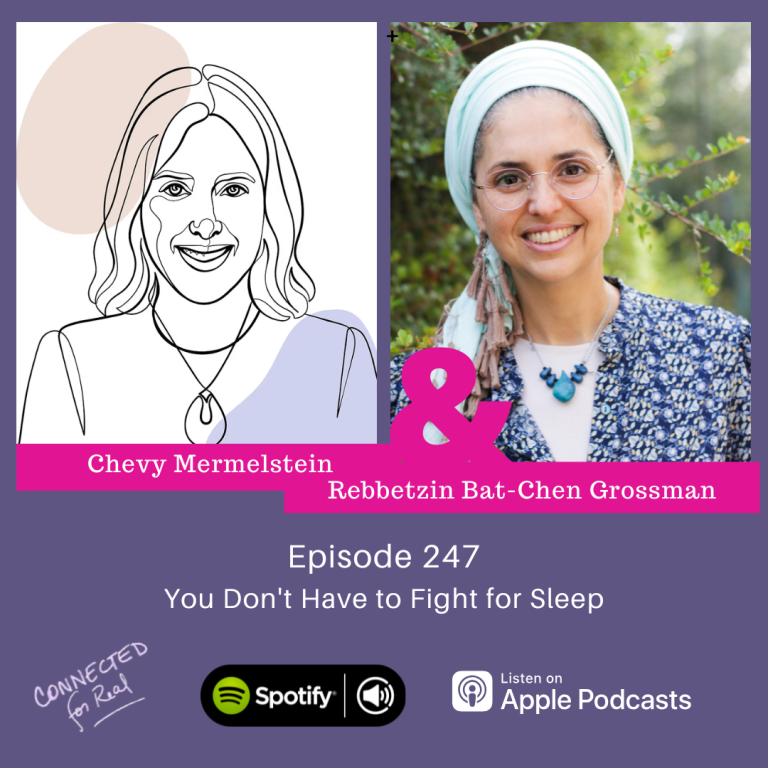
247. You Don't Have to Fight for Sleep
In this episode, Rebbetzin Bat-Chen Grossman sits down with Chevy Mermelstein, an integrative sleep coach, to explore the deeper roots of sleeplessness and what it really takes to find peace at night.
Together, they discuss why our minds and bodies sometimes keep us awake, how the pressure to sleep can actually make things worse, and why learning to accept where you are can be the beginning of real change.
They also explore the connection between our daytime experiences and nighttime thoughts, the importance of processing emotions throughout the day, and how small moments of pause can help us reconnect with ourselves and with G-d.
Whether you struggle with sleep or simply want to feel more present and connected in your everyday life, this conversation offers a fresh perspective on letting go, trusting yourself, and allowing things to become easier.
Transcript:
And we are live. Welcome, everyone, to the Connected for Real podcast. I’m Rebbetzin Bat-Chen Grossman, and today with me… I actually forgot your name. Hi, I’m Chevi Mermelstein. There you go. I’m sitting there, like, moving the mouse. Maybe your name is on there. That’s good. That… There you go. We’re being normal here. So Chevi’s gonna introduce herself, and today we are talking about sleep and you. So let’s get into it. Chevi, introduce yourself. Okay. So I am Chevi Mermelstein. I am married, and I have five kids. I’m also a grandmother. I have grandkids. And I live in Montreal. Wow. And I am a sleep coach, an integrative sleep coach. So I work mainly with women who are struggling with sleep, and I help them get to the real root of why they are not sleeping, and so that they can sleep naturally again at their own pace with a plan that fits them, not a rigid program. I’m not putting anyone in boxes and checking them off. And without relying on sleeping pills. That is so important. I know so many people who are having a hard time sleeping. Yes. One in three people don’t sleep. So throughout your lifetime, one in three people do not sleep. That is a real number. That is crazy. And- Yeah … I know, but I’m going to ask you anyway because I think it’s probably gonna blow all of our minds. What does not sleeping do to you? So when someone doesn’t sleep, and we’ve all experienced nights where we do not sleep, right? We can all remember a time when we were up an entire night for whatever reason. Even if you don’t have insomnia, you’ve definitely experienced that. And you can think back of the next day, right? So you didn’t sleep a whole night. You are not managing. You are just trying to get through the day. You are exhausted. Your legs are hurting you. Your eyes are hurting you. You have no patience for anyone. You’re just in a lousy mood, and you can’t think straight. Now, imagine this went on day after day, and there’s also holidays in the middle of this, and there’s also making- simchas and trying to deal with all this while you are not sleeping, and you’re trying to work, and you’re trying to raise your family, and you have obligations and commitments, and you’re just not sleeping. Right. So that definitely has an effect on yourself, on your relationships, and everything else. Yes, and that’s why we’re talking today about sleep and you, because it’s really important. If we’re thinking about the four pillars, right? So this is the last one of the series. God, marriage, business, and then you are the container that holds all that. If you’re not taking care of yourself and you’re not able to contain all the parts of your life, everything falls apart. Everything feels like it’s falling apart, and that just, you know, sort of exasperates the falling apartness, you know? It’s like the emotion of the emotion, the meta-emotion. So it’s like everything’s not working. On top of it, nothing’s working. Like I just can’t, I can’t get it together. It’s a terrible place. Exactly. You can’t think clearly. You just want the day to end. And on the other hand, you don’t want the day to end because then you have to deal with the entire night. Right. And it’s a vicious cycle, right? You wanna see the morning, and you don’t wanna see the night. And you just wanna get- Yeah … rid of each one. I can totally relate to the not wanting to, you know, start the night because I have found myself procrastinating going to sleep even though I know I’m exhausted. And, you know, I can blame phones for such things, you know? There’s like, oh, you go down rabbit holes, and you’re already here so you might as well, and only until 12:00, and then only until 12:15. You know, you sort of buy time and there’s something about a little bit of like escaping reality- Yeah. Yes … that is happening there. I’ve experienced that, not often. I try to detach myself from the phone during those hours. Try, not always succeed. But it really makes a difference for me. Yes. Yes. And also just you have the awareness that you’re doing it. Yes. My problem- That’s also a huge thing. Exactly. Yeah. At least you know. My biggest strength and my biggest weakness is my awareness. Exactly. Now you need to do something with the awareness. Once we have the awareness, we need to do the next part. It’s not just okay being aware. We actually need to make changes, otherwise it’s not gonna happen. Right. Right. And that’s why we need you because- … it’s always easy to know what to do, you know? Right. It’s become so normal to get help for losing weight or for eating right or, you know, taking care of yourself in that way. Even just like going out and training with a personal trainer or going to Pilates or whatever, it makes sense that you have a coach. It makes sense that you have someone who’s helping you out. And then there’s all these little like sneaky things that suddenly you’re like, “Oh, that’s a thing? Like I can get help with sleep?” Exactly. And also sleep, when someone is suffering from insomnia- it’s extremely lonely experience. You know, many of my women say, “It’s so lonely. My husband is next to me, snoring through the night. He has no idea what’s happening. It’s the middle of the night. It’s dark. My thoughts are racing, and it’s really terrifying.” And it’s night after night, and they feel broken. They really do feel broken. So yeah, just being able to know that there is help out there, and you can get past this, right? It’s a process, but there definitely is help, and you can come off your sleeping pills, and you can. You can. That’s such an important thing. You are not broken. Sleep is natural, right? Every single person in this planet is born being able to sleep. Right. It’s not a gift. I mean, it’s a gift, but it’s not something that, you know, if you were extra special, you got it, right? Everyone has it. Yeah, so why is it so hard for some people? Okay, so what happens, right? How come they do feel broken? So- How does insomnia show up, right? So insomnia usually shows up when something big happens in your life. Now, big can mean good and big can be not so good, right? It can be a traumatic event or it can be a happy event, right? It could be, you know, making a wedding and it could be someone dying. It could be moving. It could be I have now a teenager going to camp, right? And sh- the kid’s been in camp for three weeks and is not sleeping. So something happens big in our lives, and it’s in us, and it’s keeping us… We’re very aware, we’re very alert, and we’re having a hard time settling down. And our bodies and our mind is trying to protect us. It’s always trying to protect us, so if it doesn’t feel settled, it’s not gonna let you sleep. And we want that. That is what the job is, but sometimes it works a little too well and it doesn’t let us sleep. So you know when this comes up for me, when I’m pregnant. I wake up in the middle of the night and cannot fall back asleep for the life of me if I don’t get up, journal, get it all out of my head, and then go back to sleep. And I built my whole business between 3:00 and 4:00 AM. Like, really. You go through my journals and it says, you know, the date and the time and then what’s going on, you know, just like I spill it all out and I sort of figure it out. And that’s also how I came up with my method, because I found myself doing this, like, rhythm where I’m like, “What do I want?” And then I turn to God, and I have, like, pages that are in English and pages that are in Hebrew just ’cause my brain works that way, that when I’m talking to God, I’m speaking in Hebrew, and when I’m writing to myself- … I’m speaking in English. And I go back and forth. But, like, really, the CALM Method was born from doing this over and over again and realizing this is what’s helping me. This is what’s working for me. Exactly, which is really amazing because you found something to do at 3:00 in the morning. Yeah. Right? Many women, they’re up at 3:00 in the morning and they’re completely in panic mode, “How am I gonna manage tomorrow?” And all that pressure, “And I’m just gonna be a zombie, and I’m not…” And they’re just… It becomes really overwhelming, and they’re chasing sleep, and they’re putting this pressure on that, “I need to sleep. I need to sleep. I need this to happen.” And the more we need it to happen, the further away it’s moving. Right. Oh, I remember. Before my first date, I wanted to rest ’cause I was, like, you know, sort of jittery, obviously. I don’t have to tell you. Anyway, I couldn’t fall asleep for the life of me, and my mother said, “Your job is not to sleep. It’s just to relax.” Exactly. And of course, next thing you know, I’m out cold. That is exactly it, and my next point is, you know, something… It’s called NATO, not being attached to the outcome. When we leave go of the outcome, we sleep. It’s as simple as that, right? When we leave go of the outcome, leave go of the expectation, then we sleep. There’s no more pressure. Your subconscious mind is letting it go. It doesn’t feel that it needs to keep you safe, it needs to keep you up. Right. Right? And so often I hear that. I even see with myself, you know, when I’m under this pressure, I need to sleep. You know, it just reminded me of a story. My daughter had a baby, and it was the first day of Rosh Hashanah. Okay? So the eve of Rosh Hashanah was a really crazy day. I was doing 100 things. I was trying to make Yom Tov. It was finally Yom Tov, and she comes… And she moved into me, and it was the first night, and I was… I told her, I said, “You, I need to sleep tonight. We’ll worry about this in the morning. Do not have a baby tonight. I need to sleep the night.” Okay, of course, 1:00 AM, she comes banging on my door, “I really think I need to go in.” I was like no. You can’t do this to me now. I need to sleep. Just, I need to sleep.” So she went in, and I had to take care of her rest of her kids. And I remember it was, like, 2:00 in the morning, and I put this… I’m a sleep coach. I’m supposed to know all the rules, and I put this tremendous pressure. It’s quiet now. You only have four or five hours. You need to sleep. You need to sleep. You just need to sleep. And of course, I was not sleeping until I actually, I got out of bed, I drank something, and I just let go. If I sleep. If I don’t. And I did end up sleeping. But you really need to, you know, you need to talk to yourself. You really do. Yeah. And the truth is, no one has ever died when they didn’t sleep. Like, nothing will happen if you don’t sleep. You might feel exhausted and it might be extremely difficult, but you will manage. And that’s something that women really, especially at the beginning when they come to me, something they really have a hard time with. It’s different being able to accept, just accepting it’s okay. It’s okay. Because the minute you accept, you’ll sleep. But- Right … It takes time for that to happen. It sounds so easy, you know? Like- Exactly. You say, like… Okay, I was in a class and the teacher was telling her life story, right? It was like this, like, you know, experiential class thing. She was telling her whole thing, and then she says, “And then I saw myself standing on a mountain And my hands were so tight, and, like, I was holding everything, and I was like, ‘I just need to let go.’ So I let it go and opened my hands, and I opened my eyes, and I saw my hands open, and I felt different now.” Okay? So I’m listening to her and I’m going, “Okay, great. That’s all I have to do.” So I go home, and I go in my backyard. My hands are all tight, and I was like, “Okay, I’m gonna take a deep breath. I’m gonna close my eyes.” And I close my eyes, and I take a deep breath, and I let go. And then I open my eyes, and my hands are still in fists. Right. And I was like it wasn’t as easy as she said it was.” No. I did it again and again. And I just realized that, like, as easy as it is to say, “Let it go,” it’s like your body is not… It’s physically not letting me go, right? And once I realized, oh these are words. We throw them around. It’s easy and fun. And then when it actually comes down to it and your body is jittery and you’re not able to let go, the last thing you need somebody to tell you is, like, “Just let it go.” You know? Exactly. And it- It’s like it’s actual work. It is. And that’s why the coaching… You know, women come to me, they haven’t slept in years. A lot of them haven’t slept in years. And they’re like, after the first session or after the second session, “Okay, why am I not sleeping?” You know, you haven’t slept for 20 years. You know, I’m not gonna take you 20 years to recover, but it is a process. And recovery is not linear, right? Right. It’s a process. Even telling someone to accept it, you can’t do that in the first six sessions, right? It takes time until they’re even ready to hear something, ready to hear that accepting will bring you closer to recovery, right? And they always, not always, but a lot of times to them accepting means giving up. “Okay, I accept it. I can’t sleep anymore. I gave up.” But it’s not true. Accepting means loosening the grip. letting go of the control. I love it. But it’s a process. I love it. Okay, you guys have to go back a couple of months. There is an entire month on acceptance. Yes. And we talk about it. Yes. And it’s so powerful. It is so powerful. That’s so funny, I just heard it this morning, and I was thinking, “Wow, she’s talking the same thing I’m talking in a completely different, in a completely different thing.” Yes, exactly. So I like to pre-record my episodes, as you noticed- … ’cause this is coming out in a long time. And it’s so fun because every person I brought to talk about acceptance brought it to a different angle and, you know, sort of took it in a different way. But everybody came to the same conclusion, which is acceptance does not mean there’s nothing to do about it, or you’re not okay with, or you are okay with something that’s not okay, or any of that stuff. It just means this is reality. Like, stop- Exactly … fighting reality. And also, acceptance is not necessarily eight hours of uninterrupted sleep. Right. It’s just not. You know, I once worked with a single, and she was an accountant, and she wrote spreadsheets on her sleep, literally, spreadsheets. And she was on several different kinds of sleeping pills, and she… Each night, how many hours. It was really hard for her, and she did make progress very slowly, and it was a process. But to her, it was so shocking to see that at the end, she’s actually still in it, she was able to tell me, “You know what? Instead of having two sleeping pills, I’m down to one, and I can sleep for four hours.” That was amazing. Acceptance looks different. It’s not eight hours of uninterrupted sleep. It’s different. It’s accepting. It’s being okay. It’s being comfortable with the uncomfortable. Right. And also not comparing yourself, because one of the biggest issues is that we’ve been fed this number, eight hours of sleep. Yes. Like eight cups of water, you know? Yes. There’s all these like rules about how much you actually need. Like, honestly, eight cups of water, I would probably be dehydrated because I drink a lot, and I love water, and I’m drinking all day. And eight hours of sleep is, you know, maybe not enough for me. No. It, it’s- And I love sleeping, and I sleep… I think my sleep pattern’s weird because it’s not what, you know, like you said, uninterrupted. First of all, thank God in the last 20 years I’ve had, you know- Exactly. … and so I’ve had to learn to be flexible with a lot of different situations. But really, I nap in the day, so I get a little bit of sleep then, and when I’m pregnant, when something is happening, I have like two halves of sleep, and I wake up in the middle and like I said, I journal or I do things that do not involve a phone. That was one thing that I made a rule for myself really early on, because I remember seeing an adult in my life while I was growing up unable to sleep and turn to her phone. And it was… Yes, you’re raising your hand. I will talk about that. Yeah. It made me realize that it’s really bad. It’s really bad, and that’s why I had to find like non-phone activities that would fill the gap. Go for it Exactly Talk about it. Yeah, I will talk about it. Sometimes I feel like I’m the sleep coach, and I know all the rules, and I know everything, and sometimes I’m such a bad client to myself. So now, just after Pesach, I had this… I don’t know what it was, but I decided that’s it. I’m not throwing my phone out, but my phone is out of my room at night. And it was something… It’s a real dumb phone. There’s nothing on it. Literally, there’s nothing on it. And in the night, I woke up, and I quickly went, I just checked it, and I just checked it, and I just checked it. And my mind was so used to it that it was like waking up to check the phone, even when I was sleeping. My mind and body got used to waking up, check the phone, and go back and go back to sleep. And so after Pesach, I decided this was my, you know, my 21-day challenge, and I put the phone away. And it re- it was hard. It was like withdrawal. But you know what? After seven, eight, nine days, I was sleeping so much better. It was just so much more peaceful. And I wasn’t waking up to check the phone, even when I was sleeping. So the question always is, so what am I supposed to do in the middle of the night when I’m up? What am I supposed to do? Right? So what are you supposed to do when you wake up in the night? Anything that’s peaceful. Anything that you can’t do during the day ’cause you have no time, do it in the middle of the night. If you enjoy it, if it’s fun, then do it, right? You can read a book. You know, when I wake up in the middle of the night, I eat ice cream. I really do. I don’t care what the rules are. Does it make sense? I need to go to the bathroom, all that sugar. It’s quiet, I don’t need to share it with anyone, and I can just eat it, and that’s what I do, even if it’s 4:00 in the morning. I’m not eating tubs of it and I’m not up every single night, but it’s calming. And then I go back to sleep. There’s no pressure that I need to go back to sleep. I might as well enjoy the time that I have, right? So knowing in advance what are you going to do in the middle of the night is always super helpful, whether it’s a book, whether it’s just… You know, in the winter here, it snows forever. In the middle of the night, I just watch the trucks taking the snow away. It’s so peaceful. It’s almost enjoyable. And then you’re ready to go back to sleep. This rules that we always put on ourselves, right? We all know the sleep hygiene rules. If you don’t fall asleep in 20 minutes, get out of bed, and all these, don’t eat after, don’t drink coffee after a certain time, and make sure that you… You know, don’t need the rules. Just do what you think makes sense. If it’s moving you forward, then do that. Hey, before we continue the episode, I want to ask you something. Are you ready to get answers from God directly? Feel more in love with your husband and more supported than ever? Run the business of your dreams without having to sacrifice any other part of your life? That is exactly what my one-on-one private coaching is for, and I want to invite you, just you and me, for a free deep dive discovery call. This is a 60-minute free call where I ask you lots of questions, and we extract the three main things that are holding you back. I then put together a personalized plan for you where I create a roadmap of recommendations with practical steps. The call is free and so valuable in itself, so go book yours today. Now, back to the show Yeah, I wanna get back to something very important. We’re talking about sleep, which is a physiological thing, and you would think that fixing it would be… have to do with, you know, what you eat, what you do, what you drink, you know, how many times you went to the bathroom before, if you had a sleep ritual before you went to sleep, and all these rules that have to do with physical things. But at the end of the day, I feel like, you know, my approach to everything is that there is a deeper root, and it’s really what we wanna focus on because it’s not necessarily a physical thing, even though it’s a physical thing. Like, all physical things, like, you know, are you telling me my hand isn’t hurting because you’re, you know, whatever? No, of course your hand is hurting. It makes sense that your body is creating pain because it needs you to focus on something, but that’s not the root of the problem, right? So, like, the root of the problem when you are not able to sleep is not necessarily physical. And so when you take that away and you strip it away from all of the beliefs that we have about sleep, suddenly you’re making room for, like, oh, I get to do whatever I want. Maybe my body is keeping me up because that’s the only time I have quiet to journal. Like, when, with eight children around, do you actually build your business? That’s the answer. It’s in the middle of the night, and my brain knows that, and it’s fun for me. And so, like having the ability to just- Give myself permission. I didn’t even realize I was doing this right before we were talking. To me, it was just like, “Oh, I can’t sleep, so this is what I do.” It’s like, no, maybe it’s the opposite. It’s like my body is doing it on purpose because it knows this is what you get. You get quiet. It’s nice and dark, you know? And no one needs you, and it’s … Right. Yes, absolutely. You need to do y- especially at the beginning when clients come, they always wanna know, am I allowed to nap? Am I allowed to sleep? When can, when should I go into bed? When should I wake up?” Like, give me the whole list of rules and then it’ll all go away. It’s not gonna work. The list of rules is just gonna make you more anxious, ’cause if you don’t actually follow the list of rules, you’ll you’re gonna completely lose it, right? I had someone call me up. She wants to know if she can take a shift in the hospital over the weekend, if she could be there with a kid. I said, “Well, why wouldn’t you be able to?” She said, “Well, will it do something for my recovery?” I said, “If you wanna go take a shift in the hospital, take a shift in the hospital. Live your life. Live your life. Don’t put sleep in a box. Live your life.” If you want to nap and it works for you, then nap. I don’t think you should nap for four hours, but if it makes sense, then do it. Right. It has to make sense. You have to know what works for you, and that’s such an important thing. So many times women come, they have no clue. And this is also a huge one, winding down. Hobbies. They look at me completely, “I don’t know. How do I wind down? What does that word even mean?” I always say sleep is a 24-hour cycle. It doesn’t happen at 10 o’clock at night when you finally finished your day and you just collapse into bed. It’s not happening. You’re not gonna sleep, right? It’s already starting. Look how much you’ve gone through since 6:00 or 7:00 o’clock in the morning, right? All that all those conversations, the work, your kids, everything, life. At some point, all that needs to be processed. When are you doing that? How are you doing that? And that’s part of the problem, that we don’t like processing, we don’t like facing, we don’t like dealing with. Like, it’s just so much easier if we could conk that, you know, conk out and not think about it 100%. And you know, one of the biggest things I say is that we don’t need to store it all up for the end of the day and then start processing every single thing that happened. We don’t need to do that. We can actually take moments in the day, which can take 30 seconds, and just don’t do anything. Just stand there And just let whatever happen, just be aware of it. Instead of just moving from thing to thing, just take a moment f- a few times throughout your day. When you’re drinking, instead of walking while you’re drinking or sitting or doing something while you’re drinking, just drink. Just be aware that you’re drinking. Yes. You know, a long time ago I had Rebbetzin Attar, Rhonda Attar, and she spoke about the pause. Yes. The power of the pause. And while she, you know, she’s my teacher for Mesilat Yesharim, which is- Mm-hmm … The path of the just. Anyway great class. She has a podcast that I host for her because it’s so good. Like, all her recordings just go straight into my podcast in a different podcast. Look up Bilvavi, Mesilat Yesharim. Anyway, she was on one of the classes explaining the pause, and I looked at the images that she has on her shared screen, and I realized that the two lines of the pause look like two yuds, which is G-d’s name. There is G-d in the pause. When you pause, you will hear G-d, you will find G-d, you will finally connect. And a lot of my clients who come to me say one of the biggest things that magnetized them to me was they wanna find G-d, they wanna hear G-d. They wanna finally feel like they’re connected and not just, like, running through the day. And this is how. It takes not even a minute, a second. Exactly. It’s so true. It’s the same thing when we wake up in the morning. I used to do this all the time. My eyes opened, and that’s it, my day started. I just got up. I, there was no … It literally, it opened, and then I thought about my day, and then that’s it. I moved on with my day and I never thought about it. Now, I open my eyes, and I just lie there, and that’s when I actually do think 10 things to actually be thankful for. It’s a whole new experience. It really is. It’s like, wow, there’s something that happens after you open your eyes in the morning, before you get out of bed. And these things are not hours and hours. They’re just little moments in your day where you’re actually just taking the pau- like you said, the pause. Take the moment. Let it actually happen. Let the thought just be the thought. We don’t need to deal with it necessarily, or we can deal with that later. But just being okay with, “Okay, this is what just happened. This is what just went on,” before we, we react to it, before we need to deal with it. And all these little things help us in the night. These are all the same tools that we use during the day are the same tools that we use during the night. When we wake up at 2:00 in the morning and your mind is racing and you’re panicking and you have to deal with… Everything always looks so much scarier at 3:00 in the morning. Then just being okay. The thought can be there. I don’t need to react to it. I don’t need to deal with it. I don’t need to… It’s just the way… It’s like a butterfly. It’s allowed to fly in, it can land, and then it’ll fly off again. But when we get so, you know, emotionally involved in the thought and we’re so busy feeding it and reacting to it and thinking of every scenario, then we just get sucked into this Yes. You know what came up to me? I was discussing with a young girl who just got married, and of course, you know, got pregnant right away, is now not feeling well every day, all the time, and she’s nauseous. And after we were talking and I was helping her, she called me up and said she finally realized why she wakes up and feels nauseous right away. It’s because she wasn’t thinking about all the things she’s worried about and stressed out about with the pregnancy, with the baby, with the, “Oh my gosh, I’m gonna be an actual adult,” and all these, like- … scary things that are going on, right? Like, while you’re sleeping. You don’t think about it. You’re unconscious. And suddenly she opens her eyes, and the first thing she thinks about is, like, all the fear, all the scary, all of this and that. And like, “Oh, I was trying to avoid it and push it away, and it was making it worse, and now I just sit there and feel the emotion, and I sit with it, and I let it be, and then it doesn’t feel as bad.” That, you know, it is an amazing thing to see someone who is having one of these, like, chronic issues, right? Like, “There’s nothing I can do about it. Everyone around me says this is just how it is. You’re gonna have to go through three months of this, and you’re gonna just have to suffer through it.” And then suddenly she has this click moment where it’s like, “I don’t have to suffer through it. I can be with it. I can sit down with myself and just enjoy whatever is right now.” Exactly. Exactly. And also, in order to be able to do this at 4:00 in the morning, you have to be able to do this at 10 o’clock in the morning. Right. Right? You have to be able to practice this through the day. There’s no way at 4:00 in the morning you’re gonna start, you know, practicing and doing all these things. You’re not. So you need to be… It changes your whole life. When you suffer from insomnia, it changes your entire life, your recovery. You’re a completely different person at the end of it. You see the world completely differently. You know, I myself, I was on sleeping pills, and I also, you know, went through all these racing mind and all these panic moments. I know exactly what women go through. And thank God I’m the other side of it and I can sleep well, but I’m a completely different person. I see the world completely differently now. And now, yes, I can see, and in a way I can say, “You know what? It was a good thing.” It was a good thing. This, the challenge of not being able to sleep and how I ended up in such a mess and all that, yes, r- it was a very hard recovery. It’s one of the hardest things I have ever done in my life, but you know what? I see the world completely differently. I can really… You know what they always say, “A coach can only take you as far as she’s gone herself,” right? It’s so true. It really is true. Mm-hmm. Just being okay. It’s okay. I like that. I don’t know if I agree, because- No? I have, I had some people who I have coached who I think went way farther than me, and I think- Yeah. … that’s one of the things- That’s true … you know, you know they say that, like, there’s certain people who will never be jealous of you, your father, because he wants you to- Right … pass him, and your teacher, right? So I feel like with, you know, the amount of people I’ve coached and the types of success stories that I see, I think they went totally past. I know- Yeah … what I did and how I was part of their story, but I think they also were able to really use what I was teaching them and take it far beyond things that I could do. So I think that’s really cool, and I think that’s really powerful. And also, you know, I met someone, it’s been about three or four years that I’ve coached her, and she says, “You know, sometimes I still use the tools, but it’s the, it’s deeper than that. I can use these tools in all areas of my life. It’s not just sleep. Sleep is the smallest problem.” Right. Right? Sleep is not really the issue when they’re coming to you. Their mind is racing. Yes, they can’t sleep, but that’s not really what the issue is. Right. And there’s one other thing when it comes to insomnia, which I don’t think we see so much in other struggles, is that an important part of it is not talking about it. Like, the first thing we do in the morning when we don’t sleep is you tell your husband, “Oh, I had such a bad night. I didn’t sleep.” Or you call your mother, and you’re calling your sister, and you’re calling everyone. You’re telling everyone. And this can really be… It’s not a good thing because your mind believes anything you tell it, right? I remember once s- telling this to a neighbor, and she was like, “But if I don’t tell my husband I didn’t sleep, how’s he gonna know I’m having a bad day?” Oh, don’t worry. Exactly. Like, she was like under, you know? Don’t worry, he knows. He’ll know. But it’s- Yes. It was smacking him in the face, right? Like, when you do not sleep, we all know. Yeah, exact- But you need to… Because your mind really does believe anything you tell it, and if you tell it that it can’t sleep, then it really does start believing that. But when you either don’t talk about it or just say, you know, “It was okay”- Yeah … You do you do start believing that You know it’s that saying what you water grows or what you focus on grows. It’s a really powerful thing. When I was pregnant with my third, I heard that pretty much for the first time, that the two things your brain believes are your… is your speech and your imagination, like, the, the images you’re seeing, right? Yeah. So I stopped telling my friends that I was nauseous. I was, like, usually very, very nauseous, you know, normal. And this third pregnancy, I finally… like, it finally clicked, and I just shut my mouth and didn’t tell anyone. Nobody has to know, and I just went on with my day. Of course, like, I did whatever helped me. I ate fruits in the morning and drank a lot of water and tried not being hungry. I figured out what works for me. Exactly. But between me and me, not so that I could talk about it and make a big deal and attract attention and have what to discuss. Like, really I realized it was draining my energy, and it was not helping me or feeding anything positive Exactly. And- I still like complaining though. But that’s at a different time. You know, you can even make a time to complain. But when it’s… It- Yeah … it becomes, you know, you’re not only telling your husband, you’re telling anyone who will actually listen to you, and you’re like you feel it. You become it. Like you don’t necessarily get dressed the way you want to, and you don’t eat because I didn’t sleep, and you just have this ugh and it’s not doing you any good. Right. You need to live your life. You know, I remember I had a woman, they made this whole grand trip. They were planning it for months. Their whole family was gonna go away for the weekend. And I remember her calling me up in the morn- one morning, like a Tuesday, Wednesday. She says to me, “Chavi, I think we’re… I’m gonna have to cancel this weekend, and I don’t know how to tell this to my kids, and I’m gonna have to cancel.” ” what are you canceling?” She says, “Well, I didn’t sleep the last two nights, and then what am I gonna do? And I can’t tell anyone,” ’cause I- that was one of the things, like don’t talk about it. Like, “What am I gonna do?” I said, “You’re gonna go. There’s no reason. There’s no reason why you can’t go.” And she went, and she was okay Yes. There’s another thing. Two things can be true at the same time. You can be in recovery, and you can also have a bad night. You can be making progress and still struggling. That’s a hard concept to accept. Back to acceptance. Yes. You know, when I was a teenager, and, maybe a young adult I really liked my grandmother, and I liked calling her and telling her how I’m doing, whatever. And as you have young kids, a lot of the time the discussion goes into, “I have no strength. I have no strength. En likych.” That’s what I would tell her. “Ah, en likych. I don’t have strength.” And you say it with this, like, exhaustion, you know? And- And then she would say, “So change the words to…” what did she say? Ten li koach. It was ein li koach, I don’t have strength- Ein … to ten li koach, give me strength. And it was so beautiful because in one tiny change, it brought G-d into it, and I was able to ask instead of complain, and it really was very powerful. And of course then f- you know, afterwards I’m thinking into it and, you know, as I do with all things, and I thought about the prayer that we say in the morning, Anoten leya efkoach, Hashem is the one who gives- Yes. Yes … strength. So it’s like you could not sleep an entire night and still have energy, because- Yes energy does not come from sleep. It comes from G-d. And that- Exactly … we say every morning. And if we can remember that, boof, like my brain just, exploded. You could disconnect the two and suddenly realize that they are not connected, that you are treating sleep like s- like a lot of people treat money, you know? This attachment of this thing has power, and excuse me, nothing has power unless G-d gives it power, and G-d is the only ultimate power. And that was a total breakthrough for me Right It’s so, it’s true. It’s true. And Being able to, Again, just take a moment. Take a moment. You know and everyone is always so terrified. What am I gonna do tomorrow? What am I gonna do? What am I gonna do? You’ll do fine. And very important, this is just a tip and a tool, and many times people don’t believe me, but it’s really true. You can try it. When you’re not sleeping at night, just keep your eyes closed. It’s 70% of sleep. It really is. It really is. You will feel like a different person. Even though you’re up, if your eyes are closed and you’re just lying in bed, it’s 70% of sleep. If you can do that calmly, eyes are closed, you’re not attached to the outcome, you’ll be fine, and you will be fine. I always say there’s always another night. However bad it is, there’s always another night. Thank G-d we always get =these, second chances and third chances and- Yes … fourth chance and another chance. When I started doing guided meditations, I realized how much it affects your sleep. Like you were saying, you practice during the day, and then it goes into your night, and it just sorta happens. When I’m having a hard time and I’m stressed out or I’m, like, all wired up, just using your breath also, it’s so calming. I would say it’s also 70% of sleep, right? Yes. Just the ability to breathe. Yes. Even if your eyes are not closed, just breathe. You know? Try doing that with your eyes closed. Oh, there you go. Then we got to, like, 90%. Exactly. There we go. Like, almost there. Exactly. Exactly. And also, it has to work for you. If this is bringing you closer to your goal, then do this. There are no rules. If it makes sense to you, do this. Right. Do this Yeah. And I was thinking back to the person who turns on the phone right away and is looking to stay entertained or stay awake. You’re not realizing, but your body is trying to wake you up to something, and you’re trying to become unconscious. You’re trying to run away, escape from the thoughts, from the emotions, from what’s actually going on, and it’s not… That’s not the point. You know? The point was wake up. Right. And that’s part of it. Part of my coaching is figuring out: What is the subconscious mind holding you back from? What is it that it’s not letting you actually go to sleep? And it’s amazing what they’re holding back. And the more you’re in it and the longer you’re coaching them, the deeper they’re able to go. It’s like they’re an onion, and you’re slowly peeling it away, and then you figure out: What do you want? What do you want, right, besides for sleep, right? But what do you really want deeper than that? And at the beginning, it’s so hard. All they want is sleep. They can’t think of anything else, right? But there is always… You know, like I always said, sleep is the smallest part of your problem. Figuring out what is actually bothering you, what is holding you back from sleeping, what are those thoughts, those feelings, those emotions, the challenges, things that have been… You know, we say in Yiddish gekvetcht. Like you’ve really been… You know, it’s something that’s deep, deep in you. Figuring out what that is and then figuring out what you want. So many of us have no clue what we want. I don’t know. Yeah. My ladies, what do you really want? “Well, I don’t want him to be this way.” Exactly. Like, anything but this. And it’s always so beautiful because really when you know, not knowing what you don’t want is definitely step one. Yes. Not the goal, and we’re tr- we’re gonna, you know, peel it till we get to it. It’s so funny. We have such similar things. Like, it’s so fun to talk to you because- I am… I hear you speak, I’m like yes.” And then I’m speaking, you’re like Yeah. It’s so… And it’s so funny ’cause we do s- two completely different things. But yeah, I do the same recording, and then I create the recording, and you listen to it, and it goes in… You know, it’s really… Because sleep is a subconscious thing. You have to let go in order to be able to sleep. It’s as simple as that. And you have to figure out what it is that’s not letting you actually sleep. And you can. I just realized that not being able to sleep is the protective mechanism. Yes. ‘Cause it’s saving you from the person that you could be becoming, and there’s something very scary about becoming that person. Sometimes it’s because, you know, when you’re very powerful and you’re doing a lot of big things, you get exhausted or burnt out or there’s like, you know, there’s prices to pay, so you don’t wanna go there. But then again, you know, the other option isn’t not doing anything or holding yourself back from doing all these things ’cause that’s just gonna kill you. Like, it, like really eats you up from the inside. So your brain is like, “I guess we’ll come up with another little problem,” right? There’s like you said, out of all the problems you have, sleep is this one tiny thing that gets all the attention, and that was the point. The point of your body doing this to you is so that you can not look at all these other things that are calling you to, like show up and be your best self. Such a great escape. Like, I mean- Good job, brain. I love you. Exactly. And sometimes- But it doesn’t have to be that way A- and sometimes it can take months. It can take several recordings, because the person doesn’t wanna go there. Right. It’s painful. It’s not necessarily the most comfortable thing. It’s something that they buried when they were, I don’t know, 12 years old, or, you know, something that’s years and years. They don’t even remember it. Right. So it’s like recording after recording, and you’re slowly bringing it up. That’s not how it works in my thing. My world doesn’t take recording after recording. No? Good for you. No I don’t have the patience for the, you know, the slow process. I’m like, “Hashem, bring it in.” Like- Amazing … I think it’s so fun. In the middle of a meditation, I’m like, “Okay, listen, we can’t figure this out together. We need backup. Like, we really need somebody who can clean this out.” So we take a deep breath, and we bring G-d into it, and then, you know, there’s this, like, light that goes through your body and just clears it all out for you and does all the work, and you don’t have to do anything. You just let it do it. And it’s so powerful. By the way, I’m saying it quickly now, and it sounds, like, a little bit comical, but it is one of the most powerful things that my clients… Like, they… You know, when they come back from the meditation, and they wake up, and they open their eyes, and they’re like, “Whoa.” You know? Like, their reaction just says, like, “How did that happen?” Actually you brought up before, like, 20 years. It took you 20 years to build this, so now it’s not gonna go away overnight, and that was one of the feedbacks that I got from someone I think it was three weeks ago. And I actually have it on recording, ’cause it was so powerful. She’s, she comes out of the meditation, and she says, “Something that I have been dealing with for, like, I don’t know, 30 years in the making, and… But I don’t know, you make it so simple, and you’re just like, it’s just like, I don’t know, disappears.” it was very powerful. So anyway, I really appreciate that you’re very, like, you know- Sometimes it is simple. Yeah. Sometimes it’s simple. Sometimes it’s simple. Yeah. I like that there are processes to everything, but I also like that G-d is above all processes, right? You know? Yes. Yes. That, that we think things have to take time, or we think something’s complicated and has to be in stages and then you don’t give G-d the opportunity to just cut corners and get you there. I like that. I like that very much, the cutting the corners and just get me there today. Yeah. I think I’m gonna use that everywhere. Yeah. I, you know, one- It’s true … one of the things that I really believe in is let it be easy, ’cause God doesn’t make things overly complicated. He makes things very, you know, brilliant. We see processes, like we see bodies and, you know, worlds and all these things that are extremely complicated, but they actually just sort of happen. It is not hard to breathe. It makes- Right … so, you know, if you look at it, how you’re breathing, and how does this make sense? There’s a brain, there’s lungs, there’s all these connections and Right? So like to us, it looks very complicated. But to God, it doesn’t. It just, you just breathe. Just breathe. Right. All you need to do is show up, right? A lot of times, I … That’s one of the things I really like is let it be easy, and let God in. Yes. And that’s something I always overwork. It’s just who I am. I will always work harder, and then someone once said to me, “Just don’t. As simple as that, just don’t.” And I remember once I was writing something, and I was, like, gonna start doing my thing, and I was like, “Just don’t,” and I didn’t, and it was fine. It worked. But it’s something I have to constantly keep telling myself, “Just don’t. It’s not necessary. It’s not necessary. Nobody knows. Nobody, you know?” I love that. Could you imagine- Yeah … like, there’s, like, a logo, just do it. Yeah. So then there’s a logo like, just don’t. Yeah. We just, we’re overthinking and overcomplicating it, and just like you said, cut corners. It’s fine. It works. It does work. Yeah. I like it. I like it. You really believe in God’s ability to, like, get you there faster. ’cause I like it, ’cause it works for me, and also ’cause it works. Like, it really- It does … is very powerful. We are the ones who are limiting God, right? God is limitless. Yes. And then we’re the ones putting all these, like, I don’t know, things that he can’t do. Like, “No, God can’t do that. That’s too big for him.” Like, stop it. Who are you? Right. Yeah. This is me. Such a good conversation. Look at us. Yes, this was fun. You see, I promised, right? One of the things- Yeah … before we start is I promise. And that’s something I really … That’s something I really like about you. It’s easy. Like you said, it’s easy. It’s fun. It’s normal. It’s just normal. You’re extremely normal. Yeah. And it really makes a difference when you go to someone who just really gets you who’s normal, who’s sitting in a dining room. I think you’re even sitting in your parents’ dining room, right? It’s just normal. You feel … It’s a certain calmness to the client when she’s just as normal as I am. It really makes a difference. Thank you. Yeah. I appreciate that. People call it authentic. It’s like a big- Yeah, it is. But it’s really authentic. I know it’s 10 o’clock at night by you, so yeah it’s real. It is real. Here we are. I have to go to sleep. You just reminded me. Yes. 10 o’clock at night. I would be recording, I would be recording this in my pajamas Sometimes I am smart enough to get ready before and, like, you know, already be in tomorrow’s clothing while I record it, and then just go back, go to sleep right away. But today was such a crazy day, and I’m going to take the advice that you said and just sort of pause before I transition, because that is actually gold. I think it’s going to- Yes … make a big difference for me. Like, that- Yes, it’s- … little transition pause. Exactly. It’s called the three Rs, okay? So you’re reviewing your day. You’re actually taking time to review day. You can do it in your mind or you can write it down. You record what’s happening tomorrow. You can make your list, but it’s… You actually put it onto something. You’re recording tomorrow, and you reflect, how did your day go? Just how was it? You’re not necessarily fixing anything, you’re just reflecting. And you also need to figure out how much wind down time you need. I need more than 20 minutes. I just do. I really need more time. It really takes me time to go through my day. It could take a couple of hours. And I know that if I try to speed it up, I’m not gonna sleep. It’s just gonna take me forever to fall asleep, ’cause it’s still happening in my mind. Some people are okay just standing in the shower. By the time they come out, they’re good. But every single person, kids included, they all need wind down time where they need to be with themselves. And they need to let that all happen, let that all processing happen. Otherwise, it’s just gonna happen at 3:00 in the morning. Right. ‘Cause at some point it needs to happen. And by the way, we didn’t speak about dreams during sleep, but this is the reason why they come up, right? Yeah. Yes. When I used to have scary dreams, I’d go to my father, who’s the expert on dreams. He’s, you know, from a long line of y- of Tunisian rabbis. So they have, you know, books about this. And he would explain to me, like, this you probably are scared of something throughout your day. You didn’t wanna face it, so your sleep brought it up. You know? And it’s so powerful because, number one, it’s normal. Everything’s okay. Nothing’s wrong with you. And number two, oh, I could just avoid it by processing before I go to sleep. And so I- Yes … I really have not as many scary dreams. Obviously, I’ve also grown up. I don’t know. I don’t know if that’s supposed to be- … an advantage or my disadvantage. But, you know, I think that it’s cool. It’s cool to just bring it up as, like, a by the way towards the end of our conversation. It just came up to me, like, oh, this is something that we can really sort of touch on. Right. Yeah. It’s true. Whatever you go through your day will somehow come out. Either it comes out while you’re winding down, or it’ll come out in the middle of the night, either in a nightmare, or it’ll just wake you up. We’re not robots. We’re people. We’re human, and there’s so many different parts of us. Our subconscious mind, our conscious mind, our behavior, all this makes us. And we can’t… You know, you can’t just put in a quarter and things will happen. We really need to become very aware of what we need. I think awareness is key. What works for you? I love this conversation This was fun. Yeah. I hope everybody’s listening. Even if you don’t have actual sleep problems, you’ve just learned something that can help you sleep even better. And if you do have sleep problems, I hope we gave you a lot of hope that it doesn’t have to be this way. Exactly. Because really, I think it could change your life to improve your sleep. Yes. You know, it’s… Sometimes things are so… I heard something last night. I was listening, actually, to a shiur. It was Rabbi Haber. I don’t know if you listen to him, but he’s amazing. And he told… He was giving over a study. A study was done on rats. They wanted to see how long a rat could swim in the water until it drowned. And so they put the rat in. It’s a good one. They put the rat in, and it took 16 minutes. 16 minutes, the rat died and drowned. They took rat number two, and they put it into the water, and after 13 minutes they took out the rat. And they waited for a few minutes, and then they put the rat back into the water. And the question is, how long do you think the rat is gonna live? Right? So some people say three minutes, right? ‘Cause 16 minutes and three is three minutes, and some said maybe more, ’cause we gave the rat a little bit of a break. The rat ended up living another 60 hours. 60 hours. And this really resonated with me of what I see with women and what I see with being a sleep coach. Women come to me exhausted. They feel broken. They’re lonely. And when they start to accept a little bit, when they start to relearn how to trust their bodies, that they’re not broken it’s natural. And they start loosening the grip, then something shifts. Even if it’s a very small thing of acceptance, very small, but things shift in your mind. And they learn the tools, and they start understanding and becoming aware. And then they experience, like, a small thing. Like, you know, maybe my body can sleep, even if it’s just two hours, but I actually slept for two hours. And that moment creates something so powerful. It’s hope. It’s just hope. They’re okay being comfortable in the uncomfortable. And then it’s, you know, I can handle this. I can do this. Sleep is not about forcing yourself to sleep, right? Sleep is about creating safety, trust, allowing it to happen, allowing it without trying to put it in a box and control it and do it. And sometimes the biggest change is just the belief. I can handle this. I can do this. Amazing. How can people find you and work with you? Okay. So I have a website, and I actually blog every single day. I have over 200 blogs. I love to write, and I do this every day. I blog, and I write, and I… You know, you can get my… be on my email list, and it’s fun. It’s just fun. Like you said at the beginning, it needs to be fun. And it is. It’s not… You know, I love it. I love what I do. I love it. We’re gonna link the website below, but just tell everybody what it’s called so that they know. Chevi Mermelstein at sleepcoach.org. Okay. My website is chevimermelstein sleepcoach.org. Oh, okay. Great. Great. Thank you- This was amazing … so much for being here. This was amazing. Thank you. Thank you. Go to sleep. Yes. I’m gonna try. This was amazing. Yeah. I’m so happy. Thank you. Thank you so much you guys for listening, and don’t forget to be back next next week for the next topic. This is so fun. Amazing. Thank you. All the best, and don’t forget to be connected for real.