
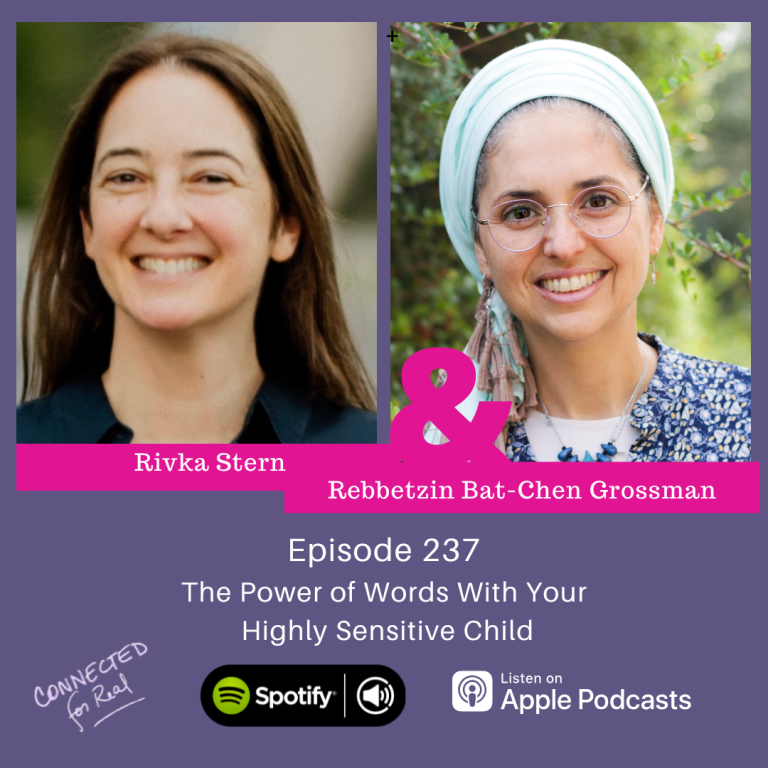
237. The Power of Words With Your Highly Sensitive Child
After more than three decades working as a pediatric occupational therapist, Rivka Stern now supports parents of highly sensitive children, guiding them through challenges while helping them build confidence and feel more at ease in their parenting. Rebbetzin Bat-Chen Grossman is a marriage coach for women in business. Join them as they talk about the power of words in relationships, especially with your highly sensitive child.
Transcript:
And we are live. Welcome, everyone, to the Connected for Real podcast. I’m Rebbetzin Bat-Chen Grossman, and today with me is Rivka Stern. And our topic for today is words and marriage, but really it’s words and parenting, because Rivka is a specialist in parenting, and I’m telling you I’m not kidding, I love her content. I love your content. And I’m gonna let you introduce yourself, so go for it. Rivka, introduce yourself. All right. So after working with kids as a pediatric occupational therapist for over 25 years, I realized that I could have an even greater impact by working directly with parents. So now I help parents of highly sensitive kids understand their child on a much deeper level so that they can support them effectively and they can nurture their emotional wellbeing, and also so they can become more calm, connected, and confident parents I love that. You said that so well. Thanks. And now all the red, alerts in my brain like, let’s talk about sensitive children. What did that mean? And next, the super sensitive. Yeah. And let’s talk about this and that. Yes. Yeah. This is so fun. And I wanna talk a little bit first about the concept of the four pillars and how all of Connected for Real World, the Connected for Real podcast, the coaching programs, everything that I ever do is based on these four pillars, because I really feel like when you have a well-rounded approach, not just, let’s work on your marriage, not just let’s work on your business, not just let’s figure yourself out and make sure you’re not burnt out, like you’re taking care of yourself. And also not just your relationship with G-d, ’cause it feels very high up there and like, yay, it’s all about G-d, but really what is it about, the practicality? How do we do it? So we have G-d, marriage, business, and you, which are the four pillars, and all of the episodes go in that flow. So right now we’re in the topic of words. Last week we had an amazing guest, Sari Yocheved Rigler, and she talked about her book and, oh, it was amazing. Definitely go back and listen. And then this week I wanted to focus on words and marriage, but I wanted to specifically talk about parenting, and because you have such an approach to the sensitive, you know, like, I, I feel like it feels a little extreme sometimes. Like you’re like, “Oh, you’re too much. I just don’t know.” so as a parent, I’m talking from experience. Just my own. Also I’m a hypersensitive person. I feel other people’s emotions, and I’m very reactive. So reactive like in a empathetic way. So I feel like that also I was made, not in a bad way, but like, to feel like I was too much. Ugh, just like can you chill? So I’d love to talk about that a little bit more. But yeah, under marriage I really feel like it’s all relationships and the way that we use words in all of our relationships and specifically in parenting is really a great time now. So let’s get into it. So I think that’s a really good point, because underneath words is being intentional. It’s not the words, it’s really more about our ability to pause, and our ability to reflect before we speak. And that is the case whether we’re talking to our spouses, whether we’re talking to our kids, or whether we’re speaking to the person in the store who’s helping us. That is across the board in every single interaction. I think why we’re focusing, on spouse and kids is because that has more of an impact. The person in the store might say no, that also has an impact if you don’t say nice words to them. But the kids and the spouse is obviously much closer to home. And sometimes, and you probably agree with this, but sometimes we’re nicer, we say kinder words to the people in the store or the people who are, helping do our nails or something like that, than to our own family because we have that sort of comfort level, and it’s behind the scenes, in private. And what I would want to say is let’s try to speak to our children and to speak to our spouses the way we would speak to anyone that would come in our sphere, our boss, or people that are, so to speak, higher up than us. Because those are the people who really need our kind words the most, and everything’s about relationships, right? Yeah. And the words is what can either build a relationship or unfortunately really burst a relationship or break down a relationship. Yeah. I was just talking to someone whose husband got hurt in the war. And so she’s working, a lot on dealing with all of, the physical and also the emotional and the post-trauma and all of that stuff. And she said, “I tell my husband I would rather you be a hero in the house and yourself out of the house, because people out of the house understand that you’re hurt, and they understand that you’re, going through stuff, and then really hold yourself up and try to be nice here because this is the hardest place for us. We see you all the time. We want, we wanna see you like, almost holding yourself up a little bit more. And it says it’s ’cause it’s really the automatic is to hold yourself up and to be the hero when you go out, when you see people, when you’re trying to, show face. And then you go home, and it’s sort of like, “Okay, I feel so comfortable. I can be myself. I can scream at people. I could, be mean. I could just demand stuff, and they’re gonna understand ’cause they love me, and I know that this is where I belong.” And they’re here to stay, and we take that for granted. So it was so beautiful how she said “I wish you were a hero in the house.” I thought that was a really good way to say that. Yeah that’s very powerful. Yeah. Yeah, so let’s talk about sensitive kids. What does that mean? How does one know if they have a kid who’s more sensitive than others? Let’s just first define it before we go into how to help. Yeah. So I always believe giving credit where credit is due, and the phrase was coined by a psychologist named Dr. Elaine Aron. And she really came up with a presentation of a child with certain traits. And when I say them, maybe you’ll think about one of your kids that presents as this, or maybe even like you were saying, you were a highly sensitive child, so maybe you’ll even think, “Oh, that describes some of how I feel.” So a highly sensitive child is someone that experiences the world more deeply and intensely, both physically and emotionally. So it could be the child that everyone else feels totally comfortable in the room, and they’re like, “It’s so hot in here. Oh my gosh, turn up the AC,” and, “Oh, we’re all fine,” or the child that someone looks at them a certain way or even someone praises them, and they go inward to this feeling of shame. They’re just very sensitive to everything. And what’s interesting about these kids also is that a lot of them happen to be very bright, very creative children. It goes along with all the, I don’t know if you wanna call it negatives, because we accept all emotions, but what goes along with those big emotions, the meltdowns, the intensity are those other really positive things of creative and bright and also can be so sensitive to other people, so kind, so sensitive. So that’s the package of when I describe a highly sensitive child. Yeah. When you were saying physically and emotionally, I was thinking, are you also including things like sensory things they feel more in their body or, their skin or whatever they need more touch or they need… Or they feel they’re more sensitive to physical things, or is that something different? So it’s interesting. That is a little more complicated. There are kids that, highly sensitive children where they have those sensory processing kinds of issues, we do see that with some of those kids. But what we also see sometimes, which people don’t always realize, is that sometimes what presents as looking like sensory processing is actually the child trying to regulate themselves. So the child that doesn’t wanna hear the loud noise, or the child that’s touching things, a lot of times we’ll say, “Oh sensory avoiding or sensory seeking.” And that can be with some of the cases, but a lot of the times it’s actually the child trying to help to regulate themselves in a world that is not set up for the highly sensitive child. Does that make sense? Totally. So it could be both things, but it can look a little confusing to people. It screams out sensory, but again, a lot of times it’s the child trying to make sense of their world, and it just looks like sensory issues when it’s actually not. I love that. And you know, I think you described it as sort of like the negative and the positive, the full package. We look at the whole thing. But when you were saying someone who experiences the world deeply, to me that sounded like a superpower. It is. I feel the world very deeply, and I experience things in a, very- it feels good to, to say it now. Of course, when you don’t know how to handle it or nobody really gets you, it’s a lot harder. But as an adult and me being able to pick and choose my experiences, it also makes it a little bit easier to then see it positively. Because I can go to a breathwork or I can go to see a beautiful scenery, and I can take myself, in my car and not in a overstimulating, trip. But as a kid, you don’t have control over a lot of these things, and so it gets a bad rep because it- it’s overstimulating. It feels too much. You can’t really express it ’cause nobody gives it words. There’s a lot of things that I think as kids, it’s just harder to see the superpower. But I … But then I also- Yeah … think as parents, when we do, give them that reflection or, the ability to see it that way, it helps them know that one day I m- I might be able to see it differently And I, what you said resonates a lot with me as well because I’m also a highly sensitive person. I, I feel everything so intensely, and I think parents can get very overwhelmed, which is so understandable, and I have my own kids who are highly sensitive kids, and it’s very overwhelming when you don’t necessarily see those positive things really shining, and it’s more, the kid throwing something across the room or, having a meltdown or whatever. It’s hard for parents to step back and say, “This kid has so much potential. This is the kind of kid that’s go on to be the world changers, the super successful adults.” because, what do they say when you’re in the w- among the trees, you can’t step back and see the forest? So that’s what I try to help parents do, is to step back and to see that beautiful picture, the whole picture of their child, not just those negative behaviors that we tend to hyper-focus on trying to change and stop. Oh, yes. Yeah, I think you put the… You’ve totally hit the nail on the head. Totally. In that a lot of times when something is difficult, and I was, you know, I mentioned my friend here, so I’m gonna mention her again, but with, dealing with post-trauma and with all of the things that she’s dealing with, it’s like you almost make the person the post-trauma. It’s really hard to see him as her husband now ’cause all she’s dealing with all the time is just this and that and the other, and she’s so focused on what’s wrong and what she wants to change that, that she lost a little bit of that. And when we went back to that and, talked about that her eyes lit up. It was like she got her husband back, and it was so beautiful because nothing changed. He’s still the same person who went through the same things and is dealing with the same difficulties. But now it’s like you said, moving back a little bit seeing the big picture and knowing that there’s a lot of parts to it and not everything is bad. So that brings up a personal thing that I told you a different time, that my elderly father moved in with us about a year ago. And when he first moved in, we were both trying to just get into the new normal, and I was very reactive. Everything he said I would get huffy about because it was so triggering and so new. And he responded right back, and as soon as I started changing my wording of things, instead of reacting, I would respond gently and compassionately, everything changed. And it’s the same, like you’re saying, about this friend of yours, and about our kids, and about our spouses. When we come at them with kindness and softness and gentleness, they’re gonna respond that right back to us. Yeah. It’s so beautiful. I’d love to get into some practicals. What are ways to help our children regulate? Is it, if it’s with words, if it’s with different types of tips that you can help us with? ‘Cause I really, I follow you on Instagram. I have to be honest, I deleted Instagram two weeks ago and haven’t looked at it for two weeks, so I’m really proud of myself. ’cause I have nothing to do on my phone now. But- … I still post and I still, try to be a little interactive. But when I was looking at Instagram, I really enjoyed your posts because they were very practical. Thank you. And they were very to the point, and also very original. You w- you weren’t repeating and regurgitating things that are just going around and everybody’s saying. You were really- … really specific and really helpful in the- Thank you … in the approach and the way that you see things. So let’s get into it. Oh, wow. There’s so many ways to help our kids regulate. Let’s start with simple things. Stepping back and saying, “What allows my child to feel calm in their bodies?” So asking yourself, what activities can my child engage in that I look at my child and you could tell they’re just like in their zone, they’re feeling good? It could be, I have one son that goes to the basement and just builds Lego, and he just feels so regulating using his creativity. Sensory things are wonderful for these highly sensitive kids. They even make swings that you can put in doorways and things like that. Very regulating for children. Sand, tactile experiences, getting out into nature is probably one of the best regulating activities, whether you’re a child or you’re an adult. And then those are sort of those activities that regulate children, the fresh air Free play, which unfortunately has really gone down in recent years. Kids just being able to be imaginative and that free play and I, we have the fight in my house with screens. I’m definitely not spared of that. But to try to have the children engage in real world type of experiences. And then- Yeah … yeah. I want to give you an example. My son just came home with one of those prizes from the, cheap store that they gave him for knowing something or winning something. He has a yo-yo, and it’s like this cheap yo-yo. And he’s learnt to use it. And I used to love yo-yos, but we had the good ones. Yeah. And I remember trying to do it with the cheapy, plasticky ones. And I did it. It doesn’t come up the same way. It- Right …… a piece of junk. Yeah. But he was able to do it. He can get it to roll on the floor. Wow. And do. And I told him, I said, “I’m so impressed with the fact that you mastered a physical real skill with the toy that we used to play with. I’m willing to buy you the expensive one just so you can feel the difference. And l- if you did so well with the plasticky, you’re probably going to learn really cool tricks with the real one.” And that, that made me so happy to see him crack the code on something that isn’t really done anymore. It’s like- that’s impressive … cool craft. It was very cool. Yeah. So when you were saying swing, it brings me back to many years ago. I have one of my older daughters now, when she was younger, she would love to swing. She would walk herself to the park and swing for, I don’t know, hours. Amazing. And then come home completely chilled. Yep. And when she wasn’t able to go, she would run around the house. Yeah. We would hear her running from one room to the next, across the living room and around the kitchen and down and up and down and up, and it shakes the whole house. And my husband’s like, “What is she doing?” I’m like, “She’s probably helping herself do something.” I don’t know what, but it worked. She’s regulating herself. Exactly. I didn’t have those words then, but I realized that she’s figuring herself out. Yeah. She’s doing what feels good to her. She’s doing what helps her feel good, which was, very blessed in my eyes. Yeah. I think also the advice that I always give parents when we talk about what’s regulating for a child, what’s, how to respond to children, how to talk to children, how to, hold a boundary or not hold a boundary, is my general rule that I tell parents is, would you want someone doing that to you? And that’s a great litmus test, and the problem is that because we live our lives in such a stressful state, we don’t have the wherewithal to step back and reflect and say, “Huh, would I want someone to speak to me this way or do this to me or say this to me?” And that, I really think, what boils down to responsive and intentional parenting is that one thing. Would you want someone to say that to you? Would you want someone to do that or handle you in that way? And if the answer’s no, I wouldn’t want that, then we have to step back and reflect, and we have to say we’re gonna say something differently or we’re gonna respond differently. I love that. It’s a little hard, ’cause I think of- It’s hard. It’s hard … Kids that age and how they don’t wanna come along and do the thing, and you’re trying to just get on with the program. And so as a parent, it’s very easy to just sorta like, “This works, and this gets the job done, and that’s all I can do right now.” I feel like there, there must be a balance. No, I wouldn’t want them to do that to me, but I also wouldn’t do this to them. What they’re doing to me, I wouldn’t do to them. So it w- Yeah … it’s not a fair question. Yeah. But I think also I think also when we’re talking about words- and I always share this with parents as well, is that a lot of times as parents we get into the, “Go up and brush your teeth. Get your shoes on. We’re leaving now. Stop playing.” And what I share with parents, which is very helpful, we don’t necessarily think in these terms, is that when we’re about making it a little more playful or looking at things from their point of view, so I give the example, instead of saying, “It’s time to stop playing. We have to blah blah blah,” “Let’s go park our cars in the garage.” To try to enter more into the child’s world of playfulness and fun. And again, it’s hard to do this if we ourselves are not regulated, we ourselves are stressed out. So really, the foundation of all this is to work on trying to get ourselves regulated. What are we doing to de-stress ourselves? What are we doing to fill our cups up so that we have the ability to be playful and sing a song as we do things, or make things more playful. Because put yourself in a kid’s point of view. The kid is playing really into their things, and their father’s taking a work call in the office right there. Think about, “Oh, we have to go upstairs. Shh, don’t talk. We have to go up. Daddy’s working.” That especially with a highly sensitive child, it puts them on the defensive, because these kids want to feel in control, just like we all wanna feel in control of our lives, right? So you saying, “Do this, don’t do that,” da-da-da, that will put them in a, “I’m not going, ah,” so the opposite of what we’re trying to accomplish. Whereas if we were in a state of being regulated and not feeling stressed about it, and a calm state, we could have the wherewithal to say, “Oh my gosh, remember we were gonna look at that cookbook together, and we were gonna pick out cookies that we wanted to make? Come, let’s go see.” And then the child happily comes. So that’s just an example of using our words in a way that promotes cooperation, as opposed to us thinking, “Oh, we have to get them to do something,” and that’s actually creating more pushback and more resistance. And again, it’s so important for us to be regulated ourselves, because otherwise we can’t access the part of the brain that’s involved in that kind of reflection and intentionality Yes. And you’re talking to the core of being a parent. I need to get them to do stuff, I told my coach, I was like, “Ugh, I need to get them to sleep.” I, yeah. And she says, sleeping is a natural need. The kids want to sleep.” And I just looked at her. I’m like, “If they really wanted to sleep, then why are we up until 10:00 PM every night?” Yeah. Some people blame it on the fact that the two-year-old is napping, but I really think that there is something in, in the core of just realizing that if I could, and I’m not there yet, but I know that there’s, something that’s going to click. The belief that they really can and want to sleep, just like they can and want to eat, and whatever- Yeah … else they do. Play and cooperate. Kids are built to want to do all these things naturally, and sometimes the defensive and the fight and the I don’t wanna cooperate really come from, like you were saying, the defense. Almost like the fight-flight thing. Yeah. It’s like they feel attacked or they feel like somebody’s trying to control them, and so right away it’s a defense mechanism, as opposed to this is my nature. I’m gonna fight you with everything. It’s not really usually, it’s not from that place. Yeah. Yeah. So I love that you’re saying, the words we speak show the intentionality and the thought behind what we’re saying. So sometimes we’re not thinking, and then you can tell. You just react, the automatic, “Get in the shower already. Get in the shower already. Get in the shower already.” I hear myself saying that a million times. And then when I actually think about what I’m gonna say, it sounds completely different. “Hey, you want me to help you get in the shower, or are you gonna go yourself?” Or, “Which shower are you picking today? Are you going in mine, or are you going in the kids’ shower?” there’s so many ways to word it in a way that feels like I’m actually listening and I’m actually there present with them- … as opposed to just pressing buttons in my brain and spewing you know- What’s the word? Ah. Orders? I love- Commands? Commands, yeah. There you go. Spewing commands I think also it’s so important because, like you said, because we get in this thing of like we have to get to this, we have to do that, we have to move. And there, there are a lot of things that kids have to do through the day that sometimes we just forget that just to talk to them sorta like as a friend, just have fun and tell them about a funny story that happened to you that day, and listen to like funny things that happened to them or interesting things that they wanna share. Again, it’s about pausing and not being busy to be busy, and slowing down. Slowing down to just- enjoy talking to your child and, you know, enjoying their company. And when we do that, it’s gonna create more cooperation, down the road. Like I always say my mom, God rest in peace. She died eight years ago. And I always say she never really had to command anything because we just had this super tight, close, incredible relationship that I was like, she didn’t have to put boundaries. She didn’t have to nag me or whatever. It was just like I just kinda wanted to do what she said because I just felt so much love from her and such this incredible connection that she just appreciated me for who I was and just loved me unconditionally, that there was… I didn’t have any of those “Come on, do this, do that.” It just was so natural that I just kinda like I wanted to please her, not in a toxic earn her love way. The opposite. It was actually a unconditional type of love of just wanting to please the person who just showed me so much love. I love that. Yeah. You’re giving me chills. You’re giving me chills because the feeling that you’re describing, that is natural. That is what- Yeah … every child wants. Yep. Every child. Every child wants to feel loved because cooperating really is part of belonging. When you- … when you’re part of something, then you wanna be part of it. Then you’re, taking part and you’re doing the thing, and everybody’s taking something and we’re working together, and it feels so good. My- Yeah … I have a really cute seven-year-old daughter who one day she said to me, “You know what we should do? We should all stand in a line on Friday morning, and each one should get their, assignment. And then we put on music, and everybody starts doing their assignment all at the same time, and that way we’re all gonna have so much fun.” And I’m sitting there going I wish I would have the ability to get you all… It takes more out of me to have to make- Yeah. … up the assignments and to also get you all in one room all at the same time. It was cute coming- That’s exhausting. Yes, it’s cute coming from a seven-year-old, but to her, feeling excited about doing all these things would be doing chores all together. Like, Let’s do it. Right. It was so cute. It was so cute. That’s adorable. I wanted to get into my, into my question of my daughter. Oh, yeah. Go ahead. I’ll do my best. So today I went to the parent-teacher conference, and here in Israel they have it at the end of the year to wrap it up and talk to you about how, the year was and whatever. And the cutest thing is that the teacher has her things that she wants to tell you. She needs to tell you about her lateness, she needs to tell you about how she’s learning math and science, whatever, she has like her list. Yeah. But they also give the kids this really cute page that they fill out about themselves. The things I love to eat, something I like that my parents call me something I wanna tell my parents, things like that And it’s, it was cute. It was really cute. My daughter wrote all sorts of funny things and cute things. And she was s- in the middle, smack in the middle of this page it says, “I really want my parents to love me more than all the other kids.” And I read this and I was like, “Yes, that is why we’re having such a hard time with you, because you’re like an emotional, soul-sucking child.” Nothing is ever enough. She just wants all of me, when in reality there isn’t all of me to go around. So I… It’s just like, first of all she is, extremely sensitive. Second of all, she’s genius, she’s brilliant, she is creative. Like you said, it all comes- Yeah … together in a beautiful package. I think that because she’s so smart and creative and, thinks differently than other people, she’s also able to sort of manipulate the situation to get all the attention, which she’s been- Yeah … doing really nicely. She’s been successful at getting, a lot of me because of the way that she’s been non-regulated, right? So I just feel like this is a really good time for me to sorta- Yeah … w- workshop this. And I’m sure the people listening are sitting there at the edge of their seats going “Oh, yeah, I wanna know what happens next.” so can you just describe Like, does she do things at home, like misbehave-type things to get attention, or it’s more just constantly needing you, like asking for your help? Like she, she is intense. She screams, or she starts yelling, or she starts getting really loud. She goes from zero to 100 with, oh, if she needs something- Yeah … she won’t say it nicely. She’ll just scream it, you know? yeah. A- and she’s also super sensitive to what people say to her, so you know, kids will be kids and they’re gonna say things. And so an example is today we were walking to school, and her neighbor, who’s in the same class, offered a ride. So really in theory it would’ve been so cool if she just got in the car and got to school, but she didn’t. She said, “I don’t wanna get in the car. I’m uncomfortable. I really would rather walk with you.” And I said, “I’m only walking to the corner. You’re gonna walk most of the way yourself, but I don’t mind continuing to walk with you if this is your choice.” And my son was walking to school also. Their schools are right next to each other. And I kissed everybody goodbye. I got to the second corner. I was even extra nice, and they started walking together, and maybe five seconds later she comes running back crying, “He said that I’m so stupid for not taking the ride, and he told me that I should have taken the ride.” And it’s like, “Yeah, but you chose not to take it. You could just say to him, ‘Okay, but that’s not true.’ I’m not dumb. I just made a choice.” And she’s “No, I can’t. He told me…” and it’s like, “Okay, but you have the ability to choose. Like, Don’t let… Don’t fall into all this.” I just was, like, so irritated. I… Anyway, I was I myself was not at my best this morning. So it was, like, extra difficult because I just didn’t feel like dealing with it, but her reaction was usual. It wasn’t because I was, less patient. It’s explosive. It’s very loud. It’s very emotional. It’s crying, and also it’s this feeling that she has to hold on to the sadness. She has to hold on to the hurt. It’s almost like she doesn’t- Yeah … she doesn’t get to decide when somebody hurts her feelings. Anyway, it’s very- Yeah … exhausting emotionally for me. Of course. It’s very exhausting. These kids are very draining emotionally. Yes, exactly. Very draining. The question I would ask you is this. Were you able to finish the walk with her to school, or did you have to get back home for something specific? So no, what happened was that I walked them in the morning before I got to pray and eat. So I was hungry and not fully there yet. Like I haven’t, started my morning. And so I told them I’m only walking them to the corner ’cause I can’t walk up the hill. I haven’t eaten. I’m, thirsty. Like I grabbed a drink and walked out. I didn’t have enough of the energy and stamina to walk up the hill, even though it’s like a five-minute walk. And so when she came back and she was crying, and she’s like… I’m like, “Just go.” So I sat myself down on the bench, and I just sorta like, “Okay, you could choose to go or you could choose to, I don’t know, stay here. I don’t know. What do you wanna do?” She’s like, “I’m going home. I wanna go home with you.” At that point I was like, “Whatever. I can’t deal.” So I walked home and she followed me. And then I just decided I’m gonna- Do what I need to do. So I prayed and I ate breakfast, and I went into my room and journaled, ’cause that was my plan or what I needed to do. And when I was done, it was already 10:00. So it was like two hours in . Okay. But meanwhile, she did yoga for herself. She turned on yoga on my daughter, my other daughter’s phone, and did yoga with a cute kids yoga thing. And she did, I don’t know, I think some art. She did things that helped her regulate. Okay. And then she came to me and said, “I’m ready to go to school now, and I need to get there soon.” So- … Mm-hmm …she ended up walking here then, ’cause I felt like, okay, I already did all- So let me give you a question, okay? Okay. Little coaching. Okay. If your daughter was like, you saw her sort of in the distance, and her nose was, like, bleeding like crazy, let me ask you a question. Would you go up the hill and do what you needed to do, or would you just be like, “I’m gonna go back”? I’m not sure what I would do. ‘Cause it’s midway if she’s bleeding, she just left the house, she probably would be faster to go back home, even though it’s two corners away. No, I’m saying if she had some kind of injury or something, would you … Most likely, as a mom, I would guess that you would probably tend to that kind of thing most likely? Yeah. Okay. Probably. Or I’d get my husband on it. I think these kids, they have what I would call an invisible injury at times. So whereas we could see blood coming down or them hobbling, oh, they hurt themselves- These kids have emotional struggles and emotional injuries all the time. But because we create in our minds, “Oh, they should be okay,” or, “I have to do this now,” we don’t look at those kinds of injuries because we don’t see them front and center. I had a client once where the husband wanted to bench, that’s to say grace after meals, and the daughter needed something. And he kept saying, not now. You have to wait. I have to do this first.” The daughter had a complete meltdown, and the parents are kind of like, “Oh my gosh, what do we do?” And what I say to the parents, “If she came to you and with gushing blood, there’s no way you would’ve said to her, ‘Wait a minute, I’m gonna do this first. You have to wait, be patient.’ You wouldn’t say that.” And with these kinds of kids, they are having an emotional injury. So I say to parents, “You need to do things differently to accommodate that.” Just like if a child, G-d forbid, had a physical need, they had to be pushed, G-d forbid, in a wheelchair or some kind of physical need. We wouldn’t say “Oh, this isn’t really working for me right now,” “I can’t do this right now. I have to do this.” Of course not. In our minds, we would say, “This is our reality. My child has higher physical needs, and I’m gonna do what I have to do.” So I think bringing that into your parenting of “My child has higher emotional needs, and that means that I am going to be inconvenienced. That means that maybe I need to grab a snack and run up the hill and do what my daughter needs at that moment.” And there’s a lot of pushback from parents because they say, “But aren’t you giving in, and aren’t you spoiling the child?” And what I say to that is, “No, you’re not. You’re supporting them where they’re at.” Just like you wouldn’t say you’re spoiling a child who’s, needs a walker and you’re helping the child to walk, you’re spoiling them. No, that’s what they need at that moment. So it’s the same thing with your daughter, who is a highly sensitive child, who has higher emotional needs than other kids. That means that you Have to be more inconvenienced. It means that you’re gonna have to look at doing things differently and accommodating her and supporting her, and that’s hard because you have a lot of other things going on in your life, and you have seven of her siblings that you also have to take care of. But I think if we can look at it in that physical place and say, “How would I have approached that? She needs me emotionally,” you’re gonna also be more patient with her, because instead of “Ugh, she’s always overreacting, and this is always so difficult,” you’re gonna see it as this is her emotional need, and I’m gonna do my best to support her through that. And then as she gets older and her brain matures and she’s gotten the support, she’s going to learn how to do that on her own eventually. Yeah, that’s what I was going to ask you. At what point does it then start to heal or start to, ingest? It’s not a magical number, but- I’m sure … us as the parents having faith that it’s gonna come, and trust me when I say it, it does come. There’s no magical number. There’s not “Oh, when they turn this age…” It’s their brains maturing at their pace, and it’s hard as a parent to wait for that to happen. But when it happens, it’s wow, you see it. You’re like, “Wow, this would have been a meltdown or a screaming, and they just accepted this disappointment and they’ve moved on.” And you’re gonna see that in the child, and it’s really amazing to see. Yeah, so my takeaway from this is that, A, I need to be a lot more ready. This was very different than most days ’cause our car broke down, so there wasn’t a way to give her a ride. And I get in the car and I didn’t eat yet, I don’t care, I’m driving. Big deal. But if I’m, trying to walk up the hill, even if it’s five minutes and I’m like, overtired and exhausted and whatever, not feeling well, so I’m going to also not be at my best. I’m not going to be as patient. I’m not going to, be able to… What’s coming to me is care as much, but it’s not nice to say. But when you’re hungry and tired, you don’t have the capacity to care for other people ’cause you’re s- you’re trying to survive. Yeah. So I think that’s, just like, the understanding of that. That I guess having this conversation is helping me tweak that I need to be a lot more ready for it to happen, ’cause- Yeah it’s very- Prepared. Prepared. Yeah. Yeah. ‘Cause I was gonna say “But it happens all the time.” I’m like, “Yeah, so why aren’t you prepared for it?” if you know it’s coming why is this surprising to you? I just, it, I think that for most people there is, you know, the it shouldn’t be this way, or you’re supposed to be a certain way, or most kids are, whatever, that sort of throws you off and it’s every time it’s a surprise. And it’s like, why is this surprising to you? They are very consistent. The kid is consistent, and you are the one who’s just constantly expecting something different So what you always talk about, it’s about changing our story, our narrative, rather than trying to change her, because good luck trying to change these kids. Good luck trying to change anybody outside of yourself. Yeah. And even yourself is enough, so Yeah, exactly. Yeah. Yeah, and I think- But also to show yourself kindness. You know? To say “You’re a great mom, and you’re trying really hard, and you have eight kids, and you have a business,” and to really be compassionate to yourself as well. We’re all doing the best we can, and this is an ideal, and we can’t always reach that. But we can be more intentional to step back and reflect a little more “How could I prepare for whatever’s gonna come with this child?” Whether you have a certain, you know, headphones with music that they like or some kind of squishy toy or something that you have that’s ready to help de-escalate whatever comes. That’s cool. Yeah. Yeah. Now I’m putting it all together in my mind how I told you about the friend with the postpartum husband. Not postpartum. Post-trauma. He has P- PTSD. Yeah. Not postpartum. Postpartum husband. Friend with the PTSD- Yeah … And his injury. So it’s like there’s a physical injury, there’s PTSD, and what she was saying is that as soon as she understood that the PTSD is not made up, it is physically in the brain- Yeah It’s an injury- Yeah … that’s physical, it’s just you don’t see it, it was easier for her to sorta expect it, understand it, and be able to give it space. So it just felt like that. And then as I’m talking and I’m thinking this, I’m saying, “Oh, duh.” Mm-hmm. Like, her reactions are very PTSD, and she’s gone through so much since the beginning of the war that it makes total sense that she’s become this sensitive, recently in the last three years, which is, October 7th, and the- Yeah sirens and the whatever is like- Yeah … these kids have gone through so much- … that it’s messing with their brain, that it sort of really feels like like you were saying it’s not made up and it’s not, know, non-tangible. It is real. So it also helped me put the dots together, yeah, it’s nice how it’s full circle, how we started with one story and then it all came together. It always happens. God is so good, like- Yeah … puts all these in my head, and somehow, like- … we spell it together. Connect the dots. Yeah. We make a big salad and then toss it at the end. It’s very exciting. Yeah. That’s so cool. What else can you I guess talk to or talk about when we talk about words and marriage, words and children, words and parenting, the power of our words. What comes up for you? Like I said before, that words are so powerful And if we’re not careful with them, they could take a child who feels excited or creative or good about themselves, and a few words can squash all that. And that just shows how important it is that we try as hard as we can to speak kind words to our child. And it’s the same thing with the relationship with our spouses, and I’ve definitely said things that I wish I could have taken back, and we all do that ’cause we’re all human. But I would say also an extremely powerful word is I’m sorry. Two words, sorry. Two words. I’m sorry. And not to rely on I’m sorry because I feel this whole thing with repair, “Oh, just be this way, do this, but you could repair. Don’t worry.” That’s not how we wanna live our lives also. We wanna take accountability. We wanna say to ourselves, “Why am I not showing up as the patient, compassionate spouse or parent or a friend or whatever that I wanna be?” So I feel sometimes in our society it’s kind of like, “Oh, just keep repairing,” but that’s not a strategy. The strategy is we hold ourselves accountable. We try to do the best we can. We give ourselves what we need. But then when we do slip up, which we always do, then we’re vulnerable enough to say, “Hey, I’m sorry.” And that sets such a beautiful example for children. Yeah. When you go to them and give them a heartfelt, genuine, or it works in marriage also, a genuine I’m really sorry, and then saying to yourself you’re gonna try better next time and try not to repeat that. But that’s so powerful in relationships, and it does require some vulnerability to be able to go to a little child, who’s underneath us. We look at kids as beneath us, but it’s so powerful when you say, “I’m really sorry.” Yeah. “I’m gonna try not to do that again.” It’s … And it sets them up for how they’re gonna lead their lives, what they’re gonna say to their spouses, what they’re gonna say to their children. So it’s a generational thing that’s really beautiful to give as a gift to your child to role model that. That’s amazing. So beautiful. I’m hearing you speak about this, and the first thing that came up in my mind and I think needs to be said is the five love languages. And how one of the languages is words of affirmation, and I really appreciate words. Everybody knows that. Tell me how amazing I am and I will take it in with two hands and a hug because it means so much to me. I really appreciate, good feedback and good words. I also hurt much, much stronger by words that hurt because I really, give them meaning, and I feel them when they come in. Not everybody has that love language. Yeah. Everybody has that sharpened ability to use words in ways that empower or affirm or whatever it is. To them, words are just words. And I realized that when I started working on, on my marriage and learning about the different things that were going on. The five love languages was one of the big aha moments that not only are we speaking different languages, but sometimes we don’t even understand the power of certain languages. Another example is gifts. For some people, it’s “You didn’t bring me anything. You don’t care about me.” Meanwhile, the other person’s like, really? Does it actually matter that I walk in with a physical product? Like, why can’t I just say I love you?” And it’s like, no, ’cause it’s just not enough. I need something differently. So yeah, something really fun that has happened in our marriage is because words are important to me, but my husband completely not a word person, and it’s just so comical. I started telling him how important they are and how much they mean. And sometimes I really take the time to slow down and explain it. This actually means this, when you say these words, what you’re actually saying to a person who gives meaning to words is a lot stronger, deeper, it’s a whole story. So it just reminded me that, as you were saying, some people use… They could say I’m sorry, and it’s I don’t know, it doesn’t mean much to me, and another person can really take it in and feel it. And so of course it has to do with what the person is feeling and how they bring their I’m sorry. But also it has so much to do with the listener and the one accepting the words and how intense their meaning is to words. That’s a good point. Yeah. Yeah, it’s really … I think we got a lot, we covered a lot. We got cool stuff coming. That’s very- Yeah … Very cool. Do you wanna wrap it up for us? Is there anything else that comes up for you as we speak about it before we end? I feel like we covered so much. We did. I would say what I usually say to parents is try to do like, 85% of words and conversation with your kids to be just nice conversations, like chatting and stories and like you’d talk to a friend. And try to make the, the commands, the demands and pushing them through their day, try to make that fewer words and have much more as relationship-building words, which is just enjoying their company and having friendly conversations. Oh, I love that. I love that. And you know, you said fewer words when you’re saying, like, when you’re giving them commands, use fewer words. I actually heard that as one of the tips. You know, Instead of saying like, “You forgot your backpack. You always forget it. It’s always over here at the table,” whatever, it’s like just scream out, “Backpack,” and they’ll know, ’cause they know they forgot their backpack as soon as you say the word, you know? yeah. Or “Shoes” … is enough for them to know what you want them to do, and you don’t have to give a whole speech. And sometimes we use so many words to say something that could be said very quickly and just effectively, and it ends up hurting because it’s like a whole long speech about how you’re not enough, or you’re not getting it together, or something is wrong with you. And it’s like we don’t need that. We just need, “Hey, sandwich.” That’s it. Yeah. End of story, and I think one other thing which we didn’t really touch upon and we’re not gonna go into now, but I think is just important before we conclude is that when kids throw hurtful words at us as parents, it’s really important to push our egos aside and understand that is coming from a place of dysregulation, and hurt, and struggle. And a lot of times when the kids are throwing the words or speaking disrespectfully, the parents respond with anger because their ego is “Oh my gosh, you can’t talk to me that way.” And obviously I’m not promoting kids, speaking disrespectfully or saying mean things. But it’s so important, especially with our highly sensitive kids, that when they are saying these things, look past the words, look past what they’re saying or their attitude, and look beneath the surface- to a real struggle that’s going on underneath, respond with compassion, and that shows your child that you love them unconditionally, and that you’re seeing beneath the behavior to what the struggle is going on underneath that. I love that. I’m gonna add one thing, even though you’re, you said we’re not opening it up now for discussion. But I have to give you one example which totally supports your point. When I did this once with my daughter, one of my daughters, I have, thank God, six daughters, so you have no idea who I’m talking about. But anyway, she was disrespect- I only have one daughter. She was disrespectful, and she was so, you know, aah. And I just went past it, completely ignored it, and just addressed what’s actually going on. “Hey, I see you had a hard day.” Amazing. Something- Good for you … who did you have a fight with? What’s happening? What’s whatever. Yeah. The thing that came next was an apology. Yeah. Which, right away they catch themselves. They s- they feel so seen. Yes. It does not make sense to them that they said that or- Yes … or acted that way. Yes. If it’s not automatic, it’s about an hour later where they come to you with a note and they’re like, “I’m really sorry. I didn’t- … mean to scream at you. I know you love me, and I really didn’t know what I was doing.” Yeah. It’s so cute. It’s so cute. You just wanna eat them up- Yeah … ’cause they’re sorry. And good for you. Kudos to you for responding in that way, ’cause it’s not always easy, and it’s much more powerful when our kids come up with the apology themselves as opposed to, “Say you’re sorry right now.” It’s so much better the way you handled it. So good for you. No, I think it’s, it’s automatic. Like we were talking about saying I’m sorry before. We were talking about helping them seeing that. Um, one second. My son. My son came in here and didn’t tell them, so now they’re looking for him. Oh, no. This is unusual to have so many disruptions, but- … so grateful to happen with you. Yeah. Um- I had so much fun. It was great. Yes. So let’s wrap it up. I had an amazing time talking about this. I think we got through a lot of words, the way words are used, the way words, aren’t bestly used. I made up a word. We talked about what’s behind the words, how you see the person, if you see them as a whole person or if you see them just as their issue or just as their sickness or just as their whatever this thing is that you’re dealing with. And so it’s much harder to have a relationship with someone if you see them as, the PTSD or the, the misbehavior or whatever it is, the anger. It would be much easier if you saw them as a human, having a lot of different things, and one of the things they’re dealing with is this. And also you’re, you’re handing them the ability to see themselves like that so that now they’re freed to go focus on other parts of themselves and not just have to harp on this one thing that is getting them all the attention. Yeah. Yeah. I am so grateful that we got to talk about my daughter, because it was sitting on my heart today and I was like, you know what? This is the perfect time to just, like- Mm-hmm …… open it up and just deal with it. Now I feel so much calmer. First of all, I’m gonna see her as a whole person. I’m not gonna make this all about the attention sucking. And also I’m just going to feed the attention intentionally so that she doesn’t have to seek it and doesn’t have to, like- Mm-hmm …… command it. And so I feel like that’s going to help her regulate automatically just by not having to ask for it. Yeah. That’s another thing that came up for me as we were talking. This is so fun. It was great. Yes Thank you for having me. Pleasure. Thank you. And everybody listening, thank you so much. If you have any questions for Rivke, how could they find you? How could they start following you so I’m basically mostly on Instagram. That’s my place. Stern.rivka, and my business is called Invite Calm, because we all wanna invite calm in our lives. And so they can check out my Instagram. They could shoot me a DM there if they have any questions. That’s amazing. I love it. I love it. Everybody go check her out. Go follow her. She is really amazing. Thank you. I am so happy that we got to do this. If you guys aren’t already subscribed and following along, this is a really great time to start doing that, ’cause this month talking about words is really powerful. There’s something really amazing about Trying to take this one topic and really breaking it down in all the different pillars. It’s a lot of fun. So thank you for coming. Thank you guys for listening. Don’t forget to be connected for real.