
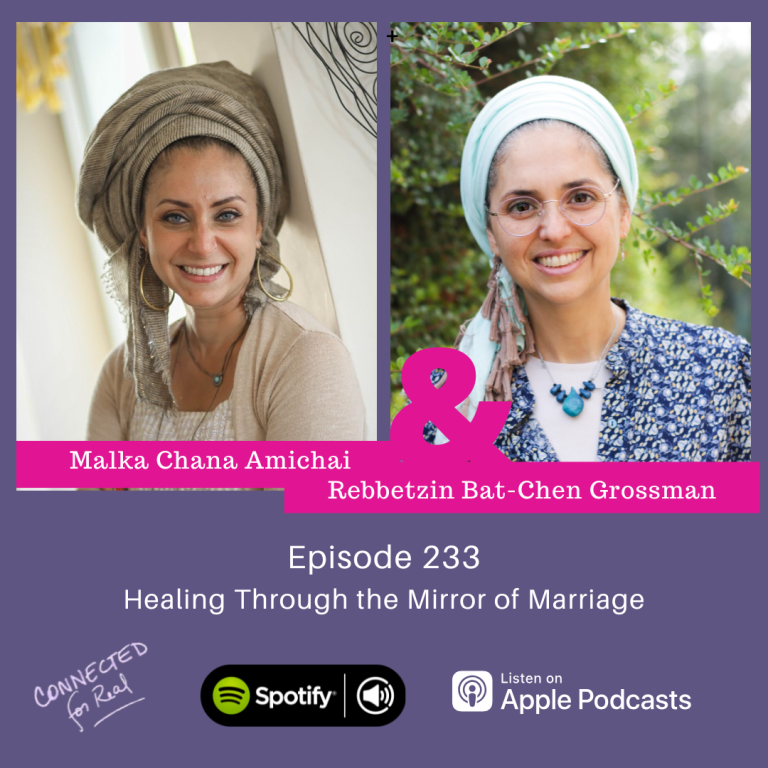
233. Healing Through the Mirror of Marriage
Malka Chana Amichai teaches Jewish women how to build an emotionally healthy, embodied relationship with Taharat Hamishpacha and their menstrual cycle. Her work blends halachic clarity with nervous system awareness and emotional support, helping women move from survival-mode observance into a relationship with this practice that feels integrated, confident, and alive. Rebbetzin Bat-Chen Grossman is a marriage coach for women in business. Together they will talk about the topic of healing and marriage.
Transcript:
Welcome- Yeah … to the Connected for Real podcast. I’m Rebbetzin Bat-Chen Grossman, and today we are talking about healing and marriage, and we’re actually gonna get really interesting into it. And I have with me the most exciting guest I’ve had in a while, because this is a person I’ve been following for over 12 years, Malka Chana Amichai. Introduce yourself. Hi. I’m Malka Chana Amichai. I am the face and owner of Bohemian Balaboosta, which is a brand that supports and empowers women as they move through different life cycle events through education and courses and all the things. Yeah. It’s so cool because like I said, about 12 years ago I met her twice very close together, once at a wedding and once at a conference, and I was so excited for her to be my doula, but then it didn’t work out. And it’s just been really exciting to watch and follow- … and see how you’re sharpening your message, changing up what you’re doing, expanding and leaning into some of the coolest topics and things that people aren’t talking about. So this is the reason why I asked you to be here on my podcast. It is such a pleasure. So let’s get into healing and marriage, and the first thing that Malka Chana said is, “I hate the word healing.” So tell us why. I said I don’t believe in the word healing. Different. Oh, okay. Okay, Okay. Um, Look, healing, I feel like, is this term that is thrown around so easily today, and I think that there’s a lot of beauty behind it, but really the way that I see what people are referring to as healing, it’s the human experience. We go through experiences, and they can make certain stamps on our psychology, on our bodies, on our journey, and our healing journey is really holding space for those past experiences and growing and evolving from them. But I feel like sometimes healing has this association that, when you cut yourself and you have a wound and it heals, it goes away. You don’t see it anymore. I don’t like that term for the personal growth of the human experience because all of those past experiences are a part of us, and they should stay a part of us. We don’t reject or, expect it to disappear. It stays there, and then we grow and evolve into another level, version of ourselves that can hold all of it, but it becomes, percentage-wise smaller in the bigger scheme of life. I like that. I really like that. It’s… When I think of healing, I think of God’s ability to heal things that we think are impossible to heal, and sometimes I think of that. Just like you said, your body is self-healing. God created it that way, you might not see it anymore, but there’s… It went through a process, and that process is built in- physically and also emotionally where God is taking you. Part of that growth is part of that healing. It’s the ability to not stay with open wounds and not function with, like all these different things that are leaking everywhere and bleeding everywhere. It’s like how can you move forward and start to create closure, even if it’s not perfect, even if it’s not whatever. But really that the growth comes with I guess a healing aspect to it. So that’s what I think of when I think of healing. Sure. It’s the process that encompasses the whole journey, really. Right. Exactly. So I mean, we agree, and it’s really fun to talk about this. So let’s get into some of the things that you do. Tell me a little bit about the different angles and things that you’ve been attacking, ’cause I know there’s like a book that you wrote, and then you’re also healing- A few. Yeah, a few books? Yeah. There you go. I need to update myself. And also, like I saw some of the reels that are talking about how you talk about kallah teachers and how they haven’t taught certain things, or they taught things that were actually hurtful, and I talk a lot about intimacy and what your kallah teacher never taught you. So I’d love to hear what are the different angles that you’ve taken and spoken about? Yeah. So when you met me my main focus was being a doula, which was a 10-year beautiful career. Lots of beautiful souls coming into the world. And then with time, I felt that I needed to be able to help women in multiple stages of life with the same inner essence of finding that strength and their ability to overcome hardship or life cycle events, right? These transitional times in life. So you met me at the birth stage. But really, my entire career has gone backwards in feeling that I needed to get to women earlier. So before I was a birth doula, I was a postpartum doula, and then a birth doula, and then prenatal yoga, and then childbirth education, and then kallah teaching, and now I’m in the stage of- motherhood and helping teens learn how to understand their female bodies that will go through the whole process again. The focused areas are really the majority of the spectrum of a woman’s life cycle experience. So the main angles that I like to focus on is creating normalcy on what women really are experiencing. I feel that so often we’re subconsciously taught that we should be feeling a certain way, or expecting a certain mitzvah to feel a certain way, or our marriages are supposed to be a certain way. And if we don’t feel that’s aligning, we wonder if there’s something wrong. And I felt that there was such a need for normalizing the full female experience, and the nuances within that, the ups, the downs, the whole picture. So a big part of the angle that I take when it comes to marriage, and intimacy, and kallah teaching, and sexual education, and teaching your daughters about menstruation, all of the things, is not necessarily… I guess a little bit is saying that there’s a problem with the system, but that’s not really the area that I like to focus. It’s more of I’m there, too. I feel those same things, too. I’ve had that journey, too, the parts that are frustrating or resentful, or you feel like, “I need someone to hold me through this. The education I got was not enough to hold me.” And really helping women come at that from a mature place full of education and then the nervous system regulation so that you can shift not only in your brain but in your body, because our body is experiencing these life cycle events, is crucial. So it’s really holding harmony within all of the different spheres of what it is to be a woman, and then re-addressing and revisiting these topics that we’ve been exposed to in one way or another. I love that. I love that. And you’re talking about the body and not just focusing so much on, the soul and the experience that is in- an inner experience. And just now in the last couple of weeks, I have been sharpening this understanding about our bodies and our souls, and I’ve been thinking about this, and I’m gonna say it out loud I think for the first time. But a lot of people say we’re a body with a soul, and then they’re like no, we’re a soul with a body.” And both of those are trying to create this hierarchy of which one is more important. And in reality, they’re actually supposed to work together. They’re a team, and they’re not… They don’t have a hierarchy. They just are different, and they’re meant to be working together. And just like marriage, if we can actually lean into that and be like, “Oh, we’re different, and we’re meant to work together, and I can bring my strengths and he can bring his strengths, and then we can make it work,” it’s very similar, and I think that I’m leaning more and more into that. And then last week I went to a class where the woman was reading from the Tanya and said that- Most people think that the ultimate is when the soul goes up to the next world, and that basically means the body is buried, stays behind, and the soul goes on. But in reality, she says, the rebbi says, that the ultimate is actually techias hameitim, which is the resurrection of the dead, which is one of the fundamental principles in Judaism, right? So it’s not that the soul goes on and that’s it. It’s that the soul will go on, but then it will come back and reunite with the body, and at that point, they’re going to have reached a way of unity, a way that they can work together in such a beautiful way that’s going to be the redemption. And I think to myself, wow, that totally aligns with making them equal and making it just as important. So people who feel bad about investing in their body or trying to feel good in their body are made to feel bad because it’s almost ” like, Aren’t you focusing on your soul? Isn’t that the most important? Why are you spending time on, weight loss or trying to look pretty or trying to feel good or trying to have pleasure, when in reality it’s all about your soul?” And it’s like, no, no, no, it’s not. It’s really not, because they’re meant to work together. The soul can’t be without the body, the body can’t be without the soul, and not only that, this is what G-d wants us to do, is to create that connection. So I’m, I’m putting this out there for the first time, and I feel really excited about it because I feel like it takes a lot of the shame out of wanting to find that balance Absolutely, and I love what you were saying, specifically with the concept of techiyat hameitim. It’s that the soul comes to the body, right? The soul needs a home. The soul is returning home when we come back, and that’s a big part of my mission for women now while we are alive in this temporary stage, that we can learn to be at home in our bodies. Because ultimately, I think that’s the essence of the harmony of when we come back, right? It’s coming home. Our soul is coming home, and I do think in a sense that we are more spiritual beings having a physical experience rather than physical beings having a spiritual experience, but it’s a back and forth. And learning to have that dialogue, that it’s not one or the other, or one’s better, they have to work together. Our body is this vessel to explore the world, to do good, to experience life, and our neshamah has these different tafkidim, these different functions and levels of growth and evolution or healing that we go through, and our body is the kli that enables that to happen. So learning to like- Awesome … be at home in this, that this is my sacred space that holds my soul, which is on a wild ride of life, is such an honor, and I feel like learning to appreciate our bodies and our soul with so much love, and like I’m so grateful that I’m here and living this life, I just wanna live it to the fullest, is something that is so missed. Because it, you’re right, I agree. Often it’s like I’m fully focused on my body and forget about the soul, or I’m so into my soul I’m just gonna I don’t know, eat Coca-Cola and like gummy bears l- forever because what does it matter? It’s about my soul. Doesn’t work that way. It comes together. It’s compassion and love from the relationship, the harmony between the two. Yeah. Namesh. I agree with you. Yeah. And it’s so beautiful because I’ve been helping girls and women. I, it, mostly I work with women. I only work with married women, but I do work with some teenagers who are, close to my heart. Some of them are mine. And we’re talking about like pain, and what is the pain trying to tell you, and what’s going on in my body, and why is it malfunctioning, like, why is it doing the thing it’s not supposed to do? Or things like that, and it’s so beautiful to watch how when they’re able to just lower that sense of it’s not supposed to be this way, like my body’s trying to tell me something. It’s not trying to fight me, it’s not trying to kill me. It’s not trying to, overtake me. It’s just trying to communicate, and it’s like can I listen and can I connect and really tap into the wisdom that comes with the body, ‘Cause the, we always give wisdom to like the soul. Oh, your soul has wisdom. You have wisdom. But like the body have so much wisdom that if you can connect the two wisdoms, you could be totally up there. I feel like that is redemption. If you can connect to your body on a level where your wisdoms can actually communicate and work together- It’s so true. And I feel like for so many of us, when we’re sitting in a shiur, we’re gaining information in our brain. And even if it’s spiritual or even if it’s soul related, it’s coming here. Giving space and being taught how to let it come into our body is the ultimate absorbing of letting it absorb within our kli. It has to come back to the body of where do I feel, the sensation when someone’s talking about, intimacy, and if I feel like, nervous or uncomfortable, like, where in my body am I feeling that? Let me give space to that. Where is that coming from? Not so much brain. And we all have a lot of work to do there. Yeah. I’m just going to make sure that anybody listening who doesn’t speak Hebrew, so you said shiur is class- I speak a lot of Hebrewish. Yeah. And then kli is vessel. And it’s really beautiful because you’re bringing, the word vessel, that your body holds, it has the capacity to contain so much if we let it. And it’s a beautiful thing, and I love that you used that word. And then, having to translate it made me really drop into it and be like, wow, that is- that’s what it’s all about, the capacity to contain all of the things that are going on inside you and still be able to hold it all is just fascinating. Absolutely. And with the example you were giving about working with teenagers specifically and feeling pain and our body’s against us, I feel that our human experience is often very polar. Our body’s doing one thing, and then our brain is trying to understand it. There’s so much space in between, and when we can learn to move out more of the front part of our brain that’s trying to understand and control, and only when my brain can understand it can I actually lean into it, it’s that Emunah and healing piece of Hashem that you were talking about. The leaning into knowing that G-d is helping us evolve, shift, heal, that allows us to get out of the, “I need to control,” or, “I need to fully understand in order to embrace my body.” Once we can learn to invite Hashem in, keep our heart open, we can move out of that frontal, controlling human experience space more into the soul space that allows me to, “Oh, I hear you body. What are you saying? I’m gonna let that feeling or that pain or whatever it is be there and hear what you have to tell me, and then we can bridge.” So there’s such a journey of moving from the very, very conscious world, more into the subconscious to move more into the body that I feel like is such an honor to be able to have that human experience of learning the different vibrational levels of our soul-human existence, yeah. And you said subconscious, and I love that. A couple of years ago I learned about the super-conscious. The subconscious is more like the default stuff, the things that are going on behind the scenes that are making your body work and your, your brain do the things it does. And then the super-conscious is when you can click into an intentional subconscious-type thing. It’s the same vibration, but it’s intentional. You’re actually being- That’s cool Yeah I’ve never heard that term, but that’s what I was talking about. Yeah. So super-conscious. Yes. ‘Cause, I do this a lot with my guided meditations where I bring God in, and then we let Him fix it, and we don’t try to fix it ourselves or control it- Oh, yeah … or try to do it for Him. It’s just like bring God into your body. Allow it to just, relax a little bit more because it’s in good hands. There’s something so powerful, like you were saying. But I really, I love that journey and that all-encompassing view. I feel like one of the things that’s so frustrating about going to the doctor, when I was a teenager and early in my marriage, I’d go to the doctor and expect them to know what to do. Tell me what I need to do. Tell me what’s going on. And I remember having a couple of things that were skin-related, so I went to a skin doctor and I came with a list. These are the three things I need to fix. And he said, “Okay, so one at a time. Tell me this.” And I said aren’t they all related ’cause they’re all the skin?” And the skin is all one thing, and it probably makes sense that they’re all related. And he looks at me and says, “No. Here in medicine, everything is its own thing.” and they, we all know- Its own chapter and page in the book. You’re in three different chapters… And that was the aha moment I needed for me to be like, “I’m never coming to a doctor for skin stuff again ’cause I just don’t feel like that is the right approach.” And then, that was the very beginning of my journey, and now I’m so much in a completely different place where I really sat down with my daughter and we made a whole list of all the different body parts and what is hurting and what is not working and how are they relating to each other and what happens when this flares up. And it was fascinating to see how everything was so interconnected and connected to the things she’s feeling and believing and her experience in the world. And ha- helping someone at that age figure it out so early feels like a gift. I was just gonna say, you’re such a gift to her. Yeah. You’re such a gift to her to learn how to not be at war necessarily with her body and learn how to listen and to view her life experience as from a holistic perspective. And not trendy holistic. It’s all a part of a system, and you have to look on multiple levels simultaneously, and how are they talking to each other, for sure. Yeah. So let’s talk about marriage ’cause this is healing in marriage, and I wanna get into that a little bit. A lot of women are at war in their marriage, just like they’re at war with their bodies, and I want to be able to give, a little bit of inspiration and also practical tips, practical help. How can someone go from trying to make it work and working so hard, and trying to fix him, and trying to change it, and trying to like, you know, make it the right way, to just leaning into it and learning to listen, and drop into a different level of connection in their marriage? Yeah. So I wanna start off by saying that some marriages cannot be fixed or evolved. It’s important to normalize that. So I don’t… I wouldn’t want anyone listening to this podcast to feel that they’re doing something wrong if it’s time to move on. But I think on a specific level, when we’re choosing to marry someone, or Hashem put the two of us together, whoever put the two of you together, that it’s an opportunity to grow with someone. It’s having like, energy that’s bouncing off of each other, that we may have our own personal experience and our own life processes that we need to grow and evolve from, and there’s this person here that as we’re doing that, you know, if we like, throw the ball, it’s gonna bounce off of them and something’s gonna be reflected back to us. It’s like this constant, “Okay, this thing is coming up in me. I think I need to grow on that. No, I don’t think so.” And then I’m talking to my husband, and I’m, like, mad at him for whatever it is, and it just got totally reflected back to me that I didn’t do as much evolving and growing as I thought I did, because that trigger is still very much there. And I think that’s really one of the most beautiful, exciting, and special parts of marriage, to have this relationship that is so deeply committed. We’re on the same team. We wanna make this work. We’re giving it our all. And to have this safe, comfortable, committed space to let all those triggers come out. And very often, we think it’s them, and I’m sure they have work to do, too, and they’re humans, and they’re growing, too. But so often it’s really a reflection of ourselves, too, and our own work, that if we can shift something within us, it totally shifts the dynamic. Yeah. I think of it as, you know… I talk a lot about the mirror, where you walk into the house and you look at yourself in the mirror, and there’s a spot on your shirt. So what do you do? You start cleaning the mirror, because that’s where you see the spot. But really- Exactly … nothing is going to change until you clean the shirt. And we waste a lot of time scrubbing and bleaching, and doing all the things that we think we need to do for the mirror, and it just doesn’t change anything. And that’s the cool thing about cleaning your own shirt, is now suddenly all the mirrors are clean. And some magical thing just happened. Yeah. So I love how you’re using the same words as reflect and, all that cool stuff. In marriage, I feel like the mirror is one of those big enlarging mirrors that shows you every pore and, really- Absolutely … gets in your face. Because it’s so close to you, and is able to be right there with you, and also reflect you in such a gigantic way. And sometimes that’s very scary or very big. And so making sure that you understand that that’s normal, like- … “Why don’t you understand me like my friends do?” Because your friends are not this close like I am. Absolutely. Right? So validating that it will be, triggering and annoying and hard because he’s right there in your face. But also understanding that you’re here to work together, just like we were talking about the body and the soul and all that. You’re here, you’ve been put together, you’ve been united for a reason, and it’s really to be there for each other and to bounce off each other and to support each other. And I love how you said that full commitment makes it that you have nowhere to go but to be right here, right now with this person, and have to deal with these things. Without running away. Recently we were fighting about something. My husband said something that really triggered me. I was so upset, I like left the kitchen and I, “I have to go breathe.” And I walked outside and I’m walking on the grass and I’m trying to like, shake it off. I’m like, “I can’t believe he said that da, da, da, da.” You know? Like, yes, I am human too. And then I sat there on the grass and I like, my automatic is to run away and be like, “It will fix itself. I can’t deal right now.” And then I thought, “No, but he needs me, and it’s not fair for me to walk out in that way.” And I was like, “Okay, I’m gonna take a deep breath, I’m gonna come back in, I’m going to try to figure out what he’s actually saying. I’m gonna actually listen, and I’m going to be as, as present as I can. And I’m also going to give the warning that I’m still triggered, so don’t take anything I say too tightly.” And I walk back in and it was magical, because it really started a whole conversation that led to, “Oh, you misunderstood me and I misunderstood you,” and whatever. And I realized that was one of the strongest times for my growth, where I was able to overcome my automatic run away and distract- And I think I used to think I’m doing such a great job at “Okay, it must not be you. It’s must be me. I’m just gonna go and journal or stay with myself.” But I was neglecting the relationship. I was almost making it about me or about my growth instead of the interaction. So coming back and having that interaction and then, being able to clean the kitchen together while we were talking about it, I was still saying things, and he was still trying to explain to me and prove to me that I was wrong, whatever. But at the end of the whole thing, it felt so good because we actually had this oh, okay, it’s not as bad. It’s okay. We survived this experience. It was very powerful. That’s the growth. That is the growth and the essence and the beauty of marriage, is we have this opportunity to shift our own previous ways of coping with challenge or whatever it is to decide I love this person, and I’m committed to this person, and I want to make it work. We’re on the same team, so I gotta find a way to chill myself out right now so that I can show up, we can communicate it, and we can talk it out. We may in the end still have different opinions about it, but I wanna work together. I wanna work together. And why can marriage be so powerful? Because it mirrors that experience we were just talking about with our bodies, learning to have a relationship with our bodies. It’s the same avoda. It’s the same work. It’s the same pathway of growth that you were just describing, and our relationship with Hashem is the same concept of learning to be in a relationship. Learning to be in a relationship with our bodies, learning to be in a relationship with Torah, learning to be in a relationship with taharat hamishpacha, which is so much of what I do, it’s a relationship, and here’s this person you’ve been matched with in order to fine-tune and work on what is it to be in a relationship, you know? and I think, with the mirror example- I was actually laying in bed last night, and this whole example came down to me, which often happens when I’m sleeping, which is strange. But I spent a lot of yesterday in elevators. I was taking my kid for a test for high school, whatever, so it was, like, an elevator up, elevator down. I was in an elevator so many times yesterday, and I was thinking how interesting it is that almost every elevator I think I’ve ever been in has a mirror in it. Now why? It’s because an elevator is this little, tiny, claustrophobic space that can be really intimidating to feel so alone in this stuck in this little, tiny vessel. So when you put a mirror there, it makes the vessel feel expanded. And so our husband is our mirror, but it’s also the mirror in the sense from a different angle of allowing our human experience to feel expansive, that you’re not claustrophobic and that you have where to feel that you’re growing or you feel that the space is bigger than it is because you have this safe haven together to live life together, to learn how to be human together, to learn how to help your soul thrive together, and I think that’s such a blessing. It’s really the greatest blessing to have this partner in life figuring out how to do this work of being alive. Yes. I love that elevator, I love that elevator mirror thing. I’m gonna use it. Oh, it’s so good. No, really I’m telling you, I was laying there last night. It was, like, 11:00 at night, and I’m like, “Please go to sleep. Please go to sleep.” And my brain’s like, “The elevators, the mirrors.” Oh, my gosh. People say our kids are mirrors, our husbands are mirrors. They are, but they’re also mirrors that expand our own closed-minded, scared view, and makes it not as scary- … when you have your mirror there. Yeah. It’s beautiful. It’s beautiful. I love it. So there. This is so great. Okay you mentioned a lot of things. You mentioned Taharat Hamishpacha, which is the laws of, Jewish family purity … Jewish family purity. Beautiful. I love how you translated that so well. Do you wanna say anything about that? ‘Cause a lot of people have a hard time with that. I’m sure that’s not surprising to you. I’ve also had a hard time with it. That’s how I got into this field, I feel like so often the scene is there’s an expectation of what Taharat Hamishpacha, Jewish family purity, is supposed to feel like, that it should always feel inspiring or expansive or I like to explain it as pixie dust sprinkled all over your entire life. And I think that a lot of us don’t have that experience, myself included. I can tell you definitely the first few years of my marriage- I’m like, how can this be what the laws say? I am not feeling any of that. I’m feeling frustrated. I’m feeling resentful. I’m taking it out on my husband. I’m taking it out on Torah. There’s gotta be more there. And from my experience I went straight to learning more. I wanted to learn more, not just being taught from, one person. I wanted to explore the books and the sources, and really, again, having that mirror that expands the kli. I wanted to see the expansiveness of this topic so that there’s room where people can find where they fit within that. Now, for myself, specifically you were talking about like when we get into fights with our husband. For me, I also was very much on a journey of learning my menstrual cycle in a deeper way, meaning understanding my certain psychological and emotional tendencies throughout the month, not just, pre-period, post-period. Really tracking and understanding how my personality and behavior shifts over the month, and it’s really very predictable which, women are always called unpredictable. We’re actually really predictable. We just don’t think about looking at ourselves at a month. We see day to day, and we can’t show up- Right the same every day because we work on a month perspective. So I was very much on a journey of realizing the power that my menstrual cycle had, and really able to understand myself so much deeper by understanding my different emotional phases throughout the month. And as I was doing that work, I realized how perfectly it fits on top of taharat haMishpacha, of actually energetically providing a woman with the space that she needs in certain times of the month, allowing for more of an opening and clearing to do more inner work when she’s not with her partner. And then when she’s in a stage of her cycle where she, her energy is more outward, she is wanting to be more connecting, she wants to be with her partner more. And as those two worlds were combining, for me personally, I realized that the reframe of taharat haMishpacha allows for a woman to develop such consistent personal growth by having this system that allows her to have time together, time apart, and where her energies are focused. Because I feel that so much of the discourse comes from this expectation we’re supposed to show up e- the same way every day, and that our taharat haMishpacha experience is supposed to show up the same time every time. And it’s important to realize that every single time we go to the mikvah, we’re a completely different woman when we’re dunking in that mikvah. We’ve grown. We’ve evolved. There’s different things up. Like that, it’s a journey. So once taharat haMishpacha becomes an experience that doesn’t have to be one way forever and doesn’t have any flexibility to grow with you, and you realize the nuances and the space from an educational perspective that you can grow with it, that you can learn how to use it as an opportunity to invite consciousness into your body, and that your body and soul are working together with Torah, it’s- In my opinion, it’s very much this harmonizing practice that holds all of it. But it’s very often not taught that way. And so a woman’s experiences when she’s vibing with it, when she’s not, when she’s feeling inspired, when she’s feeling frustrated, all of those feelings are welcome. But when she feels that she is the one holding it all in her own two hands, she’s holding the mitzvah. She knows what’s the mitzvah. Even that word I think can be very loaded. She’s holding the practice. She’s the one that understands what’s going on. She’s in the driver’s seat. That she’s really holding it, she can hold herself and all the emotions that come with it, and there’s so much work to do there. So much work to do, and I feel like it’s something that people are so nervous to talk about because if I’m having a hard time with Taharat Hamishpacha, does that make me a bad Jewish woman? Does that make me, less observant? Am I going off the derech? No. You’re in a relationship. Sometimes it’s vibing, sometimes it’s not, and holding space for all of that, that’s the energy that women need to be taught. And that’s why my favorite thing to teach out of all the things I teach is my Mikvah Reset course because it’s for married women. It’s… I mean, I love my kallot too. They’re amazing. But specifically for married women that have gone through this journey of realizing what they’re not, feeling inspired about, where they wanna grow, having the sense of having a more mature relationship, and knowing what nekudot, what points need shifting and reframing. They can really transform their life, and it’s amazing. It’s amazing. It is amazing. I feel like, you know, intimacy and our relationship with our body as women is one of the most impactful things in our life because they’re so deep, they’re so in tune, they’re so there, but also because it’s so deep it has so much weight to it, and sometimes it feels heavy ’cause it’s not held correctly or it just isn’t sitting right. And so one of the things, I have also an intimacy masterclass where it’s completely changing the way that you think about the whole experience because it’s just stuff you’re not taught. And like- Right …… I feel like now my daughter’s getting married. At this point she has already gotten married, ’cause we’re dropping this episode after. But it’s an amazing thing to watch this 19-year-old learning things and trying to figure it out, and really like, dropping into it. And like you said, really the, the growth and learning is going to happen once she is married. ‘Cause now- Right …… she’s learning everything in theory. And it’s great. Yeah. And, you could learn books and read things and whatever, but at the end of the day, the practice of going month after month and trying to figure out what’s going on with my body and why am I feeling this way versus that way, that’s going to be the time when she actually has the growth. Absolutely. Absolutely. I can tell you that when I’m teaching my kollels, this is the one-liner I always say, and you just said the exact same thing, “Everything you’re learning right now is completely in theory. This is not like you’re in college and you’re preparing for a final exam, and you’re supposed to have everything memorized and fully understood by the time you’re at the chuppah. Once you’re married, that’s when you’re gonna be trying to figure all this out. That’s where your questions are gonna come in, and that’s when you should be in touch with me.” No pressure- … but I’m always like, “That’s when you’re gonna need me, and I’m here.” a kollel class is not just a set certain number of hours. It’s a relationship. I’m here as their marriages are shifting in all different phases, and they’re actually internalizing, “Okay, what is this whole talas and mishpacha thing in my life now that I’m living it?” It’s exa- that’s exactly the work. It’s after. Yeah. Yeah. And the beautiful thing I tend to attract a lot of 50-year-olds and 60-year-olds to my to my coaching practice, and one of the coolest things is to watch how even at that point, even after so many years, you can start shifting things. I just had a woman, 30 years married, her kids are already, married and starting to get married and things like that and she’s shifting her entire relationship because she’s ready, because she wants to, because it’s- Absolutely … This is the right time for her. It is so powerful to see that because it gives everybody hope. It’s not about the first year of marriage. It’s not about five years for marriage. It doesn’t have to have a deadline or some sort of magical number. You can decide that you want it to get better. You can decide that you wanna have a better relationship with yourself, with your body, with your husband, with G-d, and then just jump into it and do it. Absolutely. And that decision takes so much strength and so much bravery, and that, that’s like the fire that makes me love my students and my platform so much because it’s specifically women that are facing their life, their soul, their body, their growth, their journey, and saying- I want to shift. I want something to shift, and I’m willing to do the hard work. And those that are willing to do the hard work, like my heart is just so… I, I mean, I, I try to be kind and love everybody, but those are my people, the I wanna get into the hard and the challenge and the shift and do this work. Ugh, it’s just I have so much respect, so much respect for women that I’ve seen flip their lives in the most empowering ways, as you’re saying. Yeah. And I think it’s… You know, I see it on them because I see it on me. I do a lot of that work, too. You know, I’m willing to go deep, and I’m willing to jump in. I’m willing to get the right mentors because I know that it’s worth it. I have this mindset. I have this thing that I tell myself all the time before I jump into anything. I will always get return on investment. I will always get my return on investment, probably tenfold, because I am the one who’s coming in here wanting to learn, and I know that I’m going to get something out of it no matter what. And going into anything that way, even if you don’t literally make your, you know, return on investment, maybe you didn’t make the money that you thought you would make or maybe whatever, like I always shift something. I always learn something. I always am able to pinpoint a bunch of things, and I’m conscious about it. I take notes about when I come up with things that, oh, that was really cool. I just learned something. I just met someone. I just did something. All these things, they li- they gather up in my brain as evidence to, yes, this was worth it, and then it pushes me to wanna do it again because I’m like, “Ugh, I always get my return on investment.” It’s very cool. It’s a cool belief to have. It’s true, but really that’s what ma- that’s what makes you a good coach and a good teacher, is, one, going in saying “Yes, I may be in the mentorship role here, but I’m in there with them. I’m not on some ginormous pedestal that is separating and I’m talking down to my students.” It’s women need to work together, build communities, support one another, so you have from that angle. And being humble, knowing that we can learn from experiences and from our students is such an important part of being a mentor in this space, of being human also. Yeah. Yeah. I see a lot also that you said, like it takes so much bravery to sign up to anything, and it takes so much of that courage to even just schedule a discovery call or try to figure out what is the best thing for me. Making that leap is usually 80% of the work. Absolutely. It’s so amazing to watch. Like- Yeah … she’s already there. Like all you have to do as the coach is just “Okay, now here it is, let’s just try this, and this, and let’s, shift there, here and there.” But it was like that commitment- the courage that it took you to make a commitment and then to drop into it, now it’s, I, I think of it as smooth sailing. Even though you call it hard work, but I don’t see it as hard work, because the hardest work was to get out of that, ugh, out of that- … out of that Egypt- To take that first big step … that was holding you in. Yeah. And I think that making that first big step, whether it’s, signing up for a course, or shifting something in our marriage, or whatev- whatever the big challenge is knowing that the emotions of discomfort and fear and unknown don’t have to go away, that all of those can still be there and say, “I’m doing this.” And that comes back to the holistic aspect that we’re speaking about, of being able to hold all of it, and one doesn’t have to cancel out the other. If you’re waiting for the fear to go away, or the vulnerability to go away, or the till I’m at peace with the unknown, then you’re never gonna move anywhere. You go, you make these decisions with those emotions, knowing that you will naturally grow and evolve with holding all of that. It’s really like the psychological developments of children, of being able to hold two things or multiple things at once. You can feel happy and sad. You can feel scared and really proud of yourself and excited for this next venture. It’s holding that holistic aspect and the many dimensions of what it is to be a woman, which is what we do. We are always multitasking, so we also multitask with our emotions, too. I love that you said that, because a lot of people are scared, and they think they need to get over that before they do anything. Early on I learned I am scared and I will do it anyway. And I think it’s so powerful. It’s so powerful. Absolutely. I always used to describe myself as the person who’s terrified of roller coasters, and I go on them anyway. Yeah. It’s I’m like, I will be shaking in that line, and I will be scared, and that fear will not go away, and I will not tell you it was the best thing of my life when I get off the rollercoaster. But I will still get on that rollercoaster scared. I’m still gonna do it. That’s so fun. Yeah. I used to like roller coasters. I haven’t been in one in a long time. Yeah. Okay, cool. Tell me a little bit about your books, ’cause I only know about one, but I’d love to hear more about them. Okay, so again, so I work with women in different stages of life. So there’s three main books that I have available right now for, including a coloring book. The first one is My Mommy’s Moontime, which is actually right over there. I can bring it closer if you want. It is a children’s book. It came down to me also in the middle of the night, which seems to happen to me very often. And it is a book normalizing menstruation for younger kids. I was finding that most of the things on the market are catered towards preteens and puberty stage, like actually telling them what menstruation is, but nothing is warming up children to this concept earlier, normalizing it as a normal part of life, the home dynamic, a mother’s experience, older sister’s experience. So My Mommy’s Moontime is a book told from the perspective of a little girl watching how her mother deals with her menstruation, leaning into the different energies at different phases of her cycle. And it’s beautiful, and it’s enchanted, and it’s magical. And my kids helped me edit the illustrations, how to make it more magical that, little girls will just be like, “I can’t wait to have my period,” it’s beautiful. It’s beautiful, and it’s something so needed in this space. It’s a real piece of my heart given to the world. And I’m very proud of it. So there’s that book. I also have a coloring book called Sacred Womanhood, which is mandalas of different anatomical body parts. So this is a great way to also introduce, preteens or teens to learning to become familiar with their bodies without necessarily having to look at an anatomy picture that maybe could be, feel too intense or too quick for them, that it’s a piece of art, and learning to connect to their bodies by coloring. And for women specifically, I found that, a picture of… It’s all very distorted because it’s a mandala, so it’s not as intimidating. But with certain pictures of the female anatomy, like learning to color it and almost meditate and create a relationship with it because it takes forever to color a mandala, is slowly warming up a woman to become more comfortable with this part of her body, and she turned it into a piece of artwork. So that’s also a really fabulous book that I have. Another book that I have is called A Mother’s Guide to Teaching Sacred Menstruation, which is also a huge piece of my heart, which is how to teach our daughters about menstruation in a way that builds connection and safety for our children, okay? That so many women are like, “Please teach my daughter. Please teach my daughter.” And I say to them, “No, I’m going to teach you how to teach your daughter because you’re the mama and she needs to know that you’re gonna be her safe-” person throughout this female journey that she’s going on. So through that work, mothers end up healing or, rediscovering parts of themselves that needed nurturing, and they’re able to heal that by teaching their daughters. So it’s a beautiful guide that is helpful on a physiological level, on a spiritual level, on a parenting level, that really, again, holds that holistic experience of how to teach and be the mentor that your daughter really needs. I like to say her lighthouse, that you’re, like, there guiding her light, and she always knows you’re there. She may go on her own journey, but she knows you’re there. You’re her grounded space on the shore as she’s on, the waves of life. And then the final one is called On the Horizon, which is a book on perimenopause, which is something that scares so many people. And I feel like so many of the things out there are signs and symptoms and coping and do this and do that. And I really feel that the journey of perimenopause has such a huge spiritual shift coming on, from moving from our childbearing years into this exploring our wisdom, exploring our power as women, to really holding and internalizing that grounded, strong female wisdom. So this book is explaining the technicalities of perimenopause so that we’re not in the dark by all of a sudden, we’re getting these huge symptoms and we’ve never heard this term, and we’ve been avoiding it. Really kind of explaining what this journey is, but then also huge perspective shift on the spiritual journey that we’re going on also. Because perimenopause can, again, be one of those journeys that we just feel at war with our bodies, as opposed to realizing we are recalibrating. And in order for something to recalibrate, a lot of things have to, fall apart or disintegrate in order to be built up differently. And so when we can see it with that perspective, it allows us to ride the waves, to ride the waves with a totally different, more zoomed out view of the journey. I love that. So those are my four main books. Oh, I love it. So what came up for me while you were talking, by the way, I already told a bunch of people about your children’s book, because I think it’s fascinating and fantastic. Oh, man. Also, as you say you’re filling a role that nobody has ever filled before. Yeah. Which is this, addressing the younger children, which is like just preparing the surface. I feel like that is the, the greatest thing. I’ll add something into that also, that even though I’m an observant Jewish woman, these books are made not religiously affiliated at all. Because I feel that there’s, just to throw out what’s actually going on there’s so much woke energy going on in all of these books. I feel, in my opinion, it makes it really confusing for girls. So for people that are not into that and want really just straight female journey, exploration of our bodies without any of the confusing messages, that really doesn’t exist. I’ve read all the puberty books and they’re more and more getting… gonna create a lot of confusion, a lot of confusion on a woman’s journey. So that’s really important to know too, that it’s creating an open-hearted, not agenda affiliated approach to these life cycle events too. Yeah. That’s beautiful. And then when you started talking about the perimenopause, I thought suddenly, it’s amazing how all mothers feel responsible to welcome their daughters into their first period and this new stage of life. And even, a lot of girls have told me, fr- the older women who I work with have told me that nobody told them or that, it was very uncomfortable. They thought they were dying. Things like that really bring up a lot of n- necessary healing, and this is part of their journey, and they’ve really been able to work on that and grow from that. But I would say in this generation of, I, I don’t know, I’m, like, 40, but… 41 it feels like for the most part, everybody feels like they can or should help their daughters go through it in some way. I know also my mother, felt the same with me. So it’s a natural thing that happens in the world. I don’t think that happens so much with the perimenopause. Feel like a lot of- … women are falling into perimenopause and menopause like in this the exact same experience that those women who never were talked about with their period, certainly suddenly everything just falls on you. And there isn’t… Some, a lot of people don’t have their mothers anymore, or they don’t have that feeling of what to expect or what to know. And it just dawned on me that it’s not even a thing that people feel responsible to guide you through or usher you into. And so that’s why it’s so important to have a book like that. I… It’s- Absolutely. Yeah. Absolutely. I do find that things are changing. It could just be because this is my niche I see what’s going on in the field. I do feel perimenopause is definitely has a larger, a louder voice than it ever has in the past. But I think that the spiritual shift is not talked about as much, and I think with specifically with my Mother’s Guide to Teaching Sacred Menstruation, I have an entire chapter- in that book about most of us are going to be helping our daughters through adolescence while we’re going through what they call cougar adolescence. We’re going through adolescence again from the other side, right? They’re phasing in, we’re phasing out, and a lot of those shifts are the same. So as we’re feeling motivated to hold space for our daughters, we also need to be held through that experience, and to know, how to hold ourselves through that journey with empathy and compassion. The same tools that I’m teaching women how to use with their daughters, every chapter is saying we reflect the same thing on ourselves, that we also are re-parenting ourselves and nurturing ourselves from that same place of loving dialogue, which so many of us need help learning how to build that way of communication. Again, back to building the relationship. It comes down to communication. Yeah. Yeah, and I love… I went to a really amazing class. It was in Hebrew. It was… I think it was, like, six or eight classes, and they focused on every organ. On every, every class was a different organ. Oh. And it was amazing. And it, it makes you cry to think of, like, how amazing God is and how He created us, and how they’re all… Each one of them has the thing that they bring and the thing that they’re able to hold. Oh, it was so amazing. So amazing. I was so excited. And they started by saying that it really is bookends. Like you were saying, they’re very similar the getting into and then leaving and, going out of- Yeah … are very similar, and it’s very fascinating. It’s really- and specifically, I’m… Like, I’m sure in this class you were speaking about also a uterus, right? Oh, yeah. So the word for uterus in Hebrew is rechem, which is connected to the word rechamim, which is compassion. And while we’re dealing with these female life cycle events, specifically surrounded with uterus energy, whether you’re phasing into periods or phasing out of periods, it requires so much compassion. Compassion to those around you. It’s something that we have to learn how to hold space for, which is so interesting, because that is exactly what our uterus does. It it holds empty space. We hold space as women in our organs. That’s what we do. And learning to learn how to lean in to that intuition, that essence, that power we have as women, to have self-compassion and to hold space for ourselves our uterus can teach us everything. Yeah. It’s so beautiful. It really is something that I highly recommend. If there’s ever a class that teaches you about your body, about your organs, about your energy, just your ability to lean into that, it’s so good. It’s so good. Take it. Jump into it. Amen. I wrote it. Sacred Woman’s Moon Course. Come join me. I’m so excited. We’re gonna have all the links below, so don’t worry, everybody. I’m so grateful that you’re here and that you’re able to- have this conversation with me, ’cause I feel one of these little girls like, “Oh, I’m so excited.” Yeah. So yeah. So thank you. Thank you for being here. Thank you for having me. How can people find you? Where can they start working with you? How does it work? Great. So my website is www.bohemianbalabusta.com. There has all of my courses, my digital downloads, mini courses, all the things, everything we’ve been talking about here, ways that you can bring that information into your own life, whether learning live or on your own time. And I also have a platform on Instagram, also called Bohemian Balabusta, and that’s the best way to be in touch. That’s amazing. Thank you so much. Oh. Todah rabah. Thank you, guys, for, thank you for listening, and thank you for coming back every week. It’s just amazing. Don’t forget to be connected for real, and I’ll see you next time.