
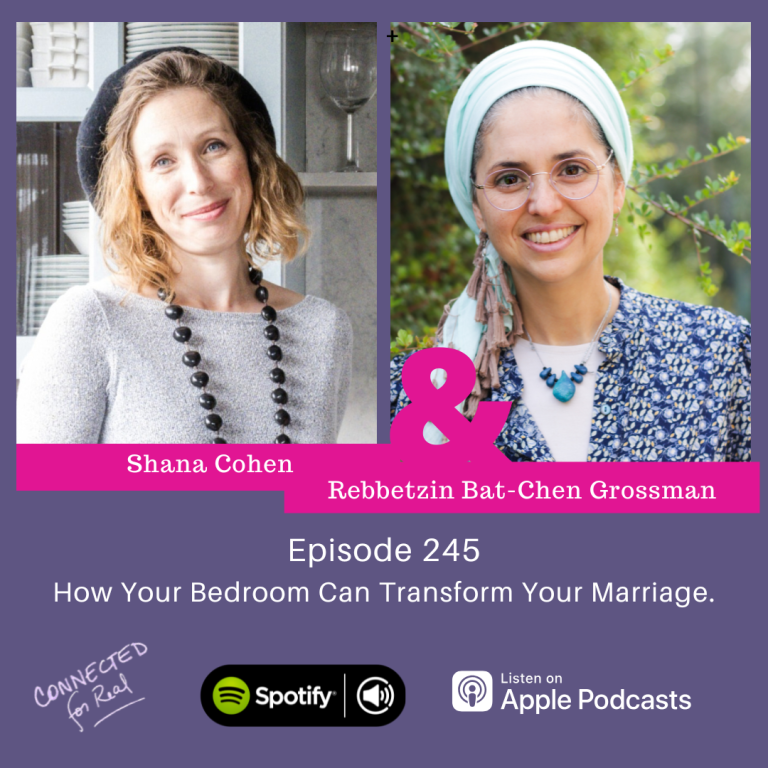
245. How Your Bedroom Can Transform Your Marriage
What if improving your marriage starts with something as simple as making your bed? Rebbetzin Bat-Chen Grossman and interior designer Shana Cohen explore how your bedroom can become a sanctuary for rest, connection, and your relationship, why small daily habits can make a bigger difference than waiting for everything to be perfect, and how taking care of yourself helps you show up better for your family.
They also share practical ideas for creating healthier phone boundaries, bringing more calm into your mornings, and making room for the things that refill your energy.
Transcript:
And we are live. Welcome, everyone, to the Connected for Real podcast. I’m Rebbetzin Bat-Chen Grossman, and today we are talking about sleep and marriage. What a topic. And today with me is Shana Cohen. Shana, introduce yourself and tell us. Hello, everybody. I’m so excited to be here, so th- thank you for having me on. I am a lot of things, but the reason I think I’m here for tonight specifically is for my interior design perspective on sleeping, marriage, and how space really affects relationships, and how we go about that, how we can enable good habits and… Right? Yeah. That’s what we’re here to do. Yeah. You know, I’ll tell you guys, I met Shana in real life at a networking event, and then a couple times, you know? I was like, “Get on my podcast. Come on, I need you.” And then I called her today. I was like, “Please, come on today so we can do this sleep and marriage.” And I’ll give you a little bit of background. I had someone who already was scheduled, and we even met on Zoom and started recording sleep and marriage, and halfway into her own introduction, she, she couldn’t do it. And she’s like, “I can’t. I can’t do it.” Mm-hmm. And she stopped everything, and I was like, “But what?” Anyway, I, I told her it’s fine. We don’t have to do it if she doesn’t feel comfortable doing it, and we stopped the recording and ended up having a whole conversation about why and how and this and that, and it… She walked out happy and so relieved. Mm-hmm. And I walked out really believing that God has got my back and I will not be left alone without a- No … episode. It was- And so for the last- It was just meant to be … it totally was meant to be. And, and we were going to go in the, like, sleep as a euphemism thing and talk about intimacy in a very, like- Mm you know, kosher way, and not really make people feel uncomfortable. But apparently that’s not what we need to talk about. Mm-hmm. Or maybe it, you know, will come up eventually if we get really into it. But, but there’s something about sleep and marriage that I think is a really- not talked about enough Yes And, and I, you know, I don’t know, what comes up for you when, when I say that? I think, I think even, like, when you, you just told this story, I was like, “What made her stop and say, ‘I can’t do this?'” And I think it touches a nerve for a lot of people. In general, I feel like sleep is something that needs to be protected, and I feel like a marriage is something that also needs to be protected. And each one of them, like, even the combination between them is, like, even when you asked me, like, “What has sleep got to do with marriage?” But when you explained what you were thinking I was like, “Oh, of course it has to do with each other.” And it, and it’s just making those small connections of what is it about a relationship with sleep, about a relationship with marriage, and what happens in the bedroom that can really touch a point for people. And s- a lot of people haven’t figured it out, and a lot of people struggle with it. So I think that’s, that’s the idea here, to kind of try and untangle different elements of it to make it clearer and more cohesive. Yeah. And I wanted to tell you guys, You know, Shana’s specialty and what got me all excited about having her on the podcast is this triangle. And what is it called? It’s called the focus triangle. Yeah, yeah, yeah- … the focus triangle. Right. So let- Tell us a little bit about that … a little bit about it, which is not what we’re talking about tonight. We can maybe do another thing about it. But what it is was, as an interior designer, you know, we create spaces to enable people to behave certain ways or to help them live better lives. And I was l- designing a lot of offices and realized that the people that worked from home really struggled to focus, and then people that worked at work were also really struggling to focus. And I, I paused m- I put my business on pause to write a book to help people live better and work better. And, and somehow the book snowballed into, one minute, it’s not only about their environment. There are so many other sections to it. So it started going into research in psychology and neuroscience, and it was all about our brain and what we need to focus. And and so a lot of it is environment, and a lot of it is energy. And then the peak of the triangle is focus. So you have e- environment, energy, and focus. And I think what’s interesting about how this comes up in it is that one of the things that I teach is that we have renewable energy. We are the greatest source of renewable energy. It’s God-given. It’s even better than solar energy or hydro energy or anything like that. The problem is we don’t always know how to harness that energy, and the people that do are athletes and their coaches. And what they know how to do, and this has got a lot to do with sleep, they don’t just train hard. They sleep hard. They eat well. Everything is about this balance of, how am I going to be at my peak, at my best? And sleep is a huge part, part of it. They have sleep regimens to be able to, to perform. And we, as, you know, just, just our normal little selves who are not performing at our peak, or we’re not winning gold medals- How much more so could we perform if we understood what these athletes knew, if we understood the concept of our renewable energy and how to harness it? So sleep is a really big part of that. I love it. And so the second you said renewable ener- okay, listen, when I asked her- … if she could do sleep and marriage, she’s like, “No, my real topic is renewable energy.” I’m like, “Yes, and that has everything to do with sleep.” But also, you guys let me know, send me emails, let us know in the comments, do you want a whole full episode on renewable energy? Because I do, and I’m super excited about it. Would you come back for that? Yes, definitely. It’s a lot to talk about. Yes. So I, I just, I really, as soon as you said renewable energy, I was like, that is why God created sleep. Yeah. And it, sleep is only one way to renew your energy. There are other ways, and I love that you said, you know, athletes get, get this right. Actually, when I was early on in my business, I realized that there is a lot of skills that if you start doing something athletic, you will grow muscle for your business. And so I took on swimming, and I swam across the Kinneret. Oh, wow. And it was so cool. Mm-hmm. And it really changed the, it changed my identity, because suddenly I was a swimmer, and I never was any of that before. And also, it got me into a rhythm where I, I had to practice twice a week- Yeah … no matter what. Mm-hmm. And I proved to myself that I could do something hard. Totally. Like, all these things are so valuable- Yeah … to being in business. And I think I really give it a lot of credit for, you know, where I am today. Where, you know, regular people would be like, “That has nothing to do with it.” Right. It has so much to do with it. Exactly. It’s like- It’s all about also it helps us emotionally regulate movement. It’s, it’s part of our renewable energy 100%. And I’m also a swimmer, by the way, and that’s also kind of new. It’s in the last five years. And, yeah, I can’t, I can’t go for a week without being in the water, moving like that. It’s, it does something to you. It’s very cool. So one of the things that I, that comes up for me when I think of sleep and marriage is that we’re always tired. You come… You, you almost, like, burn yourself out. You get to the bedroom and you’re like, “Ah,” like exhausted. Right. And I feel like if we could tap into renewable energy during the day or just know how to manage our energy better, then we wouldn’t get to a place where we’re falling apart. I also believe that just like babies get overtired and then can’t fall asleep, we do that to ourselves also as adults. Yeah. 100%. You know? We’re like so wired and so hyped that we can’t relax. Right. And then you wonder why you’re never, like, eh, you know, never in the mood. It’s a winding down process, first of all, and it’s also arriving in your bedroom not completely depleted, and still have energy for the relationship that happens in your bedroom. If I can, I’m gonna jump straight in to what a bedroom is. And as a, as a designer, I, I studied feng shui. And feng shui is in layman’s terms the art of- Understanding that energy has a place in your environment and how to place things. There’s a lot of levels to feng shui, but that’s the basics. And according to feng shui, the bedroom is actually the most important part of the house. In any renovation, and I’ve said this to many clients, w- you know, people go straight into, “What’s the kitchen gonna look like? What’s this gonna look like? We have a budget for this and this and this.” And I always stop and say, “Your bedroom is, in Jewish terms, your Kodesh Kodashim, which is your Holy of Holies, and it has to be a sanctuary.” And we don’t do this for ourselves if no one’s there to say, “Hold on, your bedroom comes first.” And the question is why. Why according to feng shui is it your sanctuary? Why is it so important that you know, there’s a, there’s a whole way of setting up your bedroom, but why is it so important? And the truth is, is that it comes from a place of understanding who sets the tone in your home. And it’s the mom, and it’s the dad, and their relationship. And if they’re annoyed at each other or something’s off, everybody feels it. They feel it. The kids feel it. Something’s out of sync, it’s not a great place to be. So basically, we’re taking that energy and, and kind of sprinkling it everywhere else, right? Throughout your home where When you’ve created a good setup and good habits around your bedroom, and your bedroom becomes your sanctuary, and you don’t walk in there depleted like, “Sorry love you, but I need to go to bed.” you know, or… And, and that happens, and it’s fine, but how do we not make that happen all the time? Then- Right. I was gonna say, like- Yeah … it’s totally normal that that would happen, but it starts getting really, really bad when it happens- Right … every single day, every single week- Right … every single month, and you’re like- 100% … “Aren’t you prioritizing, you know, this?” No. ‘Cause it’s really- Right … like I love that you said this is the holy of holies. It’s the holy of holies. This should be top priority. And then instead it’s like, yeah, but… Right. So I think it starts, and, and what I know is that environment shapes the way we behave in a certain place. And that’s why, yes, there are habits to incorporate, but first we deal with what does your bedroom actually look like? What else happens in that space? What is that space meant for? And really what it is is, is a little bit of a couples therapy to look around their bedroom and say, “Is this our sanctuary, and how can we make it like that?” And a lot of the time I’m not talking about a crazy renovation, I’m talking about getting a bedspread that you both love that just, you know, brings joy, or making sure that all the shoes aren’t out, or there’s not a lot of clutter all around. And, yes, this takes priority over a clean kitchen because you wake up there, and you go back to sleep there, and that, like… And then you’re getting all your energy from there. So you’ve got two elements in a bedroom, which is quite a complicated space because in the rest of the house, you have a lot of specific areas, like the kitchen is for making food and for discussion. And the bedroom actually has a little bit of, like in Chinese you know, the, the yin and the yang. And what it is, it’s, it’s the quieter energy, which is our sleep, is where we’re getting all our you know, everything, all our- Our sleep, our kohot from, our kohot is like our, mm, let’s call it powers, right? Everything that w- that we generate with. And we also have, in that bedroom, it’s a multifunctional space because that’s where a lot of married life relations happen, right? And we wanna create a good space for that. So you’ve got the quiet part, which is the sleeping part, and you’ve got the relationship part and what happens there. And so the bedroom really has to facilitate two almost opposite functions, which is really fascinating, and that’s why it needs to be a discussion between a husband and wife. Even what color is the wall? That wall bothers me. Now, it’s very hard to be in a romantic situation when the wall is bothering you because our subconscious mind is constantly you know, it translating, “Okay, but that bothers me, and the shoes are there, and why is there, you know, that on the floor?” It really needs to incorporate so much. So, so that’s, I think that would be the starting point of the bedroom, making sure that it’s a sanctuary for both parts of the couple, for the husband, for the wife I love that. I love that, ’cause a lot of times it’s like, “I’m gonna do whatever I want, and I’m gonna make it my way.” And it’s like, yeah, but you’re sharing this room. Not only is it yin-yang, like high energy, low energy all in one room, and two different functions all in one room- … but there’s also two different humans that have to- Yes … share this room. Where if, let’s say you were talking about a kitchen, it’s like it makes sense that the wife would, you know, design it the way she likes, ’cause maybe she’s there all the time. Mm-hmm. For us, it was the opposite. My husband was like, “I need the counters to be tall because I’m always working on the counters.” And there was like, you know, there’s different things. You, you know who’s gonna be there. But in a bedroom you’re both there, and you’re both equals in that space. 100%. I also think there’s another element especially when people have little kids, or even big kids. I have big kids, and they, they’re everywhere. They’re all over the house, and I know that there’s one space that’s mine. That’s… It’s shared, but it’s still mine. I can go there and I can take a deep breath and not be in the hullabaloo of what’s going on. And I feel like having a sanctuary in a house that is busy, thank God, with children, with a lot of things, with, you know, just f- families having a space, I think it’s important for parents, for a relationship, to know that they can just go there, close the door, and it’s theirs. I love that. I think it’s important. I agree. I also remember I went to visit a friend when I was young And, and, you know, they went in… Like, we, we were walking around, we went to her bedroom, we played games, whatever. We went to the living room, went to the kitchen, and then she needed to get something or whatever it was. Somehow we ended up in the parents’ room, and everybody’s just sitting on the parents’ bed watching TV, and I was like, “Wait, what? Why am I not a family member in your parents’ hou- like, bedroom?” Yeah. “Th- it doesn’t make any sense.” It was a shock for me, because I grew up that nobody goes like, an ex- outside people do not walk into your parents’ bedroom. That’s a good, that’s a good habit to, to definitely encourage, to tell your kids also, “If you wanna come into my bedroom, please knock on the door.” And at a certain age, they need to know that. Whether or not, you know, you’re in the middle of something, or you just need your space, I think it’s a very healthy boundary to put out there. So, so, so what I wanted to say, another thing about, about the bedroom is that not only is it a, is it a space for what we spoke about, but it’s also, it’s enabled by certain habits that we do. And I find that if someone makes their bed every single day in their bedroom, whether or not they were raised like that or not, it doesn’t really matter. When you come home to a made bed, and I’m talking bedspread as well, because there’s nothing like a bedspread over two separate you know, mattresses, or just a bedspread. It kind of just clears the… Sorry, whoops. It kind of just clears the way. It makes it look like a little bit like a hotel, and that’s… Like, there are, there are these tiny little elements that we can add to our bedroom that’ll just make it feel like, “Oh, that’s so nice.” And all it takes is an extra two minutes in the morning. And it makes a big difference. When you come in there and you’re tired, but your bed is made, you’re like, “Okay, that’s nice.” That, that’s pampering. That’s kind. That’s a kindness to yourself, to your husband, whoever’s up later and wants to make the bed. It should be a habit that’s very much, you know, a part of the, the life, the relationship. I like that. I like that, even though I don’t do it all the time. I mean, I do it sometimes. But, You know what? I dare you. I dare you Oh, no. Sorry, sorry. You’re gonna set an example now. It’s so easy. I have a friend who I, I told her about this. I said, “Just make your bed.” She called me back, like, two weeks later. She’s like, “You have no idea what you’ve done. I want- I- … to go into my bedroom.” That’s what it is. I trust you. I trust you that it works, and I know that it’s nice, and I have all the excuses in the world of why- Everyone does … I just can’t. Yeah. I’m sure. That’s why I’m being completely honest, ’cause I know I’m not the only one. If I felt like I was, like, the only one in this universe who has an excuse of not making their bed, I’d be, like, hiding behind my, you know, my covers literally. But it’s, you know, one of my early clients took this upon herself, and her business changed completely because she prioritized her own space. Herself. And so I, I know it. I know in my head. I’ve seen it in action. I’m a little annoyed at you that you challenged me now, ’cause I’m actually- You know what? gonna take it on. If I didn’t, if I didn’t have a 30-day challenge right now going on for people using my planner, I would do a 30-day make your bed challenge with a bedspread, and watch, watch what happens. Like, the relationship, the relationship with your room and your sanctuary… We say sanctuary, but we don’t treat it like that, and no one’s gonna make it a sanctuary if we don’t. Something to think about. Yeah. I feel like I… Yes, thank you. I’m totally taking it on. I will update you guys how it’s going for me- Yes … by the time we have our next recording. I love it. I’ll let you guys know. I feel like my room has other feng shui issues that make it, that in my head it’s just like, ugh, all or nothing, never mind, so nothing. Like you said, I’m annoyed with other things that aren’t changing and so I’m like, “Ugh, forget it. It’s like such a bad room. Like, let’s just figure out a way to, like, redesign the whole thing.” I think this happens a lot when I talk to perfectionists. It’s really this need to redo the whole room, get new furniture- Yeah start over, and then things will be better. Where it’s like make your bed is, is a challenge of how would you, how do you break that? How do you get out of the all or nothing and just do one thing consistently to move things forward? So I- I’m seeing a lot of facets of why the challenge that you’ve given me is so powerful. It’s not only, I think it’s really hard, I don’t know if you’ve read Atomic Habits, but it’s really hard to create a new habit in our lives. And what he recommends is connecting it with another habit or making it, like, look like enticing or good. So the question is is can you connect it with something? And this is something that I did. I connected a habit that I wanted to do in the morning with brushing my teeth. So I would brush my teeth, and then I did what I wanted to do. Which was great, and it worked. What I would suggest also another way to do it is have an alarm clock on. I love my alarm clocks. My alarm clocks sometimes run my life, and they say, “Shana, reminder, I want you to do this and this and this.” And I set them for myself. So a way to do it would be to set a r- a reminder about 10 minutes after you normally wake up. Like after your wake-up call, make your bed. And it’s just like, “Oh, okay, I could do that.” I don’t think I need a reminder. I think I need to sell my brain on it, you know? Like- Hmm … you’re saying make it enticing. I just like want it enough. Right. There’s, there’s a study on this. What are you talking about? I, I mean, I didn’t obviously sell it well enough. I’m gonna look for the study. We can keep talking, and I’m gonna, I’m gonna scroll for the study on making your bed makes life better study. Okay, continue. We can continue here. Oh, it’s… This is hysterical. This is so fun. I love that my podcasts go on such tangents. Like who knew- … we were gonna talk about making your bed. Hold on one second. Let me just get into it. I just Google search this, right? Key findings in research and surveys. Happiness and mood. A survey by hunch.com with over 68,000, this is important, participants found that 71% of the people who made their beds daily reported feeling happy, while 62% of them who did not make their beds reported feeling unhappy. The s- National Sleep Foundation reports that individuals who make their bed are 19% more likely to get a good night’s sleep. Maybe that’s what’s selling you on it. Productivity and habits. Behavioral research highlights bed making as a keystone habit, a small morning task that triggers a chain reaction of structured behavior such as exercising, eating regular meals, and focusing on priority tasks. Survey data shows 63% of bed makers start work straight away, and 76% report that their work quality is consistently to the best of their ability. I could go on, but the studies are out there, and they’ve proven that, that tiny, tiny habit changes everything I’ll tell you why I don’t like making my bed. Because it’s pushed to the corner of the room, and that really bothers me. I’m like, I- That sounds really annoying … yeah. And so, like, in order to make my bed I need to move the bed, and it’s heavy ’cause it’s two beds. And then I need to, you know, do the sheets and the, then the pillows, and then, you know, the thing. It never really sits right because there’s a wall on one side. Does it need to be pushed all the way to the wall? And that’s why I’m telling you, like, it really bothers me. So does it need to be? It’s a tiny room, and it’s so small. It was funny. Every single apartment we’ve had since we got married, the bedroom was always the smallest room, and somebody who had a mirror image apartment to us took the bigger room for themselves and gave the kids the smaller room. And my husband came home and was like, “That is such a waste.” ‘Cause in your bedroom there’s two people, and then, you know, in the kids’ room it’s, like, potential of more. Right. Anyway, so it just, the way that it worked out, also this was, like, designated as the parents’ bedroom because it has- Right … its own bathroom, and it had, you know, Right like, a sort of, like, a nice entrance. I, I would see if you could even move it 10 centimeters. I don’t think 10 centimeters is gonna be a big- It’s, like, the exact amount to have the closet open, the closet door all the way. It touches the bed, and it is, like, the exact amount. Oh. I’m telling you, it really bothers me. And I- You’re right. I get that … I, I have this belief that if we just got a new closet and got rid of the other cl- the closet that, like, is stuck, and if it just, like, if we got rid of that and had two end tables and had the bedroom, like the bed in the middle, like it’s supposed to be, then it all would fix itself. Mm. But I don’t know why I’m having such a hard time getting out of that, like, must, must make it perfect brain. You know? Like, let’s fix the problem brain. It’s a, it’s a hard brain, yeah. It’s pr- it’s pr- what’s it called? Progress over perfection. Yeah. So I could say, like, “Yeah, I’ll make my bed every day,” but it doesn’t make me feel that excited because it doesn’t actually look perfect because, like, it’s not s- you know, it’s not, like, flowing the way- Right it’s supposed to flow because there’s the wall. I get it. Yeah, anyway. I get it. I still think, I still think maybe not a specific, like, duvet, but, like, a bedspread that is, like, big enough to, for you to just kinda, like, whoosh it, you know? Yeah. So I had that. It is what it is. I could, I- It hits the wall, and fine. It’s still better than an unmade bed And I would possibly even throw some pillows at it, like some throw pillows at that wall in the corner. It might be fun. Yeah. I’m gonna go progress over perfection, and I am not doing it happy, but I’m going to trust the process. Just trust the process. And I really, I, I also am hoping that it will create a chain reaction to get the bigger things- Things done taken care of. Right. ‘Cause, like- It definitely will. Even the concept of, “Wait, this is my sanctuary?” That changes everything I agree and I love it, and that’s why I’m giving so much pushback, first of all, ’cause my… I, I don’t know why I’m, like, in this honest mood. Like, oh, man. Lucky for your viewers. Right? I’m sure they’re getting to know a whole ‘nother side of you. Exactly. Yeah, this is, like, really fascinating what’s going on in my brain. Like- Mm-hmm … why is this so, why is this so difficult? Like, all the excuses are coming up, all the reasons, all the things. It’s so funny. It’s so interesting. I think sometimes we hold on to our excuses, like, “I can’t sleep well because, you know, well, look at my room,” or, “I can’t you know- talk to my husband in my room because, like, it’s not a great place for us to be romantic because my room is na, na, na.” So the excuses actually fuel something else that maybe we don’t wanna deal with. Right. And, and taking them away- So I’m definitely proud of- Yeah … right, I’m proud of that it’s not cluttered, that there’s not, like, you know, it’s you can walk in, it feels nice. Right. Mm-hmm. It, it like better than it could be. Mm. But I am, I’m excited, and now I’m getting into, like, the motivation part of it, like I am talking myself into it. I’m excited to see what it will do. ‘Cause as a coach, you know, it’s hard to coach yourself. You can’t see the label from inside. Yeah. So that’s why I’m having such a good time, like, bouncing back and forth. Mm-hmm. As a coach, I know that when you’re waiting for something to change or when you think something big has to change, then there’s this really desperate energy and it’s not very you know, it’s, it’s icky, and, and it’s grabby. It’s like- Mm … when this thing happens, then everything will be better. It never works. Even if the thing changes, like, you’ll always find something that’s not working. Mm-hmm. And, and being able to change that is taking responsibility over something that you can control. It’s like I’m talking myself into it because, you know- Yeah, yeah, yeah … it’s so crazy. Like, you take something that is in your control, start doing it, and then the things that are not in your control start becoming a lot more attainable because you’re moving in the direction of something else is possible for me. Yeah. It’s also, like, attacked, a- a- attached to your identity of, you know, what I deserve and what am I worthy of, and all those things, which like, when you say sanctuary, a lot of people, what they’re, you know, the thing that comes for them, comes to their mind is like, “Yeah, that would be nice for someone else,” you know? Right. “Who feels like they deserve a sanctuary, but I don’t.” You know? Whatever that thought is, which I honestly don’t believe that about anybody. If you’re in this world, you’re worthy of living, okay? Yes. You’re worthy of being. You are- Definitely … a very valuable person in this world. But I think that’s one of the things that really clicks into p- place for people, is the, the ability to take control over how I think of myself- Mm-hmm with the actions. Like you were saying, there is something so powerful about doing something consistently, and over time, giving yourself the feeling that, “Oh, I love myself just as much or more than everyone else. Wow, that’s great.” It’s permission. So. Right. Yeah. Yeah, I think, I think it’s, I think it’s the narrative that we come last, especially as mothers. Like, everything comes first. And I, I happen to think personally that I’m a better mother when I put myself first. I’m a better partner when I’ve put myself first and, and looked after myself, and I was kind to myself. I don’t wanna show up as this depleted half of myself ever. It happens, but when we go back and we can look at why it happened, it was normally that you were depleted, like, your, your, yourself. But you gave so much to everyone else. But I tell my kids sometimes, I’m like, “I need to do…” You know, they understand the concept of filling my tank, like. And we once went to go see a friend that I really wanted to see, and my daughter said to me, “So is your tank full?” And I was like, “What?” And she… And, and she was, like, little at the time and, and she was like, “Your tank.” And I was like, “Oh, yes. Yes. That, that filled me. It did good for me.” And then she was really concerned that my tank would be full after I’d explained it to her, like, previously. It’s, it’s those things that, that, number one, we come first. Number two, that’s why feng shui, which has been around for thousands of years, puts the parents’ bedroom in the center. ’cause it’s so important, because we come out of there. ‘Cause I wake up after a good sleep, hopefully, from that bedroom, and then I go out into this world of people who are relying on me, people who look up to me, people that need me to be in my best self. Of course I have to make sure that that space is my sanctuary. It’s not… I would even think to say it’s not a luxury, it’s a necessity. It’s n- and, and we don’t need permission for it, because it’s just going to ensure that we’re giving the best version of ourselves constantly. Yes. Yes. It’s not a luxury, it’s a necessity, and it’s even more than that. If you love your kids enough, you would take care of yourself. Yeah. Because your kids deserve a well-taken-care-of mother. 100%. And even more than that, if your kids see you taking care of yourself, they will make sure to take care of themselves- Oh, 100- … and give themselves permission to take care of themselves … It’s role modeling that your boys will ensure that, you know, their wives are being taken care of. There is something so powerful about breaking that generational need to put yourself last. It’s not working for us anymore. I don’t think- I don’t think it ever was. It’s the opposite of a vicious cycle. What’s the opposite of a vicious cycle? Like, a kindness cycle. We’re just breaking it and saying, “Hold on. The moms need to be, you know, have the, the basics,” I would even call it. And it makes them better. My kids know when I go away, and, and I used to travel a little bit when they were little, and they knew that I was coming back. They knew that I was having fun. They knew that I was coming back different, and I did every single time. I was, like, full. I had been walking around art museums and just filling my, nourishing my soul, and my husband knew that that was important for me and, and encouraged that and enabled that. And my kids grew up with that, like, knowing that this is, that, that’s, that’s Ima that I want, not the one that’s just been, like, you know, working, working, working, giving us dinner, putting us to bed, and go, you know? Right, right. I have- so it’s not an everyday thing, but it’s, it’s part of them watching the whole process. Yes. I love it. I love it. I feel like if I think of my, you know, I have my, like, come into my world freebie, which is the guide to unravel overwhelm, and it’s exactly that. Basically, overwhelm is when everything else is more important than you, and there’s just no room for you to breathe. Mm-hmm. And the first step is taking one thing, a tiny, tiny, tiny, tiny thing, and just making it a priority- Mm-hmm … because you want it and because it matters to you, and not because you have to do it, not because it matters to anyone else. You know? And, like, the four quadrants, it’s, like, the quadrant that’s important but not urgent- Right … and it just sort of falls by the wayside ’cause, “Ugh, it’s fine. I’ll just, you know, take care of myself later. I’ll just eat breakfast later. I’ll, you know, I’ll pray later.” Like, whatever it is that everybody has their own, there’s this one thing that is the thing that’s going to fuel you, but you don’t give it- Yeah to yourself because you think it, there’s no time. There’s no point. There’s no thing. Ironically, now with the phones, we waste so much time- Yeah … and think that we don’t have time, but it adds more noise, and it takes you away from being at your best. Ah. I was just- Yeah … re- remembering back to when I got married and was… I had my first baby. And so I wasn’t going to work anymore, and I started crocheting, and I went to the library, and I started- Wow … crocheting things for my, for my baby, and it was just, like, so cute and so delicious. Oh, yeah. But I, I really remember I don’t even, I don’t know when was the last time I crocheted Wow you know? So- Sure … recently, like maybe half a year ago, I ordered from, you know, from one of these, like, just send it to your house stores a whole kit of embroidery. Oh, wow. And I started embroidering on a backpack. Every time I would sit down with the kids at the park, I would challenge myself to not get on my phone because there’s two reasons why I’m getting on the phone. I’m feeling alone, ’cause maybe there’s no other mothers there or n- everybody’s ignoring me, whatever it is, or I’m bored. So it’s like- Mm-hmm … those should not be the reasons why I’m on my phone. Yeah, 100%. So I started embroidering. Ah. And what happened was that I had a great time, of course, and my backpack looks, you know, awesome. I’ll take a picture- Amazing … and I’ll put it on Instagram for you. I wanna see this backpack now. Yes. And all these other kids in the park come and circle around me, and they wanna see, what is this that you’re doing? And then it hit me that they have never seen any mother or grandmother doing anything like that anymore. Like, I don’t know. Yeah. I used to see my grandmother or my mother stopping, you know, taking her time for herself, sitting down on the couch and actually doing something with her hands that was, you know, sort of like repetitive and meditative, and they just, like, had their own space and they had, like, space for myself type of thing. Yeah. Our kids are growing up with mothers sitting on their phones on the, on the couch, and there isn’t that meditative, there isn’t that conversation opener. There isn’t any of, any of that. Right. So I’m really proud of myself that I’ve leaned away from my phone, you know- That’s very cool … during, during those times where, you know, I feel- Listen, it’s a start. It’s, it’s, it’s, it’s just being the present with what you w- what… You, you brought joy in, and you’re present with it. I think that’s- Right … I think that’s huge. Also, now the winter is coming, and I’m very excited- Mm-hmm … ’cause I take, I took it upon myself to crochet a blanket. Yeah. So I’m going to I’m gonna start and actually make a blanket, so I think that, that will fill my cup totally ’cause it’s like a long process. But you know what you reminded, you reminded me a little bit about talking about the phones just going back to the bedroom concept. Right. Mm-hmm. An- another concept, and, and this is harder than making your bed, is taking phones out of bedrooms and making, and having a charging station, and putting in good old-fashioned alarm clocks This used to work fine, and now I feel like when we have a phone with us in our hand next to us, there’s another sense of something else is there. Something else is now a part of the relationship. There’s, you know, I could get a ping and I might be having a really interesting conversation, but I really wanna see what that is. And like for my kids, I don’t let them have phones in their bedrooms. We, we started with alarm clocks, and everyone kind of went out of the alarm clocks, and now we are the alarm clocks. But the point is that Maybe we need to disconnect, and maybe the bedroom and the sanctuary is a place of disconnect where maybe we can read a book before we go to sleep. And, you know, how nice would it be to have a conversation without your phones present? It’s like they’re these own- they’ve got their own little, I don’t know, bubble saying, “Pick me. Pick me up. I- just check, just check one more thing.” And, and, and unfortunately, the way that phones and all this modern technology is created, it’s to create a need and to create an addiction around it. And I think we’re all in there. We’re, we’re, we’re all so far gone. A lot of people doing my program, we just started and someone said, “I’m newly diagnosed as ADD.” And I was like, “We all are, honey.” Like, like we, we never used to be. We used to be able to do things without getting distracted, but these things, these are just distractions. Like, like no one used to walk around with a constant distraction. So we’ve all got the same, you know, disorder, and, and it’s crazy, and we’re still supposed to function, have healthy families, have good you know, relationships and jobs and be a good, you know, role model and mother and everything else. It’s tough. And I think for, for the brave ones out there, and maybe I’m even inspiring myself right now because I need to do this- I’m challenging you because- Okay … I actually feel really good about this one. You know what? I, I see your challenge, and so you and me will be in touch about making the bed, and I will take my phone out of my room because I did try it for a while and I loved it. And then, you know, I’ve got older kids, so sometimes I just need to be available for a late night call or something like that. But it’s also okay, you know, if that doesn’t happen or there’s one phone in the room or even it could be in the bathroom so you can hear it ringing, but it’s not accessible. That’s what also they talk about in Atomic Habits, making it less accessible. So let me just say, I feel so- I’ve been inspired. Thank you. I love how you talked yourself into that. I didn’t even have to say anything. So first of all, I’d like to say I feel less embarrassed now ’cause before I was like, “Oh my gosh, I’m that person who doesn’t make their bed and has to be like, you know, put on the spot on a podcast of my own.” I’m sorry. But now… No, I love it. But now I feel like, okay, at least we’re even. I took my phone out of my room many, many, many years ago- Good for you … and I will never look back. Good for you. It is the best thing I’ve ever done in my entire life. You should all do it. It is completely the best, the best thing in the world. I can talk you into it for as long as you need, and I’m sure there’s many, you know… Google any of the research, and it will tell you it’s the best thing you can do. Oh, 100%. One of the things that happened when the war hit was that we all had to have our phones near our beds, and so a lot of people sort of regressed into having- Yes their phone back into their bed I’m so proud of that decision I made. Sometime during the war, you know, months, it was just like, “I’m done. I can’t do it anymore.” Like, I wanna go back to that really great habit of not having it in my room. So- Hmm … I am definitely challenging you, because this one is even stronger than making your bed. I am willing to put my money down on that. Okay. I’m, I’m in. Yeah. I’m in. I, I take you up on the challenge. I will definitely do it. I do wanna say that my phone goes dark. It goes into dark mode from 9:00 PM. Hmm. So it goes all black and white. I set it… There’s a wellness setting on your phone, and you can set it and it goes black and white so it’s really much better for if you do have to be on your phone later on the blue light isn’t showing as much, which has been shown by many studies to make it more difficult to fall asleep and, and kind of wind down during the day. So that was something that I did and, and I still like it, but like I don’t get big phone calls. My kids know if they need to get ahold of me, the one thing that overrides that is a WhatsApp call. Hmm. So that’ll ring. But otherwise, everything’s on silent, my notifications, everything, and it’s just like black and white, so it’s not enticing. So I have… Yeah. I have that also. I, mine goes at 10:00 because I try not to go on my phone at 10:00, so it actually locks. So it locks my WhatsApp, it locks my, my, a- a- any of the apps that are sort of, like, interesting. It locks it away and I have to, like, go in and say ignore limit, which by the way, if you don’t trust yourself to not ignore the limit, then you can keep ignoring limit. Right. But that also builds self-trust, and I really appreciate the fact that I have the ability to ignore it, but I also have the ability to be, like, caught… Like, it’s a double check, you know? It’s like you open the app and it says, “Nope, it’s closed.” Now you have… Now you’re faced with the choice- Hmm … of do I just go- Yeah with it and ignore it or do I just close the phone? And that is one of the hardest things you can do is just turn off the phone, ’cause it’s not really that important and you’re, you’ve- It’s really not … you’re not doing it. We don’t miss anything. You don’t miss anything. We’re just very addicted. Yeah. And then also for me, when people want to get through the block, they need to call twice. So the first call won’t go through. Hmm. But then if they call again within three minutes, it will go through. So the kids- Oh … know that. Yeah. Okay, fine. Yeah, that’s really cool. That’s good. The other thing that I wanted to talk about was, just ’cause you reminded me, I also have a morning mode. And what I can say about morning mode is I found myself, like, quickly, like, going through notifications and things in the morning. I was like, “That doesn’t need to… That’s not how I wanna wake up.” And so I have a morning mode that my alarm clock will go off, phone calls are open, but the rest of it is quiet. Definitely social media, because it’s so easy to just go and scroll. And what I, what I wanna add about a bedroom in morning mode is when you do wake up and you ha- open the curtains Sunlight is so good for us, and so is fresh air. So what I would suggest if we have like a going to sleep habit is also a waking up habit of opening up your curtains, opening up a window, getting fresh air in. Air quality and, you know, some circulation is just so healthy for us. Before we need to face everything that’s waiting for us, because that’s gonna happen anyway. But when you just let the sun in, like, like I would say even wake up, don’t straightaway, you know, quickly brush your teeth and then, like, make your bed obviously. But I would say open up the curtains, open up a window, let it come in, take some deep breaths, and then… Right. Yeah. The slowing down into the day is really important. I actually have this, I think it started when I was pregnant, where instead of jumping out of bed and getting like, you know, a little bit of like a blackout, I would put a pillow under my head, like a second pillow, raise myself a little bit, take some deep breaths. Then I would like sit up and like take a couple more breaths, say, you know, Modeh Ani, just thank, thank God for being, you know, being alive. Right. And then slowly get up and out. And I really think that there is something so powerful about that. You know, the listeners are sitting there being like, “Okay, we started with making the bed, taking the phone out.” Uh-huh. “And now you’re telling me to also slow down. It’s too much, too much, people.” Don’t slow down. Yeah. So honestly, take whatever resonates and be like, “That’s what I needed to hear. That’s what I’m taking on.” Like, just like for me it was make the bed, and for you it was take the phone out. For someone else it could be open up the window and just stare out the window for three breaths. That is all- Yeah, I love that … you might, maybe that’s all you need. Right. I also love that you said like, you know, sunlight and fresh air. It reminds me of the list of things that are so healing and so built in to helping us live a better life that are all free, that God created, available to you anywhere, and that’s like sunlight and air and outdoors, nature stuff, and water, which by the way is, is amazing for- Yeah you know, rejuvenating and just getting you back in alignment. There’s so many things that we take for granted- Mm-hmm … and we think we need all this like consumerism ex- external stuff to help us. So I love that we went back to that core and the, you know, sort of like the things- Right. I would even add to that, that there’s a concept in called biophilia. And biophilia is basically our human innate nature- We need or, and crave to be close to nature. So when we bring plants, flowers, anything in, it does something to our nervous system. Besides for it helps air quality, it’s so easy to have like a nice plant in your room just to kind of soften things, just to kind of connect you a little bit. And even if it’s a subconscious connection, because it is, and that’s why we’re always looking for, you know, views and trees and, and it just helps us regulate. Bringing a plant into your room is like one of the easiest things that you could possibly do. Sometimes when, you know, I’m cutting the flowers for Shabbat and I’m like putting them all together, I’ll take a few and put them in my room because I’m worth it and because I deserve to wake up to nice flowers. And they go next to my bed, and then it feels a little bit more like a, a cute little hotel, and it does a lot. It goes a really long way. It’s something cheery to look at. So it doesn’t have to be flowers, it could be a plant. But we have this connection to nature that we, we actually crave it. And that’s what biophilia is. Yeah. I love that you said… Okay, you mentioned it twice, and that’s why I’m gonna address it now. Okay. Because you said it feels like a hotel room. And again, you said it twice, like once when we were talking about- Mm-hmm … making your bed. I did. And now when we put the flowers next to our bed. And I think that, you know, the reason why it works is because the hotel are doing it on purpose. Like, they know what they’re doing. Of course. They’re not- Yeah … it’s not just that we’re trying to be like hotels. It’s that the- No … hotels know. They’re basing the, you know, whatever they’re doing on the fact that it’s working and it’s bringing people in, and people- Yes … are craving. And people go there to relax. And the second that someone walks into a hotel room, they feel different. And that is, is basic design. That’s just basic good design. And all it is, is everything that already exists in your bedroom. You have a bed, you have a side table maybe, and a lot of the hotel rooms, that’s it. They don’t even have to have a you know, a chaise lounge or a couch or anything. Hotel rooms are generally a bed and, and two side tables. Now, if you wanna go extra, you could do a carpet, you could do… Just bring in some, like, warm materials. But the point is that you have what a hotel room has. So there’s no reason, in my opinion, that you can’t create something similar, even if your bed is against the wall. A lot of the time it’s the color of the sheets, it’s the curtains, it’s the lighting even. And it’s always a made bed. That… Like, imagine walking into a hotel room to not a m- you wouldn’t wanna sleep there. And they’ll say to you, “No, it’s all clean.” It didn’t, it didn’t do what it did for you when you walked in, right? Right. When you’re supposed to walk in and feel like, “Ah.” Right? Yeah. It’s that exhale. Yeah. Yeah. Yeah. Oh, I love it. I think that we addressed so many things that at first didn’t feel like they connected, but it’s so, it’s so important. Yeah. It’s so important to realize that everything connects and everything matters. Not being overtired, preparing for sleep, prioritizing your bedroom, prioritizing yourself and your, you know, couplehood. I made up a word. Love it. Yeah. Is there anything you wanna say to, like, wrap it up and bring it all together? Mm. Well, I, I, I’m, I’m just gonna go back to the concept that everyone, every couple, every human, even single moms, deserve a sanctuary, and there’s one place for it, and you have already everything you need. You might have to go out and buy a few things or whatever, but it’s small. It’s, it’s the, it’s the concept that needs to stick of what this place is supposed to be, and then will enable what happens there. Mm. That’s, that’s how I would sum it up. I love that. I love that. Thank you for coming. This- Oh, my gosh. Thanks for having me … this totally worked out. This was fun. I know. I’m so happy. It was really just what was meant to be, and this was a lot of fun. Yes. And again, I, I mean, I’m going to give you guys a chance to let us know, you know, what you think and how excited you are about having a second episode, but I’m totally looking forward to the energy… What was it called? The re- Renewable energy … renewable energy. The focus triangle. We can talk about it all. Oh, my gosh. It’s like, just hearing the word renewable energy gets me so excited, because, you know, God is so great in the way He built us, the way He created this world is, like, mind-blowing. It is. Thank you. Thank you for coming. Pleasure. Have a good night, and have a good sleep. Oh, I will. And thank you all for listening. Don’t forget to be connected for real, and come back next week for another amazing episode.