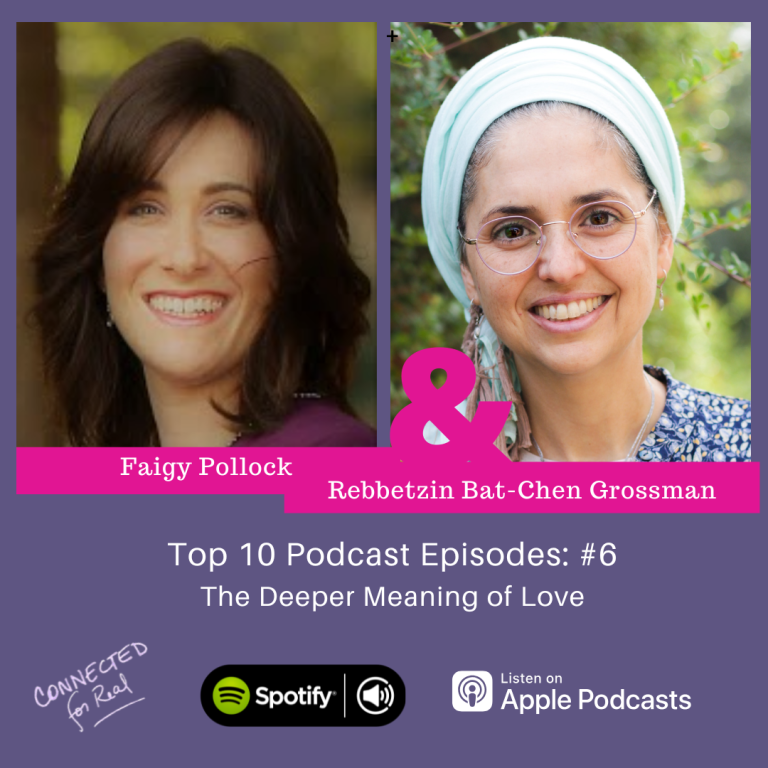
━ I believe it has been five years to this podcast. I’m so excited. We’re doing a giveaway, and it’s based on the four pillars, G-d, marriage, business, you, which should not surprise you because that is what we talk about on this podcast all the time. And also, for the five-year anniversary of this podcast, we actually went through the entire five years and picked the top 10 episodes that you cannot miss. So the coming episode is one of the top 10, and I can’t wait to hear what you think about it. Now go enjoy the show And we are live.
Welcome to the Connected for Real podcast. I’m Rebbetzin Bat-Chen Grossman. I’m a marriage coach for women in business, and today with me is Faigy Pollock. Faigy, introduce yourself and tell everyone why you are so awesome. Thank you. So, I guess I’ll start with Baruch Hashem, I am blessed with a beautiful family. I’m the wife and mother of seven. I know hard to believe I have a grandchild. Something I’m still trying to wrap my head around. Baruch Hashem, I have a married daughter, and for many years now, I’ve clearly, Hakadosh Baruch Hu has clearly, G-d has clearly walked me down the path of helping women to live a more whole, wholesome, intimate part of their marriage. And I do this through training, um, brides before they get married, meeting with brides so that they start out their life on the right path, and then meeting with women. Usually, I would say my main clientele are women married anywhere from 5 years and upward, up to I’d say about 15 or 20 years. And these are often women who, you know, blessed with children and life and business and things are going on, and life could get overwhelming, and very easily marriage, especially the more private parts of marriage, can very easily get pushed to the side. And this is often when women will reach out and ask for help because it’s just not working the way they would like it to. So, that’s where hopefully I can come in and help women with the very particular part of marriage that perhaps is, let’s call it less accessible. People are, and rightfully so, not talking about as much, and it should be that way. But I do want people to know that there are addresses for women who are looking for enhancing parts of their marriage that maybe otherwise would get really, really pushed to the bottom of the list. So, that’s what I do. I refer to myself as an intimacy coach and a, what we call a kallah teacher, a bride teacher, and that’s what I’m very, very proud to be doing, and thankful to G-d for the journey that He’s put me on. That’s amazing. I love it. And that is why I brought you here today to speak about love. And, uh, as you guys know, if you’re a new listener, we have four pillars: G-d, marriage, business, and you. And every topic is addressed from four different angles. And today we’re talking about love, and we’re talking about specifically love and G-d. So, you know, questions like what is love? Why did G-d create love? What does it mean to love G-d, to love, you know, our husbands, ourselves? How do we wrap our heads around all of this topic? So let’s see where we get started, and then we’ll go from there. Okay. So this is a big one. This is a big one. And I would start by saying that the word love, which we would translate… It’s hard sometimes to translate these words because in our holy language, every word is about the essence. It’s really about the internal essence, right? And the word ahavah, which is how we would say love, is the same numerical value as the word echad, which is one. They both equal 13. Add up the numbers, make sure I’m not making a mistake, but you’ll see that they both equal 13. So we understand before we even say anything that ahavah, love, is a lot about one. About one. It’s about wholeness. And this is a topic that would be very, very interesting to unpack together and explore, especially within the context of marriage, which, as we will see together, is really just an emulation of our relationship with G-d, with the divine Yes. Yes. I love that. I love that we realize that a lot of what’s happening down here is really just a training of how we are meant to deal with G-d and have a relationship with G-d, right? Our relationship with our husband is a place where we can really learn and get the skills that we need in order to turn back up to our relationship with G-d. I also see it with parenting, right? Yeah. Where a lot of times we learn a lot about what it feels like to love from that perspective. Yeah. Yeah, exactly. So I guess I’ll begin with a very beautiful introduction that I often teach the brides that come my way, and this does often come up also in the context of the healing work I do with women. I also should have said that I created an online intimacy course, so a lot of this is taught on that course. I often like to look the bride in the eye and ask her, “So you came, you’re here, you’re sitting, we’re here together. We’re hopefully gonna build great rapport together and learn some very interesting topics that you haven’t maybe touched upon yet. But why? Why are you getting married? Why marriage?” And, you know, very often they’ll start off by giving me the cliche answers. “Well, because we’re supposed to one, have children. Well, because we should populate the world. Because it’s the right thing to do. Because all my friends are dating.” And I say to them, “Just, I want you to just shush out all those external voices. Just go in, inside, just in your gut, in your soul, just like why do you wanna get married?” And they’ll often, you know, take a deep breath and go in for a moment, and they’ll just say I, I just, I just want to. I, I don’t know if I can necessarily explain why. And then I’ll walk them through a process of asking them questions. What, what are you lacking in your life? Are you blessed to come from a family of loving parents? Thank G-d the vast majority of them will say yes. Do you have friends, aunts and uncles, cousins, maybe a robust social life? Maybe you’re working, maybe you’re in school. Like, what are you lacking? And at the end of the day, it all comes down to there’s this deep, deep existential loneliness that we come into the world with that we sense intuitively that only marriage can fulfill that place, and that’s why we get married. And these things are brought down explicitly in our beautiful sources, where basically as we explore, we go way back to the beginning, the beginning, beginning of time, Bereshit bara Elokim, in the beginning when G-d first created the world. So G-d created this beautiful existence for who? For man. And man, who’s the crowning glory of creation, when G-d finally creates man, for the first time He utters the words lo tov, no good. Now this is fascinating because He creates, you know, yom rishon, the first day, the second day, everything He creates, He steps back and He says, tov meod, this is good. This is whole. And then when He creates Adam, the first human being for whom which the creation came into being, right, G-d others- utters the words lo tov, no good. So we have a few things going on here. Why do we wanna get married? Because there’s this gaping hole inside us that we sense that only marriage can fulfill. And this goes back to the way that G-d created Adam and Eve. There was Adam and he was alone. Lo tov hiot ha’adam levado. What’s no good? Adam alone in this state of alone is no good. So then He creates Chava, Eve, who joins this partnership, this companionship together with Adam, and then they become whole, and only now can the, the whole bria, the co- the entire existence now is transported from lo tov, from not whole, from not complete, from not good, to whole. Which just by the way, in brackets, or maybe not in brackets, maybe in bold, we should be yelling this at the hilltops, that means that that’s the power that a woman has. To take lo tov, not complete, not whole, and literally bring the entire creation to wholeness. That is the power that we have as women, and that’s what the first woman was all about. So we have this union of male and female, and together about them G-d says, “Now, now it’s whole. Now it’s complete.” So G-d creates the world for Adam, for Adam, for this first human being who is really, he encompasses the entire humanity. We are all like a little segment of Adam and Eve. So Adam and Eve at the time really encompassed the entire humanity, and for them, the world was created, and only once Adam and Eve connect and choose to be connected, we’ll soon elaborate on this further, only then does G-d say, “Vayara elokim et kol asher asa.” Everything that he’s seen is whole. You look like you want to say something. I love it. No, I’m like blown- Okay … I’m opening up to receive. I feel like my body needs to expand to contain what you’re saying because it’s so beautiful. Wait, it’s about to get even better, okay? So now, so we, we asked the question of why marriage, and we’re starting a little bit to answer. But now I have an initial question. Why did Hashem, why did G-d create the world to begin with? What was he lacking? As we know, G-d is whole. He lacks nothing. So why did he, quote-unquote, bother and create the world, and ultimately the crowning glory being Adam? And the answer is because G-d wanted to give us the greatest good possible, which is himself. G-d wanted to give us himself. There is nothing greater than G-d himself. So essentially, what he wanted to bestow upon us mortal human beings is a relationship with him. Now, how can we be in a relationship with G-d? So our sages teach us that in a spiritual realm, the more we emulate the divine, the more similar we are in our life to G-d, the more G-d-like we become as human beings, the more connected to him we become. Now, we’ve already established that G-d is good. We’ve already established that G-d is in relationship with us. We’ve established that G-d is one and whole. Where in our day-to-day life do all of these elements express themself with utmost precision? The answer is, as the Zohar HaKadosh says, “B’sha’ah d’isdabaq zachar b’nokhah.” In the moments where the male and female connect and cleave to each other, it’s in those moments that G-d looks down and says, “Look, this is one. This is whole. This is a relationship of giver and receiver.” And it’s then that he rests his name, his Shekhinah, through the union of this couple to fill them, to fill their home, to fill the world, essentially. And this is the secret of a Jewish marriage, particularly the innermost parts of marriage. Because as the Maharal often explains, everything in creation is a harmonious dance and relationship, an energetic flow between the giver and the receiver, the giver always being the masculine energy expressing in the world, and the receiver being the feminine. Now, we’re not talking here about a passive recipient. We’re talking a very active one. The power of the female recipient is to take the bestowal, to take that abundance given through the man, and to bring it into fruition. Okay? This corresponds to what we said before about her taking the world from a un-whole to whole, to tov. Okay? So that’s what we’re talking about here. We’re not talking about a passive receiver. We’re talking about the most active energy that exists in the most beautiful, delicate way. That’s the power of the female. So everything is this beautiful dynamic between male and female. This is true, obviously, in the human world. We see men and women. This is true in the animal kingdom. This is true on all level of physics. This is true in spiritual realms. It’s all expressions of that, the ultimate being G-d and his people, humanity, right? G-d and humanity. So here we have this relationship of giver and receiver. Okay? Now- Even our soul, before our soul came into this body, into this lifetime, our soul existed at a realm, a world of souls, a world that is very real. We can’t see it because our vision is very, very limited because we are physical human beings in this lifetime. But if we had, if we were stripped of our, you know, the, the, the binding effect of our body, we would see that there’s a lot more going on than meets the eye. So th- there’s this spiritual world, the spiritual realm of souls, and in this realm, the soul exists basking in the pleasure that is beyond the comprehension of every human being. Try to think of the most pleasurable moment of your life, okay? And try to consolidate that with all the pleasures that you’ve ever experienced, and try to compound that with all the moments that humanity ever experienced from the beginning of time. The amount of pleasure is uncomprehendible. It’s not something we can possibly fathom. That’s nothing, nothing, compared to the pleasure that the soul experiences when it’s completely connected to G-d with nothing in the way. So that’s where our soul exists. That’s where it feels at home. And then G-d takes our soul, which by the way, the Maharal explains, and this is also b- brought down in the Sefer Kabbalah, that every soul is comprised of a male and female part, counterpart, okay? So every neshamah, every soul, has a male and female expression, and then this soul is separated into two separate individual bodies, okay? So the male, imagine if … I would give, I like to give this following, um, parable. If it’s a really cold day, if you live in Yerushalayim or maybe in New York, and it’s really, really cold, maybe it’s snowing outside, and your hands are so cold, they’re literally turning into, like, ice. They’re stiff and they’re hurting, okay? So these two hands, okay, these two hands express the soul. This is the male soul, this is the female soul. In the spiritual realm, they’re together, they’re rejoicing, they’re united, they’re whole, and then G-d separates them, which is painful to the soul, and puts them into this world into a body. So one second. Here we go. I keep these gloves handy. So on a cold day, I might take a glove and put it over my hand And now what you see are gloves. Okay? So my hands are a little bit warmer now, and now my hands are in gloves. And if I would take my hands and connect them for further warmth, I wouldn’t say that I’m connecting my gloves. I would say that I’m connecting my hands. That’s my experience. It’s true that there’s a thin layer of glove in the way, but I’m connecting my hands This is the secret of a Jewish marriage. This is the secret of a committed marriage between two loyal, loving human beings who are committed to looking out for each other and becoming one in their life, emulating the divine day by day. Because when the soul comes into this world, it comes into a body. That’s how it expresses itself, and we always have to remember that we’re not a body that has a soul in it. We’re a soul that for a very short span of time, even if we’re blessed to live, you know, till 120 as we wish each other on our birthdays, 120 is nothing, nothing compared to the eternity that our soul is because our soul is a spark of the divine. So when our soul comes into this world, there’s a deep longing of the soul to re-experience the wholeness of that spiritual realm. And our soul goes through this world, which is dark, where the physicality is opaque, and this is part of, of, of G-d’s master plan, for us to shine the light in the darkest of places, thereby bringing Him into our life, into our world, shining His beauty, and spreading His name in the world. And from the time that the souls come into this world, there’s a deep longing to reconnect, to re-experience the wholeness that they experienced before they were put into this body. And how does that happen? That happens through a man and woman finding each other. Every, every couple has an in- insane story of how they met. I mean, it’s unbelievable the divine providence that goes on when it comes to couples meeting and coming together, and then ultimately expressing their connection through completely connecting. What looks on the outside as gloves, what might look as a very mundane or even physical relationship, because marriage has many very physical day-to-day mundane activities, okay? And we might think, “What’s so holy about that?” But actually, what seems like the most physical is actually what? It’s in those moments when husband and wife connect and become one, it’s in those moments that the soul is comforted at the deepest level. It’s that feeling of, “Welcome home. I’ve known you for 1,000 years.” That’s ahava. That’s love. That’s echad. And it’s in those moments that the husband and wife are emulating the divine in the most precise way because in order to be able to express such vulnerability and have such a relationship, you have to become a giver. You have to become a receiver. You have to become a relationship being as G-d chose to be in relationship with us You have to see the other. You have to be able to communicate. You have to be able to connect. You have to be able to become whole and one. And as we already said at the beginning, ahava, true ahava, is the same numerical value as the word echad. Love and oneness are two sides of the same coin. So that’s, before we say anything, this is the foundation. This is the foundation. Chills. I’m getting chills- Yeah … because it’s so beautiful how you explain it and how you describe it, and I’m just there with you, and I’m… And I just, you know, I feel like you sucked me into the screen and just like, whoo. It was so beautiful, and thank you for the way that you described that. I’m sure the listeners are feeling the same way. When you put on the gloves and said, “My hands are together, not the gloves,” it hit that, yeah, that’s exactly what it is, right? Yeah. It’s the souls uniting. It’s something really beyond words. Yeah. Yeah, ’cause it’s otherworldly. It’s otherworldly. It reminds the soul of an existence and a pleasure of a different time and place, and that’s why the world is so obsessed with the male-female relationship and all aspects of it, because really, really everyone’s starving, right? And when a person is hungry, they’ll grab anything. And we all know, we all know how we should be eating, right? And if you’re very hungry and you grab a chocolate bar, it will give you a sugar high, but then it’s gonna give you a major sugar low, and then your sugar will be spiking all day, and then you’re just gonna feel horrible. What a person, when they’re hungry, needs is a well-balanced nourished meal that doesn’t only feed the body but also feeds the mind and the soul, in a certain sense. And that’s what the innermost parts of Jewish marriage are all about. It’s about not only catering to the physical needs, but it’s so much deeper than that, right? So when the world, ’cause humanity as a whole is longing for this experience of wholeness, except they don’t know that the only way to get that is by choosing one spouse and committing, and subscribing to a life of complete commitment, bringing G-d into our life because there is no space for anything outside of that. And only through walking and, and working the trenches of the difficulties, and the challenges, and the misunderstandings, and the resentments, and the unmet needs, and the unrealized expectations, and having to work through all of that can we really reach that level of oneness that we’re talking about. That’s real growth. That’s real connection. Because real ahava, real love, is not an emotion. So sorry to disturb this amazing episode, but I had to stop and check that you signed up for the giveaway, because this is awesome. There are four gifts based on the four pillars and an extra bonus gift to work one-on-one with me. So what are you waiting for? Go and sign up connectedforreal.com/giveaway or check the link below. And now back to the show There’s a great story. I love quoting this story. This is like, you know, going back I’d say probably many decades when Stephen Covey’s books first became very popular. I’m sure you’re familiar with like the Seven Habits of Highly Effective Families and Highly Effective People. So he was up once on stage, and he was talking about love, and he was saying that love is something that you do. It’s not something that you feel. We’re so used to thinking that love is a feeling. Like, do I feel love today? That’s great if you also feel it, but it doesn’t always work like that. Sometimes we’re not feeling love, but we s- we decide to do love. We decide to do it because it’s the right thing. So someone came over and he said, “Stephen, I hear everything you’re saying, but I just don’t love my wife anymore.” He said, “I heard you the first time. Just go home and love her.” He’s like, “But I don’t love her.” Right. Just go home and love her. Choose to love her. And this is something that, as Jews, we know this is so ingrained in our upbringing and in our tradition. Rav Dessler, may he rest in peace, Zecher Tzadik L’vracha, says this very beautifully in his Michtav M’Eliyahu, which I’m sure there’s a translation of that, but I don’t know what it’s called, and he says that true love comes from giving. We’re used to thinking that love is when we receive. Like, someone gives to me, so I feel very loved. But the truth is that when we really, when we truly want to love someone in a God-like manner, it’s through giving to them. And then I, I had the, the zechut. I don’t know how to say that in English. The merit? The merit, I guess, or I was lucky to learn this from a very great disciple of Rav Dessler himself, and he said to us very beautifully, he said, “What is it about giving that creates love? It’s because you’re giving part of yourself. It’s like you’re depositing part of yourself in another human being.” So we see this very clearly, of course, when it comes to loving our children, right? It’s, it’s almost by default. You conceive that child. You carry that child for nine months. You birth that child. You breastfeed that child. There’s the part in you that is deposited and invested in that child. But it’s much the same with marriage. The more we can invest parts of ourself and choose to share that with another, then ultimately, listen to these words, it’s ultimately the part of self in the other that I’m loving, which means, and this would be a topic for a whole nother podcast, so we’ll just touch upon it, that in order to love another, we have to first of all love who? Ourselves. Ourselves. Exactly. Exactly. Because it’s about depositing and investing part of ourself in another. So we have to love ourself. And a healthy relationship can only exist when there’s first, you were saying that that’s one of the pillars, the self. There has to be that well-defined sense of self. So we’re not losing ourself in marriage, we are becoming. We are becoming ourself in marriage, and that’s the beauty, and that’s real love. Not where we lose ourself, where we become two individual human beings choosing to connect. In fact, going back to what we were saying about Adam and Eve, one of the approaches that the Talmud takes when it comes to the debate of how Adam and Eve were created is as follows. Adam and Eve started out, according to this approach, back to back as an androgynous being. Male in the front, female in the back. Two heads, okay, one body, expressing maleness in the front and female in the back. Okay? And it’s interesting because we would think, wow, that is, like, as connected as they come. It’s like Siamese twins. Like, they’re so connected, they’re literally one body. And it’s about this creature that G-d utters the words, “Lo tov hiot ha’adam levado.” It’s no good for man to be alone. What alone? He’s not alone. He’s so connected. And the deep answer is that when we’re back to back, where we are so leaning on the other for our sense of identity, we can’t see them. That is so lonely. So what does G-d do? He puts Adam to sleep and he separates them. And now he builds up. V’yiven etzatzeila. He builds the side. Okay? So now we have a male form and a female form who turn around, need to gain footing and stability, and learn to stand on their own two feet, and then choose to connect. All connection in our tradition is always face to face. Panim el panim. I see you And this is also emulating, and this connects back to our love for G-d and G-d’s love for us. G-d chose to express his love for the Jewish people through what? There are many different ways that he expresses his love. He refers to himself as a father and us as a child, as a mother and a baby, as brothers, as friends, as a king. There’s so many different ways that G-d expresses and reveals his love and leadership of the world, of humanity, and of the Jewish people. But the mashal, the, the leading example is always the, the male female union. Okay? And this is expressed in the holiest of holies, the holiest place on Earth, which is the Kodesh haKodashim, the Holy of Holies. And in the Kodesh haKodashim was the Ark which housed the tablets, and upon that rested what we call the keruvim. I don’t know how to say that in English, so if you want to maybe translate. But they were basically a golden image of a male and female embracing, in a very intimate pose embracing. And this is an expression of G-d’s love for the Jewish people expressed through the male female relationship, because that’s the highest, most whole form of love that exists Yeah. That’s… Hmm. It’s so beautiful. So first thing I wanna say that you express so well what a lot of people maybe feel or know or try to put together. Mm-hmm. And you’ve just pulled it all together so beautifully. Thank G-d. The way that G-d loves us and put us here so that we can have a relationship with him. The fact about the self having to be a strong unit before it can love and, you know, be loved. It reminds me of the CALM method that I have. Mm-hmm. The four steps to creating flow. So connect to yourself is step one. You have to know what you want before you do anything else, right? The most natural thing is to cancel ourselves. I was very much like, “It’s fine. We’ll just do whatever you want. We’ll just do whatever everybody wants.” You know? “Oh, you don’t care? Fine. Okay, no problem.” And I very much was erasing myself and my needs and my presence so that everybody has peace, so that everybody has what they need, so that whatever. And eventually it really comes down to you can’t function like that. You can’t live- Right … like that. Not because it’s not sustainable, which it isn’t, but because that’s not what you’re here to do. Right. You know? Yeah. G-d is going to send you wake-up calls until you wake up and- Right … you know, realize that you need to do something else. You need to change it. Right. And that’s why step one is connect to yourself, because without that, you can’t move forward. Exactly. You really need to know what do you want, what do you need, what matters to you, and then you can really… You know, we had a teacher who said, “A half and a half don’t make a whole.” And while I was dating, I really kept that top of mind because- Yeah … if somebody is ho- waiting and holding onto this other half coming and filling me and making me better and making my life complete, and I just, I’m looking for my other half. Sure. There is something very needy and lacking in that- Right … where the energy is very, very low. Yeah. And it doesn’t turn out very well. Right. Right? Like we see it on the other side as marriage coaches and advisors. Yeah. It’s not, it’s not good. Yeah. And then from there you have to suddenly turn around and be like, “Okay, now I have to build myself up.” It’s a little harder. But if you realize that actually you need to be whole, and they need to be whole. Mm-hmm. You know, to the extent that we can. We’re never going to be able to be perfect, right? But- It’s a journey, right … feeling, right, feeling like you are comfortable being in your own skin and able to hold your own space. Right. And then there’s something so much greater that happens when you put those two whole people together. The, you suddenly realize that you are a half. The wholeness that you thought you had is nowhere near whole. And- And that connection is so much deeper. Exactly. Exactly. And I think all marriages go through those phases, and we all start out like Adam and Eve back to back. It looks like love, it feels like love, but it’s very, very dependent. It’s very leaning on the other. And as my great friend, Rebbetzin Tamar Tabak likes to say, she says, “We all first need to start out, before we go to couples therapy, we have to go to decoupling therapy.” We have to decouple. We have to learn to just, you know, be a unique individual. So that’s definitely- Yeah. But, and that- … such a crucial part in marriage … and that is where people tend to break. You know? Yeah. There are a couple of places where the breakage happens, and I, I find- Yeah … that people are like, “Ah, it’s not working. I can’t do this.” The first part is when you suddenly find yourself, and this is, you know, my specialty is in the s- you know, successful women, women in business. You’re finally out of this controlling, and stuck, and very dependent place, and you’ve found yourself, and you’ve found your calling, and you’re starting to do your thing. And the first thing that happens is like, “Well, look at that, I don’t need him anymore.” You know? Right. And that’s a place of breakage, and it’s so- Yeah dangerous to- Yeah … stop there. Like, you have to trust the process. Yeah. Because the process is so, is so beautifully orchestrated that- Right … after you find yourself, and you find your success, and you find your calling, and you start to lean into who you really are, then you can really go back and figure out your marriage in a deeper way- Mm and see how supportive, and how much- Mm … you can lean on each other, and how beautiful it becomes when you can really look back and be face to face. So- Right … don’t stop there. I always tell my people, you know, marriage is like a road. Everybody’s on this road, and sometimes you’re going to get all these parking lots that you’re driving through, and people are like, “What? This is it. This is it. This is just what it is.” I’ll just park here. And you have… Yeah, just park here. This is what it is. This, this is what life is all about. It’s just, you know, being stuck in the desert and being, you know, with this person. And it’s like, don’t believe them. Don’t stop. Just keep- Right going because the road was designed in a way to have those ups and downs, to have those dry spells, to, to be difficult so that you can wake up and do the things you need to do, and become- Exactly … the person you need to become. Yeah. Totally. Gorgeous. Wow, I love what you do. This is such important work because it really is a big, it’s a big problem today as we’re approaching the times of, of the final redemption. These are things that are brought down very clearly, that the feminine voice is going to grow in the world, and women are gonna grow. And if we do it by kind of like trampling over and stepping on the masculine in the world, then we’re just creating more imbalance. What we need to do is we need to grow into our glory and invite our husbands to grow with us. So this needs to be done with so much wisdom, with so much intuition. That’s why women have bina yesera. They have that extra dose of understanding, of knowing, of inner knowing. To walk that fine line is so, so, so important. In fact, it’s brought down that the abundance comes into the world, into the home. The woman is the vessel that holds the abundance, and the man is like the pipeline. Now this is also true physiologically. Without going into detail, everyone will figure this out on their own, but the man is literally the pipe, okay? So G-d is the source of all abundance, and it comes … Before we’re married, our abundance comes through our father, and then once we’re married, comes through our husband, and we’re the vessel. So it says that, that, that the bracha, the, the blessing in the home is in the merit of the woman ’cause she’s the vessel, okay? So we have to be that vessel, but we have to be placed underneath the- The pipeline, right? Like if this bottle, if I would turn this bottle over and open up the top, right, and the water would start to pour out and there’s no vessel, then all that blessing will just go to waste. Whereas if I take a vessel and I put it right underneath, right, so then it has where to go, okay? So we wanna make sure that our marriage always looks like this, that as we’re moving, we’re very, very gently, magnetically bringing our husbands along with us. Because if we think that once we become successful we don’t need our husband anymore, ooh, we’re in for a very, very big mess. Because blessing can only come when there is this harmony. Ein kli masik bracha elo shalom. There’s no vessel that holds onto blessing more than peace, wholeness. So we always have to ensure that that’s working, that that dynamic is working. Now, does that mean that we can’t make decis- decisions on our own? Does that mean that our husband has to run the finances? Does that mean that we can’t be a business owner? No, it doesn’t mean any of that. You can have a husband who is not involved at all in your business journey, and you’ve really surpassed the wildest dreams of your business coaches, and yet your marriage dynamic very clearly remains that you’re this beautiful vessel receiving the blessing, knowing that spiritually and energetically it’s coming through him. Never forget that. Yeah. Yeah, and you know, I, I have a, a training called Balance Your Marriage and Business For G-d’s Sake. Mm-hmm. And it’s exactly about that. It’s how do we create the balance, how do we keep the balance- Wow … so that you don’t have to feel like you’re pulled in different directions, right? Mm-hmm. A lot of people are saying, “My business is pulling me this way. My marriage is pulling me this way, my kids, my everything,” right? Oh, yeah. Oh, yeah. And there’s different pulls. But what happens when you realize it’s all for one source, it’s all for one thing, G-d. I am married for G-d. I am in business for G-d. Yes. I am raising these children for G-d. So instead of being pulled in all the different directions, I am being pulled up, and everything- That’s so centering. That is so You know? Yeah. And everything is now aligned because there is no different directions. Yeah. It’s just all up. Right. And the up is bringing down, and that creates that, you know, like you were saying- Words, words the pipeline of abundance- Wow … is when you can realize that it’s not like my business is an entity, and my marriage is an entity, and my children. No. It’s I am here to serve G-d. G-d put me here to have a relationship with him. And all these little things around me, they’re all what builds, what creates my ability to connect. Wow. Wow. I love the work you’re doing. I’m, I’m so grateful that we met. This is, like, unbelievable. It resonates with my soul, and I’m so happy for the women of my community to, to get to know you. Oh, thank you. You know, I was just thinking while you were talking, I’m like, how do we collaborate more? Because the way you’re speaking is so powerful and- Mm-hmm so needed. Yeah. And so needed. Yeah. There is a thirst, you know, there’s that first thirst of that loneliness and the need to find your other half and really create that wholeness, but there is also a thirst of I found this guy, I thought he was the one- I’m not really sure what I’m doing here anymore. Right. And we’re sort of just going through the motions. At a certain point, you can’t go through motions anymore. Right. You need to be able to put that, the click- Yeah … into place. Yeah. And for some people, it comes very early. It’s, “Oh my gosh, I think I married the wrong guy. I need to do something about this.” Yeah. Which by the way, I don’t know if I believe there is such a thing, but that’s for another podcast as well. But for some people, it takes 20 years. Yeah. Maybe 30 years- Yeah … to turn around and say, “What was I doing my whole life? What’s going on?” Mm-hmm. And you know, at that point there’s all the traumas and the little, you know- The baggage, right memories. The baggage. And if you don’t have who to turn to, and you’re on your own with all the noise from the external world telling you what’s supposed to be and what should be and how things can be, you’re in for big problems. Yeah. Yeah. Yeah, for sure. You have to find the right voices, the voices that are echoing God’s voice in the world. Yes. And women who feel the calling to go and do the thing they’re here to do are able to also pick up on those wavelengths. Yeah. They’re, they’re in tune already. Yeah. And that’s why I have this podcast, because I love inviting people who are on the same wavelength and introducing each other, introducing, you know- Yeah what they do. I call it cross-pollination. It’s like- Yes … you know, it’s beautiful. It’s just, it brings so much blessing and abundance into the world. Yes. And you know what, it’s also, you were talking about women being part of the redemption, right? There’s that saying that says women are going to be leading that. Yeah. And we- Well, they are already. We are already. Yeah. We see how men lead. Mm-hmm. Men lead by one guy’s on top and everybody is sort of, you know, supporting him, and he’s going to lead. But women don’t lead that way. Right. Women lead in packs. They fly together. Mm. They create more wind than they could create themselves by flying together in a pack and bringing everyone along with them. Oh, I just love that. And that’s, that’s what we’re doing. That’s why- Yeah … it’s so important to have community. It’s so important- Yeah … to be a part of someone, to grow yourself and grow the people around you. Yeah. Exactly. Wow, I think, I think we’ve hopefully done that successfully this morning. Yes. Thank G-d. Woo! Yeah. Wow. Thank G-d. Thank you. Um- My pleasure. Thank you My body feels so good. You don’t even know. I feel, I feel- Yay. I feel fuzzy inside. Like, “Wow, we did it. We actually worked, it worked out.” Let’s, let’s do backwards. How can people find you? And then we’ll wrap it up with what else you have to say about love. Okay, great. Well, first of all, if there’s any way, I mean, there, I could definitely send you some links of where people could check out my intimacy course, and all the information is on there. But otherwise, I guess the best way to reach me is through emailing my office. So it goes like this, office@, this is gonna be now one long word, unblockyourway, that’s the O.I-L. Office@unblockyourway, that’s the O.I-L. Or you could just Google Faigy Pollak, F-A-I-G-Y P-O-L-L-O-C-K, and I’ll show up on a few searches. That’s amazing. By the way, if you’re on my email list, then you’re going to be able to get the email with the link to this YouTube video and to the podcast, and at the bottom we give all the links. So if you’re not on my email list yet, you can go do that. Yeah. I’ll give you a good link for a freebie if you wanna get on my list in a fun way. I have a freebie called The Guide to Unravel Overwhelm. Hmm. And it’s at connectedforreal.com/guide. Okay. I’m subscribing the minute we end this call. That’s exactly what I need right now. Exactly. That’s exactly what I need. Yes. Yes. It’s the first step to everything else we’re talking about. First you gotta unravel the overwhelm, and then you can expand, and then you can contain, and then you can do all the other great stuff. Yeah. But really, it’s, you know, that mess is, is the best way to get us stuck. It’s the best way to keep us small, is just- Yeah … feeling all over the place. Totally. Yeah. Okay. Yeah. And I make it, I make it- I’ll also share my links to my freebies, so that will all be included. Yay. So great. You guys get on my list, and then you can get on her list and, and we are probably going to do another type of collab, ’cause this is way too fun. Oh, yeah. Cool. Let’s wrap up love and anything else you feel like you need to leave our listeners with. What I wanna leave my listeners with, and I’m talking now to myself, is to really try to transition from that thinking of love being something that we feel or fall into, and really, really subscribing to a life of doing love, choosing love. Our Torah commands us to love. Love your friend like you love yourself. Love G-d, right? Love the, you know, when you have someone who comes from a foreign nation and joins your nation. Love, right? We’re commanded to love, to love humankind. So how can we do that? What if I’m not feeling love right now? So the only conclusion that we must come to is that we can actually go through a process which the ultimate outcome will be that we are able to feel that love by choosing thoughts of love, by choosing actions of love. And the more we realize that when we choose to live a life of love, we are emulating the divine, I think that gives a big boost. I mean, that’s, that’s what we’re here to do. That’s when our neshamah, that’s when our soul feels alive, when we’re doing what we’re here to do, which is to live a godly life. So if we can try once a day, once a day, to do an act of love whether we’re feeling it or not, and if we do it repetitively again and again and again and again, we just might start to notice that true love is starting to sprout. True love in the sense that we’re starting to really feel connected because, again, we’re investing that little part of ourself into… Well, in this context, I’m gonna say our spouse, but it doesn’t necessarily have to be our spouse. So don’t choose the hardest moment of the day. Sometimes when we get inspired, we’re like, “I’m gonna tackle the hardest part of the day or the, the, the most difficult interaction.” Don’t do that. Go actually to the easiest part of the day, okay? That’s where we’re held accountable for the easier things. The things that are hard, G-d knows that they’re hard for us. But it’s where it’s a little bit easier, if that’s where we kinda, like, fall off the wagon and kinda let loose, that’s where we’re held accountable. So if let’s say when your husband walks in at 7:00 in the evening, that’s the, the most stressful part of your day and, and stopping and walking to the door and greeting him with a huge smile on your face is the hardest thing to do, then don’t start with that. Start with something else, but choose a little thing, something little, very little, but that you can do consistently for seven days. Just try to do it for a week consistently where you are doing love. I’m just so curious to hear, like, what does that do for you? What does that shift within you? And what does that shift in your marriage? I love that. You know, I’m going to even give them a discount. Even if you do it once, it, it’s worth it, right? Oh, for sure. For sure. I had a, I had a teacher who said, “Sometimes we think, ‘Ah, I’ll make him this fancy thing.'” And then you’re like, “No, but then he’ll expect that every week, every day-” “… every whatever. So never mind, I won’t do it.” It’s like- Mm … forget about his expectations or what you think you need to do. If you feel like doing it once, do it once. Right. And do something else when you’re inspired to do something different. But don’t let yourself get caught up in the it has to be all or nothing, okay? So with that, I am going to end this podcast by thanking you so much, and thanking the listeners so much. I feel very blessed to have had this conversation and to have had this opportunity to speak to you, and I can’t wait until we meet again. Thanks so much. Don’t forget to be connected for real, and come back next week for another amazing episode. I really hope you enjoyed that episode. It was part of the Top 10 series from the last five years of our podcast, and I wanna make sure that you remember to go and sign up to the giveaway, connectedforreal.com/giveaway, or in the link below.