
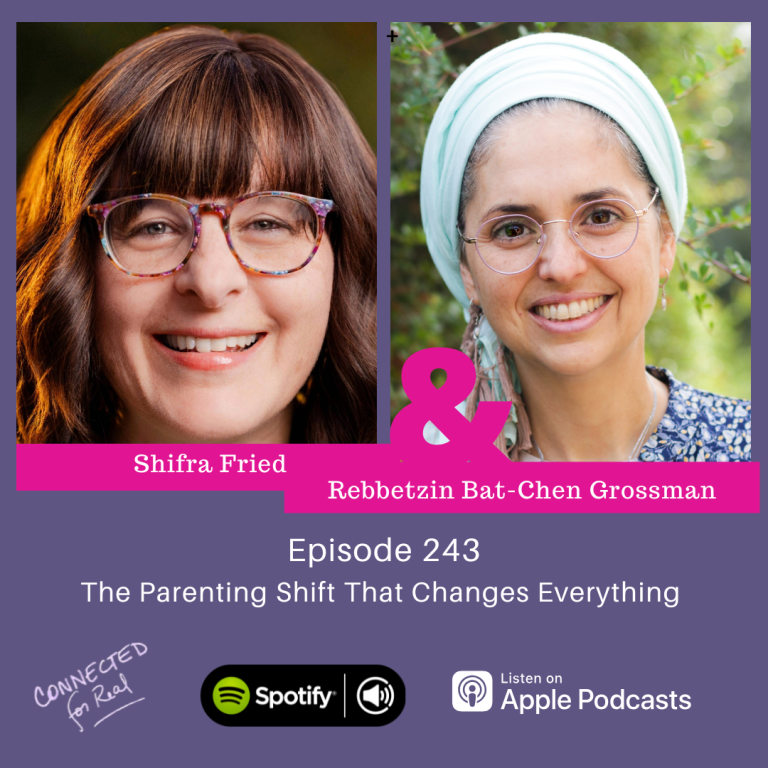
243. The Parenting Shift That Changes Everything
In this conversation with empowerment coach Shifra Freed, we explore why self-acceptance is the foundation for stronger relationships, how authenticity creates deeper connection with our children, and why teenagers need to feel accepted even when their behavior needs correction.
Transcript:
And we are live. Welcome everyone to the Connected for Real podcast. I’m Rebbetzin Bat-Chen Grossman, and today with me is Shifra Freed. Shifra, introduce yourself, and then we’ll get into our topic of acceptance and you. Okay. Thank you so much, Bat-Chen. I really appreciate you having me. I am an empowerment coach. I like to call myself empowerment because I love to empower women to become the best versions of themselves. I work with mothers of teens and preteens to help create greater connection with their children and greater understanding so that they could meet at a good place and enjoy those adolescent years together. Rather than it be a struggle, it should be something that they enjoy and connect on. Mm-hmm. I do coaching one on one, I do workshops, and yeah it’s a great place to be, helping- That’s really cool. Yeah. So how come you call yourself empowerment coach and not parenting coach, or parents to teenage coach or something like along those lines? You know, I have to tell you, it took me a long time to figure out my name. I happen to love the word empower. I, I, I just love it because I just feel like we have so much within each and every one of us, and I just want everyone to know that, and there’s so much power inside. And so empowerment says it all. Like, parenting does not at all say that. Mm. Parenting is nice, but it doesn’t give over what an empowerment coach is. Now, I have to tell you, most people have no clue what I’m talking about when I say I’m an empowerment coach, and I have to explain ’cause they don’t know what I’m talking about. However, that’s okay. I don’t mind talking about it because that word is just a very powerful word for me, and it really, really says what I really want to do. I really wanna empower women, empower mothers- To just be the best versions of themselves. So yeah. Yeah. And I, I feel like when you’re talking about teens and preteens, those are the years or, you know, the stage of life that pushes you to really find your true power. it sure does. And you can fake it in the beginning, you know? You can sort of like follow the rules and do the thing the books say, and you’re for the most part going to be okay. And then your teenagers, they know. They push the buttons, and they really dig to find your truth and their truth, and they’re trying to really, you know, get through all of the, the masks. And that’s when it gets very important to be empowered. It gets sticky, that’s for sure. There’s no faking it. There’s just no faking it. And, you know, people actually think they could, but eventually the whole thing just falls apart. So. But I think also, you know, the whole concept of fake it till you make it and feeling this need to be proper or, like, put together or decent enough as a parent, you know in face of your children. There’s this pressure that you think you have to be a certain way, and then you go and try to do that. And then that’s where the faking it comes in. It’s like, “I’m supposed to be this way. You know what I’m saying? Like, it, it’s not coming out as elegantly. I definitely know what you’re saying, and it takes a lot of energy to put on a show- Right within your own house. It’s one thing if you’re doing it outside, but if you have to put on a show in your own house, and the kids don’t want that. They want to see that you’re real. They really don’t wanna see a perfect mother. They don’t, because what that shows them is, it signals to them if my mother has to be perfect, that means I also have to be perfect. And it doesn’t give them that free reign of just, like, being normal, being okay with just who they are. It’s a, it’s actually a dangerous place to be. It’s not… It’s the opposite of what you want your kids to, t- to see. Yeah. But for some reason, for all these years it’s a recent thing that people started talking like this, that you should be real with your kids. Before that, like when I was growing up, are you kidding? It was a show. Everything ha- you have to be on your best behavior, even for your kids. So that means you had to look good. You had to, like, do everything right, be very gishick. Like, you know that supermom, picture that I grew up with for sure. Now maybe it’s a little less, but not much, honestly. You do everything right. You’re working full time. You’re, you know, you, you get, you know, many guests on Shabbos and Yontif. You put a 10-course meal together beautifully, and you’re doing everything just right. And you also look gorgeous, and you know, you have time for exercise every day. I don’t know. This, like, perfect supermom person. Like, that’s not good for our kids, ’cause our kids are getting wrong messages. And anyway, something’s gonna give. So if you’re really perfect in those areas, then behind the scenes there’s a lot of fallout. Mm-hmm. And we know that there’s a lot of fallout because we see. I, we see what’s going on in the world. I mean, there’s lots of kids at risk. There’s a lot of kids who are anxious and who are very, you know get into all sorts of situations that they shouldn’t be in. And a lot of it has to do with, like, not being authentic with them and not just showing them it’s okay to fall. It’s okay to make mistakes. That’s what the human condition is, and it’s really vital for them to see that. It’s not just a nice thing. It’s literally vital for them to see that. So I, you know, I, I share this with my mothers and, you know, I just… It’s so, it’s just so important. It’s really, really important. You know, you said, uh, empowerment is your word, and I think authentic is mine. A lot of, a lot of what I do, you know, I don’t put a filter on my Zoom. I don’t- Mm-hmm … want to seem a certain way. I cover my hair the exact same way as I do when I’m in my life and when I’m on camera. I made a very conscious decision from the beginning to show my real life and to speak the way I speak usually, and to forget words or, you know, fumble and mumble and sort of be myself when- whenever I am. And now I’m not feeling good, so you hear it in my voice a little bit. I’m, I’m like a little nasal. And I was gonna cancel, and then I’m like, nope, ’cause people are allowed to be a little sick, and people are allowed to be a little stressed, and people are allowed to just, like, you know, have those ups and downs. Authenticity is one of those things that, you know, just like empowerment, big word, people don’t really know how to, like pinpoint exactly what that means. But It’s so important. It’s so, so important, and it means so much behind the scenes and something that I connect to very much, very deeply. So you hit it on the spot. You definitely did. Well, I, I think that it’s really cool that you just said that about being authentic. That you just… Having this podcast, whether you’re feeling well or not, what, in whatever way that’s really cool because that is such a hard thing to do. Like, just to, like, show up, be whoever you wanna be and that’s it. Hi, guys, I’m here, and that’s it. You know, like, that’s so cool. I love that. And yeah- Absolutely … authenticity is amazing. Yeah. Yeah. I feel like a lot of us are waiting for the right time, for the right thing. When I look the right way, or when I sound the right way, or when I have enough confidence, or when I’m not as scared, or when something works out technically or whatever. Like, start with what you have. If all you have is a computer and Zoom, do it. And then you get a camera, great. And if you get a, you know, microphone, even cooler. But, like, really, I got the microphone, I think, two years into my podcasting. Oh, wow. Okay. I’m not even sure if anybody cared. I think it’s cool because now I have this really cute mic. It does look very cool. I feel very professional. But did I podcast for two years before that? Yes. So- Right … it, you know, I got it as a gift from from Black Friday. My in-laws bought it for me, and I was very, very grateful. Still this, you know, to this day, I’m very happy every time I unpack it. Right. I don’t think you should stop yourself from functioning, from showing up, from doing the thing that you’re meant to do just because- Right some technical or emotional reason of, like, I’m not ready yet. Right. So, so here’s us showing up the way we are and talking about things authentically. Yeah. And that brings us to the topic, acceptance, which I feel like, phew, it’s a big topic. You know? Yeah. It’s another one of those words. Right. Just accept, you know? And sometimes it’s very very loaded. Yes. So let’s talk about that. Yeah. It’s really a loaded question, and I find… A word rather so I find this a lot with the mothers that I’m working with, and because if they’re coming to me with some issue… Now, the mo- the mothers that come to me are not necessarily mothers of teens at risk. They’re mothers who are just struggling with their teenagers because most teenagers have a hard time, are having a hard time. That’s the truth. So I’m not talking about ones that are, like, you know- chas v’shalom on drugs or whatever, like that kind. I’m not even talking about them. I’m just talking about mainstream mothers of teens that they’re not connecting, they don’t understand them. You know, it’s, it’s just a mess. And what I’m finding is that sometimes let’s say the teenager is a little bit different than the parent, like in personality or in the, you know, the way they do things and all this kind of stuff, and like- Kids want to know that their parents accept them the way they are, and even if they’re a little bit different, and even if they show up in a different way and they’re not doing what the parents are doing, but it doesn’t make a difference. They want to just feel accepted for the way they are. Now, for sure, teens at risk, that’s even a bigger issue because then they’re doing things that are not appropriate, and their parents are very upset about that, and those behaviors are, are really at, at risk, right? So they for sure need to feel accepted. That’s for sure because there’s no getting them back unless they feel accepted. But even kids who are not doing such extreme behaviors, even kids who are just being a teenager and trying to explore a little bit and trying to try things out on their own, they need to know their parents love them, accept them, no matter what. Like, that is number one because if they feel that, then that’s the foundation. So they might explore, but they always know that their parents are there for them, they’re supporting them, they accept them. They’re not worried that, oh, if I do something wrong, my parents are not gonna accept me for this. They’re not gonna have that at all now, and that’s a really strong, way to keep them safe and supported when they feel accepted. That’s just really important for overall wellbeing. Now, I like to start at, even at a foundational level, so that’s talking about the children, but even for yourself, a person, a mother, she needs to accept herself. Sometimes, you know, you’re gonna do something that you feel like, “Why did I do that? That’s not right. That’s not the right thing. I don’t like that about myself.” So they kinda like, in a way, distance themselves, you know, like they’re not feeling good about themselves and that that’s not a good thing. Like, we have to be authentic, understand that we are human, human beings, and human beings are flawed. They’re just flawed. Like, we’re not malachim, we’re not angels. So if we’re not angels, that means that we make mistakes, and when we make mistakes, we have to accept ourselves no matter what. Yes, I made a mistake. I’m gonna try to do better next time, but it’s okay. It’s okay. And just accept yourself for who you are. And that, if a person could do that and work with, you know, with themselves and, like, be okay with who they are and accept themselves, then the whole energy around them is gonna change, and their kids are gonna feel that acceptance. It’s, it’s really is a domino effect, and the first person to work on it is with you. And that really would make a very, very big difference in your home, in your… with your children, with your husband, you know, it’s, it’s really a game changer to start that inner work of accepting you for who you are So that’s really powerful. I’m gonna be a little bit, you know, me, and tell you what the listener’s thinking. Okay. And the listener’s probably going to be like, “How’d you read my mind?” But a lot of times the point of parents and being the way that we are, and the reason why the kids don’t feel accepted is because they’re doing unacceptable behavior. And as a parent, you feel like you need to make that very clear, this was unacceptable. So how can I accept you if the behavior isn’t acceptable? And that’s where it gets really tricky. Sticky. So yeah. Um, and of course, you probably have a great answer for this, but I’m thinking- I have a great answer. Sounds great when you’re just talking about it in theory, but there’s, you know, there’s real issues that people are dealing with and, and it’s like, uh, I don’t know if I could accept- Right … this. It’s too, it’s too unacceptable. Yeah. You know what? I get this all the time, so don’t worry about it. Obviously, this is an obvious question because life is real and there’s really a lot of problems out there. So I totally get that question. And I also … I have a real answer. And the answer is, is, I mean, not that it’s so simple to put it into practice, but this is really where you could start. So the inner work is first of all understanding who you are. Okay? So each of us, we are a tzelem Elokim. We’re a piece of Hashem, a piece of divinity. Every neshamah is a piece of divinity. So every soul, when Hashem created the world, he created the world and he created man by blowing into man a piece of himself, the neshamah is a piece of Hashem. So what does a piece of Hashem mean? Okay, we might have heard this many times, learnt it in school, right? So basically I have an analogy. So the analogy is you have a sun. Okay? The sun is 93 million miles away. The sun gives us warmth, and the sun gives us light. Now, we are not close to the sun because if we were, we’d get burnt up. So what does the sun has? The sun has rays. The rays of the sun has the properties of the sun, and that’s what reaches us in order to give us that warmth and give us the light. Now, the properties of the sun is in the rays. And we, k’viachol, so to speak, are the ra- our neshamah is like the rays of Hashem. Hashem is Hashem. His rays, so to speak, are the neshamah, the souls that he put into each and every one of us. So what is the neshamah? What is this piece of divinity that’s put into us? This is a piece that has the properties of Hashem himself. What are the properties of Hashem himself? And we say the Yud Gimmel Midot, the 13 attributes. Hashem, Hashem, kel, rachum v’chanun, erich apai. Hashem is kind, slow to anger, compassionate. Many, many attributes that Hashem has, and we are neshamah, we are the soul. So that means we have everything that Hashem has within him, we have within us. Just, just, like, think 20 seconds about this right now. Just internalize that thought. We have the attributes of Hashem. Just imagine how powerful we are. Imagine how much lays dormant within each and every one of us if we literally have the attributes of Hashem himself. So that’s awesome. That’s just an awesome thought. And if we could literally internalize this, like r- practically right now, everybody every morning when you wake up, put it on your phone to, to remind you, put it on the refrigerator, put it on a wall next to your bed when you wake up in the morning and when you go to sleep at night. Take 30 seconds to internalize this. It’s an awesome thought. And when a person does this every day, like I call this a mantra, right? Say, you know, say something that will help you, you know, get to this… So either you put it on a paper or you have a mantra that says, you know, whatever works for you really. I don’t like to give over my mantras because my mantra works for me, doesn’t necessarily work for somebody else. But like saying something to the effect of, you know, I am a piece of Hashem and I have all of his… You know, I could just say it just like that. I have all the attributes that Hashem has within him, I have within me. If that works for you, great. If it doesn’t, think of something else. But the point is to internalize this message every single day. Twice a day is even better, but if you could do it once a day, that’s great. The point is, is that it literally is gonna seep into you, and it’s literally gonna change who you are because when you understand this and you get that, you’re a different person. You’re literally a different person. Now, if you’re able to do that for yourself- then you’re gonna look at everybody around you different as well, right? You’re gonna look at your kids, ’cause then you’re gonna say, “They’re also a neshamah. They’re also etzem Elokim. They also are this powerful and have all these attributes of Hashem.” The whole world looks different when you see it in yourself, and then you look around and you see it with everybody else. So it’s really life-changing. And I’m telling you from firsthand experience. My life has changed because of that. I literally see it. It’s just awesome. Absolutely awesome. And I see it in my clients. Now, is it the only thing and then you’re, you’re a changed person? No. Obviously everybody has their own healing because if somebody is traumatized or they have very low self-esteem, I mean, self-esteem is, like, the biggest sickness of our generation, low self-esteem, that’s for sure. So if a person has it so deep and they have to work on their own healing, so okay. It, you know, that’s okay. But this is certainly a start. Like, if you could start the process with this, and then work on your own personal healing, then that’s great. That’s, that is a way to go. It’s, it’s really awesome. You know what’s so beautiful? Because I told you the four pillars of my podcast is God, marriage, business, you. And which one do you think you wanna talk about? And you’re like, “Oh, I wanna talk about you,” ’cause accepting yourself is so important. But really what you’re saying is that it’s all, all goes back to God. Yeah. And when you understand that accepting yourself is accepting the Godliness within yourself- Yeah … then really we could have made this the God, you know, show. Whatever you need it to be. No, it’s really, it’s so, it’s amazing because you really… I saw your face and I said, “Should we do acceptance and God?” And you’re like, “No, I don’t think I could do it.” But then you start talking and you’re like, “Yeah.” “Well, this is what it’s all about.” It is so, so powerful to understand that really what we’re accepting is not ourselves, it’s the Godliness in ourselves. And once you understand that, and you also understand that God made me imperfect, like we were talking about authenticity and being who you are and where you are and not trying to be something different. If God wanted to make me perfect, He would have made me perfect, and He did not wanna make me perfect for a reason, because He needed me to have lack. Because lack is what is here in the world for me to fill, and therefore I need the lack in order to fulfill my purpose in this world. And so the lack is part of the perfection. Yes. And accepting that I have lack, and that I’m not perfect, and that my kids have lacks and they’re not perfect, and that God made us Godly in, you know, in a, in a sense- So that we have all the attributes and we’re able to deal with the lack, and we’re here on purpose. It’s all so deep. It’s very deep. Like- Yeah … you guys, you thought you were coming for a regular- Light entertainment. Right. But really it’s so powerful. I’m sitting here thinking of my teenagers. You know, I now have almost officially four teenagers. Good luck. Yeah. Yeah, my, my 12-year-old is turning 13, and my 19-year-old- That’s, that’s a teenager. You know, I think they’re getting younger and younger, honestly. Yeah. And then my n- That’s why I say preteens. Uh, it’s 10, 11 is already, you know. Yeah, for sure. Um, so yes, I have a 19-year-old that is turning 20 right after the 12-year-old turns 13. So- Oh, okay. You’re kinda- You know, for like- Yeah … a whole month and a half, I’ll have- Right four teenagers. So yeah, it’s really, it’s really powerful to think of teenagers because as we said, when kids are little, they’re little. Like, you could sort of like pull the wool over their eyes and they’ll, they’ll, they’ll bite it. Eh, they’ll- Yeah … you know, cooperate. They’ll be bribed into doing things, whatever. But there’s a certain point where a teenager, and this is how they’re programmed, thank G-d, to start to look for their own truth and to really find what they wanna believe in, and not to have to follow anymore, but sort of like own their own opinions, and try to figure out what do I believe and what do I want, and how do I wanna live this world? This is the time to do it. And I remember my father told us that, you know, while we were teenagers, he sat us down- Mm … and said, “This is the time to figure yourselves out. This is what G-d wants from you right now. ‘Cause if you don’t do it now, and you try to gloss over it, and you try to pass it and say, ‘Oh, it’s, it’s not, you know, I’m just gonna stay all good and nice,’ and sort of like let it pass me, it’s going to hit you later and it’s gonna be much harder and much heavier.” Yeah. “So do it now.” And he really encouraged us to ask questions and to look into why, or, “Why am I religious? Why do I wanna be this way? Why do I even, you know, do these things?” and I think that’s the reason why we all stayed we all stayed on the path- Terrific … is we, we got this- Good. I, I never heard of anyone say that. That’s good for him. Amazing. Oh, well, my father- That’s good … is big, big, educator, thank G-d He was on my podcast too, and that episode was the most popular episode. Yeah. People still go back and they- I have to look at it. Okay … yes. I think it was two years ago- Wow … that recorded, and people still go back and listen. What’s his name? Very good. Rabbi Chanoch Gez. Okay. I gotta take a look. Yeah. Oh, yeah. Yeah. I’ll also send it as like, I’ll, I’ll pin it down below for people who are listening. Okay. But yeah, he’s, he’s really amazing in that way. And I think it was really true parenting. Yeah. You know? One of the things he also says is that you’re not raising children, you’re raising adults. And if that’s how you see it, then you’re not going to be looking for children who are just following orders, and listening, and cooperating. You’re going to be looking for humans who are going to be choosing correctly, and thinking properly, and using their own- You know, their own backbone to live life Yeah. Right. Amazing. Yeah. That sounds great. Yeah. Wow. Yeah. Yeah, so let’s get back into accepting, ’cause I think accepting ourselves is a very difficult thing, let alone accepting our teenagers and their unacceptable behavior. So I’m going back ’cause, I think that there’s still a question up in the air. The behavior is unacceptable- Yes but the kid is acceptable because he’s my kid, and he’s forever going to be my kid, and he has a spark of God, and so do I. And so I want to accept my kid. I’m talking in the name of all listeners. Yes. I hope you guys appreciate my … my getting into your head. We all wanna accept our kids, but we can’t accept the behavior. So how do we put down boundaries? How do we create safe spaces for everyone to feel good? And also when there’s younger kids around, when you have, you know, people living in the home and, and you want- Right … to keep a certain, atmosphere. Right. 100%, yeah. So I actually have something that I call the roadmap, and the roadmap is kind of like a way to help you, get to a better place. It’s not just one answer. I’m not gonna just have a one-word answer for this question. This is a big question. Obviously, if it was so easy, then everyone would be doing it, right? You know, so there’s a lot of different angles that we need to go in on. So, let’s say the first, the first thing would be, like, we’re talking about this foundational, like, who are you accepting yourself? That aspect is a really big aspect. It’s not like, “Oh, okay, I’ll take care of this and…” it’s so big that once a person would get to that place, right, and they start internalizing these messages, and they start getting to this place of accepting themselves, and they start having more confidence in themselves, they start seeing the world around them, they start acknowledging their emotions and validating them, and they are feeling healthier, and their inner world is becoming more, you know, stronger, right? It’s not just, “Oh, that’s nice.” It’s like they’re becoming a stable place for their teenagers and their kids to be next to. Like, and their steady is gonna be borrowed by the kids, basically. Like, those kids are gonna like, “This is our rock. This is our strong person. We’re gonna hold on to mother because she’s got it. She’s confident. She…” You know? Like, wow. Like, so it’s not, it’s not min- it’s not a minor thing to- what I’m saying. It is so big, you know? So that’s why that is, like, number one, so important ‘Cause when you feel strong and you feel confident, your kids are gonna feel that strength. Yeah. And that’s healthy for them. That’s like, wow, you know? Also, then you’re then when you have boundaries, it’s like they’re gonna listen to it more. You’re not wishy-washy. You’re not like, “I don’t know. Should I, shouldn’t I? Oh, I better let them because who knows what they’re gonna do next?” no. You’re stronger with yourself, so then you’re like, “You have to come back by 10:00. That’s the rule. I’m sorry.” you feel more confident in what you’re saying. They’re gonna feel that confidence. They’re not gonna drive you as crazy because they’re gonna know. They might in the beginning when they, you know, they’re gonna try. But if you maintain your boundaries and they feel that confidence, then there, there’s more likely… I’m not saying every time, not saying always. But you’re creating an atmosphere of, you know, where they wanna listen, they wanna, you know, connect. Because I have to tell you one thing that’s so important. And listeners, I want you to hear this loud and clear. The idea that teenagers and all kids, they want to be good. No kid wants to be bad. Nobody wants to drive their parents crazy. Nobody wants to do the wrong thing. Everybody wants to do what’s right. Which brings me now to the second pillar of my roadmap here, which is understanding your teens, bridging the gap. Because your teens need people to try to understand what they’re going through. We are not understanding the world that our teens are going through right now. We’re just not. Whether you’re in Israel and you hear the siren every other minute, whether you’re in America and you’re dealing with all the other stuff that you’re dealing with, or anywhere else in the world for that matter, it doesn’t make a difference. The antisemitism that’s going on, the technology, the AI, the this, the that, everything that’s going on, it– the world is so fast-paced. We don’t understand what they’re going through. We have no clue. Literally have no clue. Because you’re younger than me, but someone else is younger… It doesn’t make a difference. We all have gone through different experiences. And none of our experiences are what our teens are going through now. Right. You know. You know, I remember one of my daughters, she’s 24 now, and I have a 19-year-old. She’s like, “I don’t even get what she’s going through.” It’s five years. Right. Five-year difference, she doesn’t get what she’s going through. That’s crazy You know? Yeah. Yeah Yeah But you can believe it. Literally, you can believe it. We see the world changing in front of our eyes. We see it unbelievably. It’s just wow. And it’s- It’s crazy. Yeah … now, in the past they were talking in our schools about, don’t have a TV, and TV’s bad for you, and, you know, get rid of your T- But the TV. I’m talking to my kids, I’m like, “Guess what? We don’t have TV in the house, but we have devices,” you know? And I- Which is much worse than a TV ever was. Exactly. Oh my God. Exactly. And it’s like, it’s interactive, it’s constantly calling for you, you’re constantly touching it. There’s things happening on it. I have to have it. My friends are gonna leave without me. Uh, you know, my 12-year-old does not have a phone because we don’t give phones until you have to have it, have to, have to have it. Mm-hmm. And my husband’s very upset about the fact that high schools are demanding cell phones. Right. But my 12-year-old says she misses activities. She goes to the meeting place, and they end up canceling it on the phone last minute. And people who are on the WhatsApp groups, they see it and they don’t come, but she’s waiting for everyone, and it’s very frustrating for her. Mm. Mm. And I see that. And I say to myself, “I wish I could solve your problems, but I’m not gonna give you a phone,” you know? I, but I get it. I get what she’s going through because it’s so miserable to be- Yeah … that kid that isn’t in the loop, or to be- Yeah … that person who, “Oh, I forgot. You don’t have a phone,” you know? It’s- Right … it’s very difficult. Very difficult. And, and so doesn’t mean we need to give in. Of course not. Exactly. But we feel their pain. I’m with you. I get it, you know? But, and also, like, when we as parents are proud of who we are, and proud of what we maintain, and we keep our boundaries, that’s also so important. It’s important for them to feel that energy of, like, then it becomes a pride. Like, we don’t do that in our family. That’s a really big thing. You know, rather than just giving off the list of rules and just like, “This is the way it is, and that’s it,” you know? Like, you know, it’s like everything has to be done with, like, a pride, with feeling good, and this is the way it is. And, and also understanding, trying as much as you can. Because also we don’t exactly understand what they’re going through. Right. I don’t think we’re just not going to. But as much as we can, we tell them, you know, like, “I’m so with you. I really wanna hear what you’re going through. I know I didn’t go through it myself, but I want, you know, I, I feel, I feel for you.” You know, maybe you could tell them your experiences when you were a teenager, and the things that you had to go through, but- Get in it with them. Get into this Parsha with them, because if you are, they’re gonna be like, “You know, my mother really cares. Like, she just really cares.” And that is worth so much. So, so much. Also, I wanna remind everyone that there are certain experiences that are universal and are not time-bound. So everybody had an experience when they were left out. Everybody had an experience where they felt like they weren’t heard or that they, you know, didn’t fit in or something. All these things- Right they’re universal. So even- Yeah … though right now the technicalities are different, your experience is very much the same. And when you can connect to those things, then, oh, okay, this is normal. You know? I’m feeling a f- an emotion that I’ve maybe never felt before or a very uncomfortable feeling, but I know that I’m not crazy. I know that I’m not alone. It’s okay. It’s a big deal. Yeah. Yeah. And also, when a parent shares their experiences with their kids, the kids feel more connected to them. Yeah. So it’s, it’s really helpful. It really, really does help when, you know, when you, you’re able to share an experience that’s something similar to what they’re going through. So that’s, that’s very, very, very helpful. You know, I have a teenager who doesn’t want to c- you know, “Ugh, leave me alone. Ugh, you and your stories. Ugh, whatever. I’m not talking to you.” You know? Oh. And like, I, thank God, thank God I have enough teenagers around that you don’t know who I’m talking about. Right. But, It’s, it’s also difficult for parents who are trying to be so nice and helpful and so, you know, listening and so attentive to accept that. ‘Cause we’re talking about acceptance, and sometimes acceptance is accepting that you’re not going to do that, like, superwoman mom, you know- Right … mom of the year thing- Right where you’re sitting down and talking and having, like, a conversation into the night or giving them your opinion or- Right … listening and, and connecting or whatever. Maybe accepting is being okay with the fact that they don’t want that right now. Exactly. Yes. Yes. But that they should know that you want to connect, but they have every right to say no. Right. And for whatever reason, and it’s okay. And accepting… Well, you wanna accept the fact that you’re still doing the best you can, but it’s okay that they don’t want it. Doesn’t mean that you’re bad, that you did anything wrong. This is what they’re going through in this time, and this is what they feel. This is what they’re feeling right now, and that’s okay. And so that piece, though, is important to remember that it’s not, you know, a lot of times people are gonna take that to heart and feel guilty about it and feel like they did something wrong. But, you know, then, then you’d wanna, like, take a look at yourself and take a look at that trigger and say, “How can I heal that really?” Because- It doesn’t mean you did anything wrong. You’re doing the best you can. You’re trying your best. They’re saying no. That’s… And it’s normal. It happens to be very normal that teenagers are not interested in talking to their mothers. Honestly, they’d rather talk to their k- their friends. That’s the truth. That is the stage, and that’s the normal stage. If they’re talking to you too much, there’s probably something wrong. So honestly, you want them to know that you are there for them, you’re their support, you’re their rock, and when they need you, they will come to you. But mostly they’d rather be with their friends, you know? Right. And that’s, and that’s the reality, and that’s, that’s a good thing. It’s actually a good thing. I like that. Yeah. I have a mantra that’s, it’s not about me, you know? Yeah. When somebody else rejects me, it’s not about me. Right. It’s about them not wanting interaction right now, or it’s about them having their own issue or whatever. But it’s really helpful because I tend to feel other people’s emotions and want to, you know, help everyone- Right … be that person who’s, you know, really, really helpful. And then when somebody doesn’t want my help or somebody pushes it away, I used to get really hurt, and now it’s a very good reminder to just know it’s not about you. Right. It’s okay, you know? Right. It is completely neutral. And I think that also helps you accept, because when, when you think it’s about you, it makes it very difficult to accept. Like, there… It can’t be. It can’t be that I’m doing the wrong thing. It can’t be that I am, you know, messing something up or that they don’t wanna talk to me. And instead you’re like, “It’s not about me. I accept that they need space. I accept that they’re not ready right now. I accept that they have their own story. It’s fine.” Right. It’s so much easier to live this way. Yeah. Definitely easier. Yes, absolutely. Yeah. But we’re talking about years of work, so Yeah, exactly. Which also reminds everybody that we’re all human becomings. Every day we’re becoming the version of ourselves. And I love how you were talking before about step one, which was the fundamental stage of really acknowledging that you’re a piece of God, and that you have all of those godly attributes within you. And you used the word dormant, which was so powerful, because realizing that it’s there, you just have to wake it up. It’s so, it’s so incredible. And then I think to myself, those are the types of things that are the 80/20 rule, you know? Where it’s like, if you just do this, 80% of the work is done. Really. And it feels a little bit weird to say, you know, I have this thing, the, the Guide to Unravel Overwhelm, and it’s free for everyone, connectedforreal.com/guide. The Guide to Unravel Overwhelm is all about 10 minutes. You pick one thing and you start doing it, 10 minutes. It’s not a big deal. It’s so little, but it will change your entire life. Same concept of find something that, you know, once you find it, the one thing you need to click into place, and then you start moving the ball and it starts rolling, and it starts building up, and it starts doing its thing. You become a different person. And I talk a lot about being that vessel and expanding your capacity and being able to become that person who can hold all the things that you want to hold and that you’re here to hold. I think that what you’re talking about is really exactly that. It helps you lean into the vessel that you’re in and expand it and really create something completely different that you didn’t expect you had the capacity to hold. Yeah. It’s, it’s so powerful. It’s so, so powerful. … Yeah. And like you’re saying, the 80/20 rule, like when you get in at the foundation You don’t know what’s gonna come up, but it’s just the whole world is a different world. It’s not just fixing things, you know, at its place. It’s like getting deep and down and dirty, and you just go right to the source. Things come up in such beautiful ways. It, it’s just, it, it’s really a big deal. It’s really a big deal. Yeah. Sometimes people get frustrated with me. I’ll have, I’ll have a client, right? And she’ll be, “Just tell me what to do. My kid’s driving me nuts. Just tell me what to do.” And I’m like, “You could go to any parenting coach for that. You don’t need me for that.” Like I… Let’s just like dig a little deeper. You know? Like I once actually had somebody who came to me and she signed up for this package, and she’s like, “Fix my 13-year-old daughter. Fix her.” And I’m like, “Okay. So I just want to tell you, I want to work with you first, and if after we’re done you want your daughter to come to me, I am thrilled. No problem. But let’s first… Because you’re really the foundation of your daughter. Like, when you change the way you do things, she’s gonna change too.” And a very cool thing happened. So after about nine weeks, she said to me, “Okay, can you talk to my daughter now?” and she really made progress in those nine weeks, Baruch Hashem. And I spoke to her daughter. Her daughter had met me on one of the Zooms, and she knew that what her mother was doing. That’s why I had the nerve to ask her this question, otherwise I wouldn’t. I said to her, have you seen any change in your mother?” And she said she sees that she’s much calmer now. That’s just awesome. Her 13-year-old daughter that was driving her nuts, and she probably still is driving her nuts at a certain angle, but her daughter is seeing that her mother is making the effort to make changes in her life, and she got to the point where her daughter, who’s driving her nuts, could see that she’s calmer. That is awesome, and that is the power of you. That’s what it is. And it’s not even big shifts. It’s like little shifts. It’s so doable. You know, for years I, you know, I, I never planned on doing this. I’m actually a CPA by profession, an accountant, okay? It was not at all anything I ever thought about. I was just doing this work on my own. I just wanted to make changes in my own personal life. I got to a point where I was, like, finished at, at a certain point, and I was like, the next step was Dina Friedman. I, I am a Dina Friedman coach, and she was offering a coaching class, and I’m like, “Well, well gosh, I gotta teach the world everything I just learned” because, you know. So I was like, “Okay, let me do the coaching.” I still didn’t make a decision, but I was like, “Okay.” But it’s just like this stuff is awesome, and we really, it, we really… It’s so doable. That’s what it is. It’s really doable, and it’s just awesome. It’s just you have to make the decision. That’s what it is. You have to make the decision, “I wanna make a change.” And the world around you changes when you make these shifts, so. I love that you said you have to make a decision that you want something to change because most of my clients, you know, we have a discovery call, and it’s an hour-long call. We go deep, and we talk about what we’re going to change and what are our goals and whatever. And once we get really, really deep, all this for free ’cause I really love everyone and I want everyone to know what is possible. And then I say, “You’re welcome to come work with me. Here is how to, how it works.” And then the ones who commit, which is usually, you know, almost everyone, thank God They don’t even start working when they start seeing results. They sign up And before the first session, like when they show up to the first session, it could be a couple days later. It does not take a long time. Like, you sign up and you schedule your first session for whenever is available. They walk into the first session on Zoom and say, “I just have to tell you, I already see results.” And there is this excitement in their voice like, “I can’t believe it.” And you did nothing, but you did everything. You committed to yourself. You committed to wanting this to change. You committed to actually seeing the difference, being willing to have hope that things could be different. And it’s, it’s mind-blowing. Mind-blowing. Like you said, it’s willing to commit. It’s, it’s wanting it. Yeah. Yeah. So sweet. Yeah. It’s so sweet. Yeah. Yeah, yeah. Okay. Let’s get back to your roadmap- Mm-hmm … ’cause I really want people to hear it all the way through. So the foundation is knowing that you have a divine s- you know, spark of God, and that all of God’s attributes are within you and you need to just tap into them. Then there is step two. Bridging the gap. Bridging the gap between you and your teens, understanding them, you know, trying to be… You know, get it, step into their world. Okay? Oh. So that’s the second. Mm-hmm. And then the third is really self-care. I call it lead steady, but it’s really self-care, and it’s basically that you have to really take care of yourself in order to be able to give to your family. So you gotta fill up your cup, let it overflow, because once you overflow, then you’re at a much better place to be giving, generous, magnanimous, sweet, right? If you’re, like, totally depleted and you can’t, you know, do any of… You’re just like a shmatta, and everybody… You just do everything everybody tells you to do, but you don’t take care of yourself, nobody respects you, first of all. You’re not, you’re not getting the appreciation, the gratitude. People just expect it. Yeah, that’s what mom does. You know, they’re not looking at you like a queen. You want to be the queen who is there for your children, and that is when you are looked at with respect, and they appreciate what you’re doing and they have gratitude. So self-care is not selfish at all. It’s actually the best thing that you could do for your family. When you give to your family, I, I say the best investment in your children is an investment in yourself. Amen. Absolutely. Hands down. And marriage, too, I would say the same. Of course. Of course. Yes. Yes. I, I believe that when your marriage is strong, then your parenting becomes easier because same work. You, you know, in order to create a strong marriage, you have to work on yourself and strengthen yourself and know who you are and what you’re worth. And then there’s something really powerful that happens as a couple- that trickles down to the kids. So I don’t even see the need to work on the parenting, because you’ve already done so much work on yourself and on your husband. By the time you get to the kids- I agree … the ans- the answers come out on their own I agree. Yes. I, I definitely agree with that. Yeah. Yeah. And especially if you come in as a united front. So that’s, that’s like the biggest gift of all. I wanna say something about that. Yeah. I wanna say something about that, because I always was very frustrated that we don’t have a united front. You know, I don’t like junk food and my husband’s giving my kids junk food for, you know, Shabbos treats or whatever. Mm-hmm. Or you know, all these different things that we’re not united front. Right. And I went to a parenting course, and she said, “I want you to just know that kids know the difference, and kids are capable of holding the difference. They know that this is mom and this is dad. They know that there’s rules for here and rules for there. They’re so smart that when there is a substitute teacher, they know that they can change their names and they can go out and eat gum, that they can do all these things because she doesn’t know the difference.” And they’re not sitting there expecting the teachers to be the same. They’re not expecting everybody who’s an adult to all have the same rules. They know. Right. So she said, “Stop trying to be a united front, and instead turn into a respect- respectful front.” So I respect dad and dad’s rules, and so I’m going to, together with you guys, hold those rules even though I may not understand them, maybe I don’t like them, but who cares? It’s Abba. That’s what he says. And the father says, “You know, I don’t get it. Mom wants us to all wear yellow socks and I don’t really like yellow, but who cares? We’re gonna do it anyway, ’cause that’s Mom.” So suddenly you turn into this human, very authentic, you’re allowed to have an opinion, and you’re allowed to not like something or not wanna do something, but you still learn to respect. And it’s so powerful, and she told that. I- it took away all of the pressure of having to be the same person. Yeah. It took all the pressure off of trying to be like, “Fake it because we’re supposed to be the same front, and really I don’t like what you like, and I don’t understand, and I don’t appreciate, and I don’t accept, and I don’t blah, blah, blah.” And then we would fight behind closed doors about the rules that we’re making, and, you’re not backing me up,” and all these things that were very frustrating to me as a, you know, trying to be a good wife, blah, blah, blah. And then all of that disappeared when I realized, oh, the kids are capable of holding those things. They’re capable of being- Nice Okay. Yeah. I love it, yeah. It was But you, but you’re still, now you’re … So it’s so, it, it’s great. What, what you just said is great and I had not heard it in that way, but you’re still a united front now. Exactly. But you are united, you’re united front with your opinions, and you’re allowed to, like you accepted that you’re allowed to have your separate opinions. So that’s- Exactly … that’s amazing. Yeah. I think, I think like all the other fancy words that we’re using, united front has this connotation that you need to be the same. On the same. Right. Okay. That you have to be on the same page. Right. That everybody has to agree. Right. And that you need to show up, you know, the same to your kids. And what we did here is we changed the definition, but we kept it a united front because when you are united as a couple, you know- Mm-hmm … husband and wife are very different. They’re not expected to be the same. Right. And mom and dad are not the same person, and they’re not- No … expected to have the same capabilities or the same personalities or the same anything. Right, right, right. And that’s okay. And we made- Right … that, you know, unity is not about all being the same. It’s about accepting each other’s, you know, look, talk about acceptance. Acceptance. Yeah. Right. I like that, Oriah. Yeah, I like that. But really, it’s all about acceptance of the other- Mm-hmm … and being okay with the fact that we’re both in this together, and we’re very different, and we have different opinions, and we don’t actually agree. But I’m willing to respect it and accept it. Right. Right, right. That’s great. And I’m gonna pull that back just to like finish the thought, to the spark of divine, right? I’m willing to accept and respect that someone else has a different opinion, and that they live their life differently, or they have different choices because they too have this spark of God that- Yeah has all of those attributes that they can tap into. And so when I am not fighting it and resisting it, and sort of pushing it away- Right … I’m able to allow it to, you know, wake up and sort of tap in. Exactly. Beautiful. Yeah. Love it. That’s great. Yeah. That’s really great. All this redemption energy. Yeah. Oh my, oh my. Okay, so if you want I could finish- Yeah, finish … I have two more of my roadmaps, so if you want me- Yes, yes … to slot that in. So the, the fourth one is, uh, what I call find the keys to their heart. And so a big part of that is connection before correction. That’s a very big part of what I talk about, that you have to have a relationship. You can’t just be barking orders at your kids, or you have to actually connect with them, and then they can, uh, you know, then they’ll appreciate if you have to correct them for something, then at least there’s a relationship. If there wa- no relationship, that’s just a disaster. And then the other idea of which you probably have heard of the, uh, five love languages, we talk a lot about that because you could really, you know, work really hard on trying to connect with your kids, but your love language and their love language is totally different, and they’re just not receiving that love. And so that’s super important to, um, try to figure out what works for them and, you know, give, give it to them, you know, the different love languages. I’m not gonna g- I don’t… Do you want me to go into the details of that or not really? ‘Cause I’m just- I love the five love languages. Yeah. It’s amazing. I mean- It’s… I mean, I could give an example of something that ha- that happened that I, I just… It’s like, it’s, it’s so sad, but it’s so telling, um, very quickly. So I, I know this person personally who, um, for years never felt like… Now she’s, she’s now in her 60s, okay? For years, as a child, she never thought that her mother loved her. Um, she was the person that needed touch, hugs, kisses. That was her love language. Her mother’s love language was action, doing things. There was a total disconnect. And she went to Israel for a couple of years to study and for years she just never felt it, that her mother was there for her. And her mother, you know, was doing things behind the scenes and everything, like when she was in Israel and what she realized was, and this was ob- obviously you can imagine how sad this is. We’re talking about a, a woman who for maybe 45 years till her mother passed away never felt her mother’s love and didn’t realize it until one day she was looking at these letters that she got from… Letters, okay? In those days, there were letters, not email, right? Letters that she got from her mother, and she was, like, just reading through them, and what she came up with after 45 years is her mother was talking about what she was doing for her. “I went to this person to send them this for you. I did this for you. I did that for you.” Did lots of acts of service for her daughter, and she was seeing it as a pattern throughout all the letters that she had received. It dawned on her at 45 years old that her mother did love her, and she was just totally different love language than her daughter. She was totally not a huggy person, or, you know, not at all a touchy person. And she thought all these years that her mother didn’t love her. That, to me, is like so sad. And her mother passed away. Like, this was like maybe during Shavuot she was looking. And like, her mother never felt, you know, that closeness, and yet she loved her daughter. But it was such a disconnect. So sad. So it’s just, you know, so important to just give the way that a person could receive it and feel it and, you know. So that’s like a big part of it also, like really, that aspect. And then the, the fifth part of it is more of like the technical part. Like, okay, tools. Okay, what should we do, you know, for this specific situation, for that… But that’s like the, that’s like the last, honestly. That’s really- Right … the last thing because everything else, you know, has to fall into place. And then when it does, 80, 80/20 rule, like you said. Like, everything else is gonna just, you know- Right … is gonna fall into place. And also the last thing I wanna say is that it’s really a journey. Everything’s not gonna be perfect. Doesn’t mean when you’re done with this, you know, you’re gonna have a perfect scenario. But you will have an understanding of yourself. You’ll have an understanding of your teen. You’re gonna have a let go, let God mentality. You’re gonna be like, “This is their journey. This is my journey.” And, and that whole, the whole energy is just gonna shift, is just gonna be okay. It ju- Yeah … everything’s okay, you know? Also, when your kids grow up and they’re not teenagers anymore, now you have all these marrieds that are still your children, and now they’re adults. And it’s a different relationship with them. And that, too, is something that you need to accept and lean into and love and be willing to experience. So, you know, think of yourself and your relationship and how it has evolved with your parents or with other people around you. You are no longer the same person. You’ve grown so much, and you are on this journey, your kids are on this journey too. And so it’s, you know, it’s very important to get the help now to alleviate a lot of the stress and the, the hardship and, you know, all of the stuff that’s happening right now with a teenager. But also, it’s an investment in your relationship with another human being who is going to be growing up to become an adult and have something, you know, connection with you forever. So I really love that. Can I just add one thing to that? Yeah. Also understanding that you’re a role model for your children. So when you make the changes in yourself, you can’t give a greater gift to your kids than role modeling change, growth, process. You are literally giving them a gift. It’s just unbelievable. So just imagine what a better parent they’re gonna be. Right. What a better wife, husband they’re gonna be, because you have role modeled this change and growth. It, it’s- Um- … the greatest gift you can give. I, I love that you brought that up. I really do believe that. Oh, so beautiful. You brought up the five love languages, and I’m going to also, uh, link it down below. I have a YouTube video, one of my first ones, so it’s cute and old. It’s very old. Um, it’s called The Five Love Languages and our Relationship with Hashem, with G-d. Hmm. I, when I first learnt the five love languages, I started trying to find the parallels of us with G-d and not, you know, how he talks about husband and wife. It was before he came out with the kids also, all the other books. It was like right, you know, in the beginning. It really tickled me. I wanted to understand, how do we connect to G-d in, you know, with words? How do we connect to G-d with, uh, you know, the different, um, the different five love languages? And, and then touch really, really, um, interested me. And I’m gonna give a little, uh, um, what is that called when you give them a spoiler? Yeah. Spoiler. I’m gonna give a spoiler because I really feel like it’s so powerful. But, um- Touch is really, really interesting to me. I feel like… Anyway, I went to my husband, and I asked him what he thinks, and he said that going up to the Temple Mount in purity, that is touch. The closer you are to the Temple Mount, so people feel it also when they go to the Kotel. They feel it when they’re in Israel more than when they’re outside of Israel. There is this presence that you feel. There is this touch, this grounded-ness, this actual physical feeling that you feel when you are close. And the one I came up with as a marriage coach, of course, was intimacy, ’cause I feel like that is when you actually feel G-d. So those were our two answers, and I feel like those are very powerful. But the YouTube video is actually really, really, amazing, even though it’s cute and old. Ugh, acceptance. Is there anything else that’s coming up before we wrap it up, or do you want to just sort of pull it all together for us? So yeah, you know, just pulling it all together, I think I, I think I said a lot. I just feel like working on yourself, working on accepting yourself, remembering who you are, the godliness within each and every one of you, tapping into that is really the way to go through this journey in this world, to connect with Hashem, to connect with your family, your children, your husband, your, your friends, everyone around you, just tapping into the power within, accepting who you are, knowing that you are the way you are because that’s the way Hashem made you. There’s no… That, that is it. It’s like you didn’t do anything. Hashem wanted you exactly the way you are, and to accept that and to move forward with that is really, that’s the best way to go through this world and to be an eved Hashem. I love it. I love it. I want to tell you that when you told me in the beginning you’re an empowerment coach, my brain went, “Man, that’s not what she said when she described herself to me, but why?” And then I asked you, and you said empowerment and the whole thing, and now at the end of the whole conversation, I really feel it. I feel like you cannot be anything but an empowerment coach because it really is empowering us to be who we are and lean into the situation we’re in, not trying to run away from it and not trying to change it, but really accepting ourselves and our children. Oh, I love it. I love it so much. I’m so happy we had this conversation. Thank you so much. Thank you for coming, and thank you for being with us, and thank you to the listeners. You guys are awesome. Mm, this was so fun. Mm-hmm. So let’s go accept ourselves and all the people around us, and don’t forget to be connected for real.