
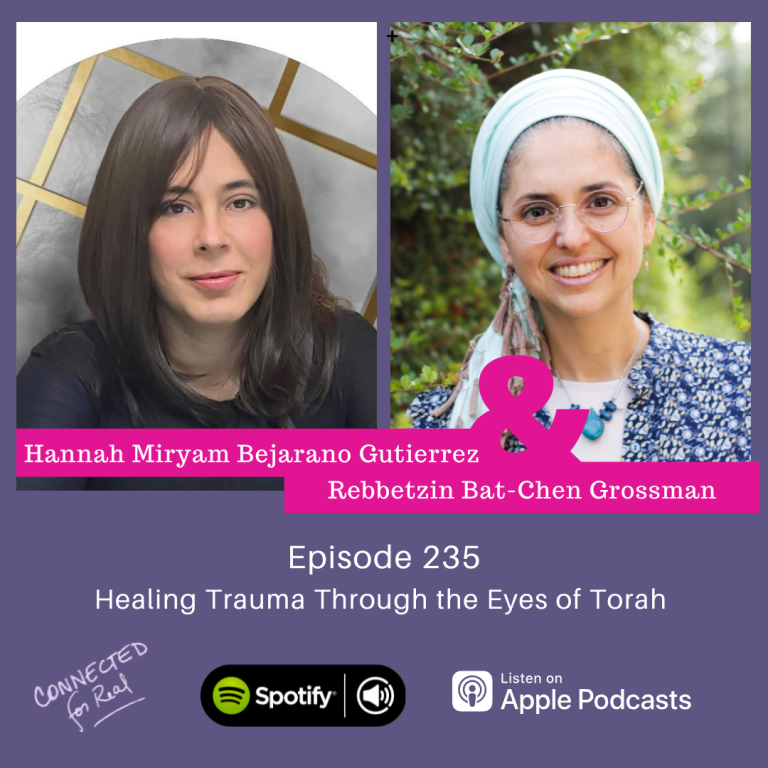
235. Healing Trauma Through the Eyes of Torah
Rebbetzin Hannah Miryam Bejarano Gutiérrez is an avid creator, writer and painter. She also is the owner of the Amazon bestselling magazine named: Jewish Posh Living Magazine, as well as a rising speaker on Jewish platforms such as: Bais Bezalel Chabad’s Raising Teens in 2021 and Jewish Girls Unite, among others. She works continuously with Rebbetzin Miriam Yerushalmi on various projects to bring aid to neshamot in their time of need. She is also a certified CBTT (Cognitive Behavioral Torah Tools) Coach, Energy and Emotional Healing Through Art and Color Coach. Her continual goal is to bring her audience closer to HaShem. She is also the Rebbetzin of a Traditional Sephardic Community. Rebbetzin Bat-Chen Grossman is a marriage coach for women in business. Join them as they discuss the topic of healing and you.
Transcript:
And we are live. Welcome, everyone, to the Connected for Real podcast. I’m Rebbetzin Bat-Chen Grossman, and today with me is Rebbetzin Chana Miriam. Introduce yourself, and then we’ll get into our topic of healing and you. My name is Rebbetzin Chana Miriam Benjarano Gutierrez. And I’m a mother of three beautiful boys, and I’m a certified CBTT coach. CBTT stands for Connective Behavioral Torah Tools, which is basically using the deep teachings of the Torah to help on each person’s healing journey if a person needs to heal from depression or any other emotional issue. This healing modality is, and I personally believe that you can heal hand-in-hand with Hashem. A person, yes, they can heal in terms of, in doing it without the spiritual element, but I think it’s much more difficult to do so, without Hashem. And I, I’m a, also a certified emotional release coach through art and color, and I believe that art and imagery and just the texture of doing art is a very soothing experience, and it’s very healing. And I’m also the owner of a magazine that is called Jewish Posh Living Magazine, and its whole mission is to share Hashem, and also the possibility that a person can heal and be close to Hashem. Doesn’t matter what stage in life they are. It doesn’t really matter. It’s like an outreach for women of all backgrounds. That’s basically me. Wow, that’s really cool. How did you start? Where did you, where, what led you to doing all these things? Basically it actually is a story behind it. Um, All started like, six years ago. I gave birth to my third child Yonatan. And what happened is that I I lived a close to death experience. I almost die a- after birth, and I remember that it’s funny how the mind works and the brain works. I was unconscious, but I was, I was in a state of consciousness at the same time. And I remember I could not open my eyes, I could not move, I could not do anything. But in my mind, I cried out to Hashem, and I asking for another chance of raising my children and be able to live. And I knew some part of me knew that I was between… It was the… It was getting decided, if you will. And then after the whole ordeal happened and I was in ICU, there was something that happened that I think that changed my whole outlook of how I approach Hashem. I woke up, I remembered, and my husband came in with my other two children. We were much younger at the time. And the first thing I asked my husband, and I said, “Why? Why? Just why?” and my husband just look at me and… My husband does not cry. Believe me, he doesn’t. And he looked at me and he started crying. Just cried. And he, I just… And he just didn’t know what to say to me And I don’t know why that moment changed me to the point where I thought I don’t wanna be in that state where I have to ask, or feel that I have to ask Hashem why. I wanna have this full trust in Hashem that I don’t have to feel that type of detachment, and I don’t want anyone else to feel that detachment, and I don’t want anyone to… We already know that, when we wake up a- and you say Modeh Ani, it’s a miracle in itself. But, health can be taken away in the blink of an eye, and it’s… Life is such a frail thing that it can change in a minute. So that’s what triggered a few months later, then I went, I started going through my whole process, after, motherhood and the whole emotional state of, PTSD, the whole thing. And I decided I wanted to do something about it. I wanted to do something physically ’cause I didn’t want anyone to have any regrets, and I wanted to share that it’s never too late to be close to Hashem and reach out to Hashem. And that was the reason why my magazine started, and that’s what triggered meeting my mentor certifying myself. And it’s all a chain of events happened through that moment of the birth of my child. And so I researched a lot about trauma, and learned about trauma and healing and I come to find out through experience that I could never have done it without Hashem leading that, that whole path, that whole moment. And I wouldn’t have trusted Hashem fully. I wouldn’t ha- be able to surpass the, what emotional trauma, what it does to you. And so that’s why I do what I do, and that’s why I, so I’m passionate about it. And yeah, that’s pretty much it really. Cool. That’s an amazing story. What were you doing before? Were you, did you have a different job or were you- I was, I can say. I was, I just- I was a home- a, a housewife, but my spiritual life was… How can I say this? It was automatic. It was like I davened and everything, but it wasn’t… I was not connected. I just… You know how to me- how you go through emotions, but it- you’re not connected at all? And- an automatic. You’re just on autopilot. Yeah, yeah, just doing things on autopilot and just not being, intentional at all. It just go through life and like that, and that’s how I realized I was. And yes, of course, I thought, “Hashem,” yeah, I thought of him, but there was no intention behind it. There was no kavana. There was no… I- it was kind of like, in a way, empty. Mm. And so I felt like… I thought about it. I felt like I was like sleep. A, awake, but sleep. Yeah, like sleepwalking. Yeah. When… I go I used to go more often, but I really love the class on Mesilat Yesharim, the Path to the Just, the Path of the Just. I have a teacher who teaches it, and it’s… I host it on my platform because it’s that good. I want everyone to have access to it. If anyone’s listening and wants to join, just send me an email. It’s so powerful, and one of the things that she really goes through in the first step, ’cause he really breaks it down into 10 steps to raising your level of consciousness. It’s amazing that this book was written so many years ago, and it’s so the exact wording that we use today. But the first step is to become aware. Just be careful. You’re walking sleeping. You’re sleepwalking. You know? You’re gonna fall into a pit if you don’t wake up, if you don’t start looking at where you’re going. Such a fascinating thing, that he has, he’s… And he says in his introduction, everybody has to hear this over and over again, because even though you know it, you don’t actually integrate it, and you have to constantly stay in the work in order to be working. A lot of people in the world, me included, are… find ourselves sleepwalking through life. And I love that you were so honest about, “That’s where I was, and that’s what led me to this,” because it really is such a f- empty feeling. Yeah. Yeah, exactly. And so for me it made me understand that, that healing is actually It’s being intentional, and we need to paying attention to your inner world, and constantly looking yourself in the mirror. It’s “How am I today? Am I okay today? What am I feeling?” not so much as having, because normally we we just react, right? We react as like a visceral reaction to your daily life and how we relate to our spouse our children. It… And when you b- train your brain and your soul so that you feel, you fill yourself with Torah to the point where it becomes an automatic response for anything. If you, if… And there’s a moment, the one of the mo- the main emotions that people go through, it’s anger. That was the main emotions. And if you stop, if we don’t… From us that we… I’ve seen that, including myself, we have an issue with stopping. We stop, you breathe. It’s like, “Okay, what was it that… Why do I feel this way?” and you think about it instead of reacting as and just do the, whatever it is that you’re just gonna reciprocate with. You just stop and say, “Okay, I feel this way because so and so and so. oh, okay. No, I should give it to Hashem, and this is not something I should be reacting this way, so I’m gonna react this way. What would Hashem want me to react as? Okay, I’m gonna react this way.” So obviously we’re not gonna do it every single time, but as it’s training your brain. It’s it’s brain train, if you will, and eventually those reactions are gonna become more often and more automatic. And what I do mainly, I, on my daily is I daven, and Mincha, and, three times a day. And there’s moments in time that I have it so programmed that I’m upset about something, and I just click and just start saying the Shema, and go through the Shema automatically, and it calms me down. Or the next thing I do is just I go outside, the sun calms me down, the heat, the nature calms me down, and I grab Tehillim, and I start davening. Going through Tehillim, and that soothes me down and calms my nervous system, and I just reframe everything. And I come back in and engage with my family. If I don’t stop, then I think… You always think about the fact that each person in my family, each one is a world. And if I hurt the world, I might hurt the generations or whatever it’s gonna do to my child from my reaction. Yeah, I think thinking that though might be a little bit too much pressure for a lot of people, yeah. A little bit coming at it from a place of fear which is a little bit … I I, I worry about that. Yeah. I, and in a way I don’t … In my perspective I don’t see it as as a fear factor, but I more see it as a just conscious about it. And I am not constantly thinking about it, but it’s just saying, “Okay, I have this in my mind. I’m gonna b- try my best.” and so if I, let’s say I do, I do something that is not ideal, and okay, I catch myself and I go, “Okay, I’m gonna talk to my child and say, ‘Hey, my love, I’m sorry I reacted this way.'” Or let’s talk about it. I know. It’s great that, just the awareness that when you touch anything, it has its effect and it has its impact is a very important thing to remember. So I think it’s, it… You know, You’re right that it’s a really good thing to hold in your mind. And I really like that it’s not driving you, but it’s something that you’re aware of. I, I want to make it really clear for the listeners that I don’t want you going around the world thinking, “Oh my God. Oh my God, I can’t touch anything. I can’t… I can’t do anything. I’m afraid to-” No … Damage anything. It’s like if you go into a, a store full, filled with glass things that are really delicate, you don’t feel like you can be yourself. You don’t feel like you can- Yeah … breathe easy, you know? yeah. And I don’t want you to live like that. So there is a balance that- No, of course … I’m all about. There’s a… Yeah, of course, there’s a balance. And one thing is awareness, and another thing is like anxiety, constant anxiety. If… Instead of awareness is, yes you’re, you’re be you and you live your life, but I’m aware of this. But if it happens, and y- you just resolve it in the best way you can resolve it and you move on, and keep living with joy and with love for Hashem and, with, every positive thing that you can have in life. And- Yeah … But just by being alive, just that’s the main thing, and that’s, anyways. That’s great. So let’s talk about healing. My podcast is built of, on four pillars, my podcast, my business, everything I do, because I do believe in finding integration and balance and being able to hold all the things. So the four most important things, in my opinion, for every woman, especially women who are in business and married and have a lot of things going on, so G-d is always at the core. We both agree on that, and everybody listening is, is on board. And then marriage and business working together, and you as the container of all that. And so today we’re talking about the pillar of you, healing and you. How do we help ourselves heal emotionally, physically, mentally, get to a place where you are- healthier in, from before? If something is bothering you, if something feels stuck, if something feels like it’s not in alignment, how do we create that inner healing to shift But my, in my personal life, what I’ve done, I do a lot of art and it helps me center myself. In those moments when you have… Whatever that each person, their hobbies are, whatever it is that’s passionate about, for me it’s art. Another person might be writing. Whatever that it is that centers you it’s something that you should do. And when, for me, I, for me painting is like the textures. It is a, it is the feeling of the paint and the paintbrush and the moment of quietness and solitude and just my time with me and Hashem and I’m, and I’m talking to Hashem. It’s been through this prayer, and I just express what I’m feeling or what I’m thinking. And I just keep going, keep going through my art and everything. And that’s one thing also that I do. I do a lot of, meditation. I close my eyes, breathing work, and and that helps me a lot to, to center myself, and I do a lot of, I dive into Helim every day. And I do believe when you’re a person, when a person fills thems- themselves with Torah, also prayer, and your mind is, it’s in, in something other than whatever it is you’re either you think, or either you’re worried about work or whatever pressures in life, you shift and your mind shifts on davening, and everything becomes easier. Everything becomes easier to handle. And for me, for some reason, the answer comes and I’m looking for an answer and I’m thinking about X, Y, Z regarding, the magazine, whatever issue, and I’m davening, and it’s “Oh, that is the answer.” And so I acquire my mind and I connect with Hashem, and I find myself, soothing my nervous system and calming down and centering myself, and I go out for walks and enjoy nature. And when you see the… You see the world and you look up and you say, “Wow, Hashem, this is, everything you created is perfect and it’s wonderful.” and you look outside yourself, and whatever issues that, that are going on within yourself- You say, “Okay, I can do this.” I- j- your mind, your mental- your, the way you’re thinking shifts entirely, and you do find those answers and that guidance. And that happens every time I go out for a walk, and then I even go to a park, and I sit down, and even I just grab my Tehillim with me, and I get it out, and start davening, and it’s oh, okay. I need to do this for that. I need to do this for that. Okay. So thank you, Hashem. And always, I think that gratefulness, being grateful to Hashem for everything from this instance you wake up, everything you do, when you eat, a brachot, everything is… When you keep Hashem, try to keep Hashem as much as possible in your mindset, everything shifts. The way you think life, how you approach life, how you approach family, how you approach marriage, how you approach your work life your creativity, everything. If it’s Hashem centered, it’s a different outlook completely. Yeah. So I’m hearing you speak and I’m very similar. I have Hashem with me all the time. I pray twice a day. I’m very connected, and I also love walking, and I also love art. So I’m very connected to what you’re saying, and I’m thinking about the listener, sitting there subconsciously probably screaming, “Where do you find time to, go out in nature, to do art, to, sit down and pray? How are you doing that when you have all these other things going on?” And I think that’s one of the biggest concerns is that it feels like it takes up a chunk of time or that if you want to have G-d in your life constantly, you need to be constantly doing things that involve G-d. Yeah. Praying, learning, walking with G-d, talking to G-d and sometimes it feels overwhelming. Yeah. And it feels unattainable, and it feels scary, and so you don’t even start ’cause you just feel like there’s no point. Yeah. You know how when you’re a mother, you have little kids, and that’s extremely difficult, and it’s very overwhelming to have more of a intense inner spiritual life. What I would say in that sense is that if it’s a mother with small children, for example, go to your backyard. If you have a chair or something, just sit down with your baby. And if you at the moment you cannot grab a s- a sedar, it’s okay, and just talk to Hashem from your heart, and that’s enough for now. Do what you can do. And I think that Hashem knows and that’s what you can do at the time. Whatever moments that you can get, use them as much as possible. If you can only, let’s say you have a person who likes to write, if you can only do four sentences, do that ‘Cause every little bit, and if you do a li- and two, three hours after, another three or four sentences, do three more. Whatever little bits that you can do in your life while then, n- well, it’s, everything that’s happening, that’s better than not doing it. Or if we, at the time you have a newborn, and then you really cannot daven three times a day just say Modeh Ani or Sidur Shema and yeah, that’s all you can do. Okay. But if you do it from your heart entirely with intention, Hashem knows. That’s right now at the time, that’s all you can do. And I think that’s a key. When you do everything, what you can do, whatever it is that you can do, you do it with intention. And that even little bit, one little step, it’s better than not taking a step at all. I love it. You know, And I was thinking, I was almost just laughing with myself sitting here, we say we have no time, and we say that we’re overwhelmed and do all the things, but if we treated G-d like we treat our phone, and we keep going to it, and we keep tapping it just to check on it, and we keep looking at what messages there are, and we keep going, checking some like, you know, some of the apps and some of the things, we’re constantly in touch with the phone even though we don’t think we’re on the phone that long. And if we had that relationship with G-d, any time we had a minute, a second a distraction, we’d be like, gamifying G-d instead. We would have a lot of touchpoints and a lot of places where you can really recharge. And what we don’t realize is that the phone’s actually draining our energy, because instead of resting, your brain is still on even though you think you’re resting, right? Yeah. I had to learn that the hard way. I would sit and like, sort of veg after a long day or in the middle of the day when my energy would drop, and my husband said, “If you wanna take a break. Really stop and go do something that fills you up. Go take a nap. Go journal. Go do meditation. Go whatever. I’m willing to hold down the fort if you need a real break, but this is not considered a break. This is not good for any of us. It ruins the atmosphere in the home, and you’re not actually getting recharged.” So that was really helpful. It was hard to hear at the time. I was annoyed with my husband that he was telling me that. But now I’m very grateful, and I’m very appreciative that he opened up my eyes and made me realize how much I actually do have time, but I’m wasting it or allowing it to drain. If we had, like you said, a minute here, half a minute there, write two sentences, come back to it later. My journal looks very all over the place. I could start a journaling thing and then suddenly have to go give someone a shower or, wipe someone or run after someone who’s screaming or whatever, and it’s just like mid-sentence. I come back to it, I just make a line and start again. I have no idea where I started, where I stopped, what’s g- what happened before. It is sort of like, okay, start over. What am I thinking now? What’s coming up now? I don’t force myself to continue it as if it’s a book or as if it makes sense. It doesn’t have to make sense. It’s just a place for me to throw words to reflect what’s happening inside. Sometimes it’s just really helpful to know where you’re at right now. I am feeling X. That’s great. Just giving it space on paper and then being able to go from there. So I love that you said that. Just give yourself permission to be where you are and not force yourself to be where you think you should be. Yeah, when you put yourself in a situation where you have this goal of what you sh- you think you should be or what others think that you should be, that you think others think. And it’s a lot of pressure. And then you stop being yourself because you’re doing what you think you should be doing or what others you think that others think that you should be doing, instead of what you a- actually wanna do or what fills you or what centers you. And you’re not looking in, but you’re looking out- … to look at. So it’s important that you look in instead of out and so- Give me an example of that. Yeah. So if when you’re looking out, you’re out- outward… In your mind, you’re thinking, “Oh, this person thinks about me that I should be doing X, Y, and Z,” or, “My husband thinks that I should be doing according to what he thinks of me, that X, Y, and Z.” But I don’t ask myself and say, “How are you doing? What do you wanna do today? What makes you feel calm? What do you wanna do what that makes you feel calm? What are you feeling?” and you ask yourself, you’ve, you’re con- in … You’re, like, saying, “Okay, I wanna check myself in with me and see, okay, I’m feeling all these feelings. Okay, so I’m gonna write down why,” if it’s just two sentences. And it’s groundbreaking because … when your mind becomes aware, because sometimes we just go through feelings and we’re not really aware why we feel them and why they’re happening, and we’re just going automatic. But if we stop and say, “Okay, why am I feeling like this?” Sometimes w- as women, we feel ugh, this annoyance. And you … Why do you feel annoyed? Like, why do I feel annoyed? Why do I feel overwhelmed? I didn’t really do anything that will make me feel that’s what you think. But then when you start writing it, it’s like, oh, okay, so I feel overwhelmed because of this and this and this. You become aware. Oh, so okay, that’s why. And when you feel … You become aware, then, okay, how can I resolve this? Either you need to talk to your spouse or you need to, talk with yourself or you just, you think you just need to go out, go for a walk or whatever it is you need to do. Right. Or just go for a drive and come back and, recharge and come back. And so I … That’s what it … I think it is that the difference be- between you- because we … If you see yourself through somebody else’s eyes, you’re not gonna really see yourself. The expectations I think are really high when you think they expect you to do something a certain way, or this means to them something that it doesn’t mean to you the same. It’s really- Yeah or, or sometimes we assume things that the other person wants from us But they don’t really, they’re not really even there. They’re not even thinking that’s, that about us at all. It, and it’s just our perception. Oh my gosh, that’s so funny because just today I was talking to my coach, and she said, “If I asked your husband, what would he say?” “Would he say that’s what that’s what he actually wants?” And I was like, “No.” I think he … I’m doing it because that’s what he wants. Really, if I asked him, would he say that’s what he wants? No. So why are you doing it? ‘Cause I’m almost blaming him for me doing it this way, but if you asked him, it, that’s not really what he wants. So you’re saying I’m assuming. Yes, a lot of the, a lot of the subconscious is just assuming things about what other people expect of me, and then trying to fill their needs and their expectations and the things I should do and how I’m supposed to do, and not really being in myself. I love that this conversation is really leading us to the CALM method, which is the method I created. And so the four steps to creating flow. And it’s CALM because it, each letter is a step. And if you want, we can talk about it, ’cause it’s just everything we’re saying fits so well into what the method is. So step one is connect to yourself, and it’s exactly what we’re saying now. It’s, connect to yourself without all the noise, without the external shoulds and supposed to’s and anything. Just connect to yourself and find out what you really want. Because once you know what you want, then you can go to step two, which is bringing, ask for assistance, ask for abundance. Bring Hashem into it. So step one was connecting to yourself. Step two is connecting to G-d and bringing him into the conversation. A lot of times we feel alone in a lot of things that we’re doing because we don’t realize that we’re not supposed to be carrying it all by ourselves. And so that’s step two, is bringing G-d into it. And then step three is listen for the answer, and that’s … You were describing it before where you said “I suddenly, I get downloads. I get answers. I start hearing and feeling, like things are falling in pl- into place,” just from praying, just from airing out, being able to get myself out of the situation, which is so powerful. So I love that, and thank you for bringing those examples. We’re so alive. And then just to wrap it up for you, step four is master a higher level of consciousness. Because a lot of people, they know the … They know what they need to do in order to get to a higher level of consciousness, awareness. Okay, I gotta know what I want, gotta bring G-d into it, I’m gonna start hearing answers, I’m gonna listen, I’m gonna be attentive. But they forget to- pause and celebrate what’s actually happening. You know? You’re constantly running after the next thing without stopping and seeing oh my gosh, that was amazing. I was stuck. I got in touch. I know what I’m doing now. The whole thing turned around. And when we can sit down and celebrate and share and really be in that, then what we’re doing is we’re using the experience that we just had as fuel to propel us forward, and we don’t have to work so hard to then get back up there, ’cause we’re already flying with it. It’s just really powerful, and I think most people forget that last step. Yeah. Yes and, also that I think Hashem many ways, um, when we ask something, and then He gives it to us, but at times it comes in a package that we didn’t even think it was gonna come in that package, and it comes in a different package. And okay here. Because believe it or not, for example, I am a very introvert person. Super introvert. And I was, before I was so afraid of speaking in public. I was panic. I was like, I didn’t talk much. I was very inward type of person. And so I sa- I asked Hashem, “Hashem, I want to help for people, for women to come closer to you. I wanna do this magazine, and I need your help to open the doors for that.” and guess what? Guess what? Okay, so what do I need to do? Okay. Be in the camera, do videos. Exact things that I was super afraid of doing, I ended up doing. And Hashem was like, “Okay, I’m gonna give it to you, but is, you’re gonna have to do this in order for you to get what you asked for.” Mm. And I would never have thought that I would put myself in front of a camera and speak. That was not me. That was just really not me. And, and- Yeah. It’s one of the biggest, most popular fears is fear of speaking in public. And I also had it. I also had to go through… It was really interesting. I also had this very similar… I’m not an introvert. I’m definitely an extrovert. But when I speak to people one on one, and I’m in my, comfort zone with my friends, I have no problem. When I have to speak publicly, like an actual speech or a drasha or, some sort of official thing, I freeze, or I used to And it was very hard for me to break through. And again, I really felt like Hashem was taking me one step at a time. First, I spoke about something I really knew to a really small group, and then I gave a class to three people, and then I, you know, was asked to speak but didn’t end up speaking because they ended up changing speakers right before. But being asked and saying yes was the part that was so hard for me, so that was what I needed to learn. And like really step by step is an amazing thing how you don’t realize, but G-d is the best coach, yeah. If you, If you let Him, He will take you where you wanna go, but you need to be willing to do it. Yeah, exactly. It’s a, it was a whole process of Hashem taking me step by step, little by little, opening up and overcoming fears from speaking in public to actually opening up to a lot of people on a camera, on internet. I was like, okay. But I thought that it was, that thought and I knew that it was something that I needed to do, but I had no idea what it would lead to or the impact that it would have. That I had, I didn’t even think in my wildest dreams, I wouldn’t even thought I would never thought that I would m- meet my mentor that I, and I did. And so I would never have thought from, since six years ago to the point I’m starting to now I was, it was two different people. Completely. Yeah. And to me, it’s all Hashem. That’s it. That’s, I could never done it on my own. Of course not. Yeah. So let’s go back to the healing. How does it work, there’s, G-d gives us all these challenges, and a lot of people have very big challenges, and a lot of people have small challenges that feel big, and then they’re sitting around in this shame spiral, and that I’m not figuring it out, and it’s just this little thing that’s tripping me up. But everybody has something, and it’s very exact to them. So let’s talk a little bit about that. How do we click into that? First I would think the key is, one, to validate yourself. Just because y- in your mind, for example, it’s a person who might think, “Oh, it’s just small,” it’s not, I don’t think, the right approach to think that something that small rather to validate yourself. Whatever that feeling now may be, first acknowledge it and validate it and then just, okay, say, “This is why I’m feeling this valid, and it’s okay to feel this way.” Because sometimes we feel guilty for feeling X feeling. We feel like either we’re not entitled to that feeling or we we shouldn’t be feeling this way, and it’s okay. It’s okay to feel it. It’s okay to have that situation, but… Or feeling a situation, that is. And then I would say what worked for me is at first either I just sit down and I just just talk to Hashem and say, “I feel this way. I just feel…” I just go to my room. Whatever that you can do, wherever you are, you’ll sit do- or you- or if you have a space a sofa or a setting or whatever it is and you feel, okay, acknowledge that I feel this way, and you start talking and acknowledging and going through the motions. And what you felt might, you might get at least one step closer to the answer then you just stop. Okay. And it’s okay to stop and then keep going about your life and then come back to it until you get to where you wanna be. You don’t have to think, you don’t have to find the answers on that moment. You don’t. I think when you’re at peace with the process that … At peace with the fact that you don’t have the answer. So we just want- Ooh, ooh. Say that again. Come to peace with the fact that you don’t have the answer. Yeah. That was so good. Yeah, because there are times when we’re not gonna have the answer, and that in itself it’s okay just to come in peace with the, with that fact. And that exact, that accepting will give you peace and say, “Okay, I can move on,” and say, “Okay, I don’t have the answer. Right now I don’t have it. Okay, I’m gonna move on,” and say, “I’m gonna put it in a box. I don’t have the answer, but I’m gonna move on.” And then I keep living my life with joy and take that off my head and put it in another box. And then I’ll come back to it, and that’s okay. It’s okay to come back to it. There’s nothing wrong with that. And I think that’s key. If we don’t see it as a, as like a kind of pressure of the, “I need to find that answer now. If I don’t, it, it’s just not gonna work,” or you feel overwhelmed. Instead say, “Hey, I don’t have the answer now, and that’s okay, and I’m at peace with that. Maybe I wanna… I will find it. Because Hashem, I will find it, and I’m at peace with that.” And be at peace with your- Yeah … peace. I think the, what you’re saying is not only you don’t need to have all the answers, and it’s okay for you to put something away to come back to later, it’s that you are allowing G-d to have the answer, and to bring it to you when you’re ready, and to make you- Right ready to hear it. The whole process is so beautiful when you actually see it. But we don’t see it because we’re so limited. All we see is how we need to figure it out, and we’re supposed to have it all worked out, and it’s not the way it’s supposed to be. So we’re really fighting reality. And I think once you said, G-d has it all worked out G-d has the answer, and that’s why I don’t have to have the answer. Yeah, exactly, and it takes away all the pressure of- … of having the answer, have it resolved right now. And then the emotional turmoil that’s going on inside, it calms down because, hey, Hashem has the answer. It’s okay. I’m at peace with that. And whenever Hashem decides it, that I will have the answer, then I will have the answer. And I just keep moving to whatever comes my way in my daily life. And then that’s, I think that’s when you’ll find the peace, when you trust Hashem completely with the process of… Maybe you’re not complete. You’re not complete yet. Because we are, I do think that we’re never a c- we’re always, we’re on a ongoing process. Yeah. We’re never complete. And that’s actually a beautiful thing, because if we’re constantly evolving, we’re constantly learning, the learning doesn’t ever end, and the healing process, it really never end. And it’s a beautiful thing because while you’re healing you’re getting closer to Hashem, and that process in itself, it’s beautiful. Yeah. And- Yeah, I think, when I think of healing and the inner healing I like to make a parallel with the external healing the physical healing, because everything physical is always parallel to the, internal And so a lot of times when you’re in pain, and you’re afraid of the pain, and you’re trying to get rid of the pain, and you’re in resistance, it hurts more. And you’re like, “Okay, it hurts. It’s allowed to hurt. This is what it’s supposed to do. It’s probably doing it to do something right, something is working for me and not against me. Okay.” it, it takes away even just a percentage of pain. It starts to lower the intensity. And it’s a really cool 30-second trick to just be like, “I’m willing to feel the pain just for 30 seconds. Like, all… I’m all in,” and after you really feel it you come out of the 30 seconds, you’re like, “Okay, and now it’s not as bad,” yeah. And there’s something really awesome that happens in that moment of switching your, fighting it. You’re no longer in, in a conflict. Yeah, just like a little kid who wa- he, who was afraid of learning how to ride a bike. It’s like he gets on the bike, and then he falls down and then, and h- prior, in his mind, he was like, “Oh, if I fall down, it’s gonna hurt a lot.” But then he falls down, it’s “Oh, it wasn’t so bad. Okay, I’ll get on a bike again.” So it’s basically that. And we riding the bike, and Hashem is the bike, and it, and He leads us, and we might fall, but then we’re like, “Okay, Hashem is the bike, so it, yeah, it does hurt, but not so much.” So and then you keep going. , it’s so funny ’cause I’m thinking like imagery-wise, it’s hard for me to see Hashem as the bike, ’cause Hashem is also the ground, and, you know- Oh … Hashem is also the one designing the fall, and Hashem is preparing you to be able to fall. It’s like there’s so many aspects of Hashem in that. It’s fascinating to me. And that’s really cool. So tell everyone how they can find you, how they can work with you, what you do. Right now I’m currently doing the magazine mainly. And you can find me on Facebook, and you can find me the magazine also has a Facebook page. And we also have an Instagram. We also have a YouTube. And I also have my art and it’s in- I’m in Fine Art America. Cool. I have a gallery there. And I have all my work there. And also, let me see, this is one of my pieces that were used in this book, the cover. Ooh. This one. Yeah. Pretty. Yeah. So that was one of of Miriam’s books, and that she used my, many other artists’ beautiful work they’ve done. And- Just tell everyone who’s listening and not seeing what the book is called. It’s called Tanya. Tanya: A From Alef to Tav, Letters of the Heart. And basically has one Letters of the Aleph Bet. That’s one of my pieces right there. So and I have, other of her projects that my art has been in, and among other artists. And so that’s how I express my time with Hashem and express what I feel or how I feel, like what I don’t feel, what I wish for people to feel or, hopes and dreams and everything goes in. Yeah. It’s really beautiful. So we’re gonna link down below all of your links to your to your art, and also to the magazine. And I’m really so grateful that you came on my podcast and, you’re a really fun, fun… This was a fun episode to record, so thank you. It’s my pleasure. Thank you so much for inviting me, truly. Yeah, and you know, I wanna just thank G-d for the fact that you are alive and with us, ’cause it’s fascinating when somebody goes through something so intense, to be between life and death, and then, you know, receives life. You have suddenly a completely different understanding of the value of every single minute and every single day. So it’s a great reminder. It was very inspirational for me just to hear that. Yeah. So thank you. Just I live life very intensely. Yeah. And very intentional, and I try my best to do that. And I help my children as much as I can until they go, “No.” Yeah. Yeah. Yeah. Yeah, teenagers will do that to you. But that’s very cool. So thank you. Thank you for being with us, and thank you listeners for being so awesome. Make sure you come back next week for another amazing episode, and don’t forget to be connected for real.