
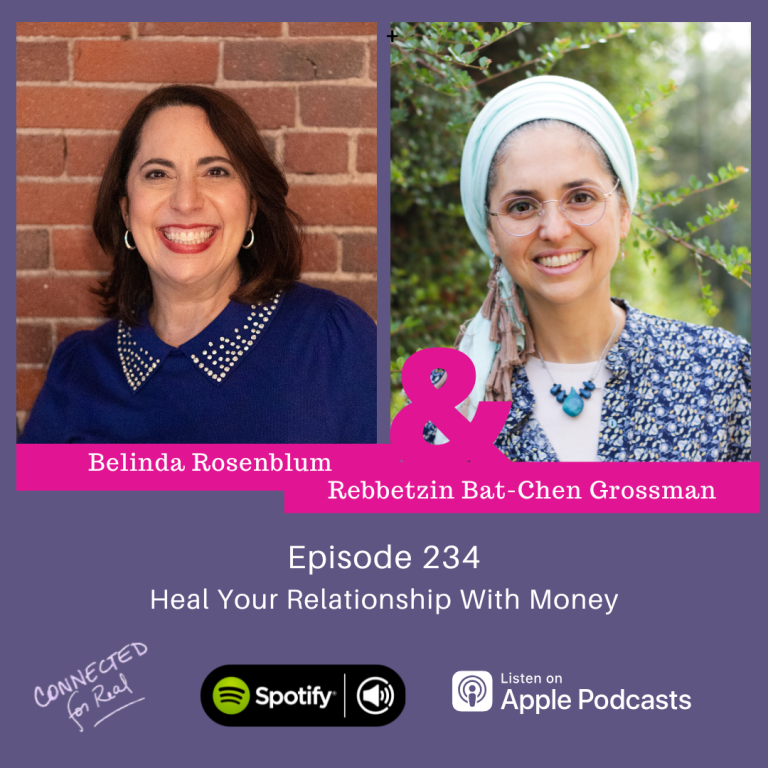
234. Heal Your Relationship With Money
Belinda Rosenblum is a Business Money Coach and CPA who helps established business owners move beyond the $100K plateau by installing the financial operating system needed to scale their business to 7 figures. Blending deep money expertise with business strategy, her clients have made or saved over $5,000,000. Think wallet, wisdom and a splash of woo. She brings 15 years of experience in Corporate Finance as a CPA and almost 19 years in online business (before Instagram existed!) and her expertise has been featured in Forbes, YahooFinance, and USA Today. Belinda is also the coauthor of Self-Worth To Net Worth: 12 Keys To Creating Wealth Inside And Out, became a self-made millionaire at 33 (now tripled that), is a cancer survivor, and mom of 3. Rebbetzin Bat-Chen Grossman is a marriage coach for women in business. Join them as they discuss the topic of healing and business.
Transcript:
Welcome to the Connected For Real podcast. I’m Rebbetzin Bat-Chen Grossman, a marriage coach for women in business. And my mission is to bring God’s presence into your life, into your marriage and into your business. Let’s get started. And we are live. Welcome, everyone, to the Connected for Real podcast. I’m Rebbetzin Bat-Chen Grossman. I’m a marriage coach for women in business, and I am so excited about today’s topic. It’s healing and business. And for this, I got you the best guest ever. Belinda, introduce yourself and tell everyone why you are the expert on healing your business. Wow. I, I just need to bring you everywhere I go. Just bringing the energy. I love it. Okay. Hello there. I am Belinda Rosenblum. I am a business money coach and CPA. And think about it this way. You know how you start a business because you want the freedom, you wanna be able to make more money, like you have these grand visions of what’s possible, and then the reality hits you, and you’re like, “Wait a second, I don’t even know how to make a dollar.” Then you make $100,000, and then you feel trapped there, and you’re like, “What do I do to be able to keep growing?” that’s where I come in, to really help you move beyond that 50 to $150,000 plateau that happens around six figures once you have the real financial operating system and understanding to be able to scale your business. And a lot of my journey, which I’m sure we’ll talk through, has been both understanding the personal finance side and the psychology and emotions behind money, I literally wrote a book on this, and then helping you use that plus the tactics and strategies to be able to grow and scale and create a business that you love, not one that burns you out. And there’s so much hustle culture out there that feels like that’s the only way, and I’m here to show everybody listening a different way to make that happen. Think of it like wallet wisdom and a little splash of woo in there, too. Yeah. I love it. Okay, so tell me first about your book, ’cause I wanna know what it’s called and what it’s all about. Oh, sure, yeah. Yeah. Go for it. It’s called Self-Worth to Net Worth, and I wrote it a little while ago, in like 2012 and I co-wrote it with a psychologist because I wanted to better understand the psychology behind money. Like, why was it that it was so stressful for us? Why was I working with these six-figure either professionals or entrepreneurs and they were worried, they were in debt? They had the money coming in, but they didn’t know how to be with money, how to appreciate that relationship, how to heal, how they grew up with money oftentimes, and then they could be 55 but living like a five-year-old or li- based on what they saw when they were growing up, and not understanding why it all felt so hard and stressful. And I was so fascinated by the topic. I did personal finance for my first 12 years of running this business, and so I was proactive in my own understanding of this. I was just… I found it so fascinating that I was like, “I need to write about this.” I need to have people understand that your wealth starts inside. That’s the self-worth part. It’s not like you’re just going to be able to amass money in a bank account and that’s gonna change how you feel about yourself. It’s no, that has to start first. You need to understand. My company is called Own Your Money, so it’s like how do you take responsibility and ownership of it in a way that feels really fun? And, I think so much of the time it’s like I want responsibility to feel as fun, and cool as irresponsibility has always felt, you know? to have people recognize that it can actually be fun to be better with money, to be wealthy. I feel like rich gets such a bad rap, that we can actually do a lot more with money than we can without, and it can be so much of a more peaceful place once we have healed our relationship with money and we’ve healed our own ability to also do those tactics and strategies so that not only do we feel better about it, but our bank account also then reflects what we need to do. So it’s has the psychology, but it also has some of the kick in the pants with the, tactics and strategies to help them know what to do. So yeah, it’s at selfworthbook.com. That’s how long ago I wrote it, that I could get selfworthbook.com. Yes. I was gonna say, that’s pretty impressive. Yeah. So that’s really cool. It’s a good URL. So let’s talk about healing your business, ’cause, it all really boils down to your relationship with money, and- your relationship with wealth and your relationship with freedom and your relationship with how you feel about, like you even used the word responsibility. And- … sometimes how heavy that feels when in reality that is one of the things that gives you the freedom is, “Oh, I’m so responsible that I thought ahead and I planned and I did all these things.” sometimes I think of myself when I go out on errands and I thought to take with me some, vegetables and a fruit and some granola bars or whatever, and then, oh, I don’t have to eat out ’cause I just snack along the way and I’m not starving and I’m not making silly decisions and all these things. Being responsible is actually a lot more fun, ’cause then you’re not stuck in these very weird situations where you’re gonna regret everything that you do from that moment on. Being hungry and overtired, not a good idea when you’re shopping and running errands. But anyway- Especially with kids. It’s, yes Just adds a whole nother dimension. Yeah. I’m a woman that brings snacks all the time for exactly that reason, so yes, I’m- Snacks are the best … I’m all on board. ‘Cause we don’t make as good decisions when we’re coming from the scarcity feeling. Whether it’s with food or with money, I’m totally on board with that. Yeah. Yeah, exactly. So I feel like you- … you hit it on the head when you talked about responsibility and making that fun- … and making it feel like it’s where I want to be. I have a client who actually told me just a couple of nights ago that her husband really wants freedom, and to him- freedom means not having a wife, not having children, not having responsibility, and being able to do whatever he wants. And if that’s- … your definition of freedom, then we’re in really big trouble because you’re not really accepting the life that you’ve built for yourself, and you’re constantly in resistance. So let’s talk about that in regards to business. A lot of people are- … building their business with one intention, but then they end up trapping themselves in it because just reality of building a business ends up having that effect. So how do we heal that? Yeah. So there are a couple of things that you touched on there. And I, to hearken back to your point about freedom and the definition of freedom, I feel like it’s really important for everybody to define it for themselves, and I love this having a conversation with your partner about it as well. ‘Cause it is really interesting how, it’s like defining success, right? It’s like it just means different things to different people. And when you don’t understand your own, you’re, you never arrive. It always feels like you just keep pushing out the bar. When you haven’t had that conversation with your partner, then it’s like you’re both heading towards a different finish line oftentimes. Yeah. Even if you’re very aligned on a lot of things, if you have a different definition of success and freedom and wealth, like the wealth that you want to be building together in your family, you’re setting yourself up for failure in terms of you’re going in different directions. So I wanna touch on that and why that is so important. And it’s interesting, too, when it comes to freedom as a word, that for some people it’s around financial freedom. For other people, it’s time freedom. For other people, it’s location freedom. And then you can even dig deeper, so it’s like time freedom. Okay, does that mean being able to work 20 hours, to end your day at 3:00, to not work nights or weekend? Like, It just means different things to different people. And so the more that you can define that for yourself, I feel like that is a really important element in this conversation. Part of what happens in terms of the trap that we were just discussing is that a lot of times when we grow our first 50K and our first 100K of revenue per year, it’s done with a lot of one-to-one, right? With a lot of one-to-one sales calls, with a lot of one-to-one coaching and direct coaching, even in courses and groups, but it’s a lot of you, and it’s a lot of you wearing all the hats all the time. And it’s naturally unscalable. And a lot of times people are undercharging because they’re just trying to make a dollar. They’re trying to prove to themselves that they can do it, prove to their family that they can do it, and that’s the energy that they’re coming to it with oftentimes, but also this underlying false belief that all revenue is created equal. Okay? ’cause when you’re getting to that point, it’s just like, “I just wanna make a dollar. Like, I just need to bring in revenue.” And so we think all clients are the same, all revenue streams are the same, and we just keep taking action and going after as much as we can you know, in terms of revenue that we’re making. But the point that I help people to see is actually we need to stop around this point and to recognize that it’s not just about the grinding. It’s also about actually recognizing what revenue is more profitable for you, right? What are your margins, and how does that differ depending on what you’re selling? And do you even know what your financial goals or targets are? A lot of times we’re just working hard, and we’re just putting in more effort, and we think, “If I just work harder, then I’ll make more, then I’ll be able to take home more.” And- What happens a lot of the time is that we just make more and then we just spend more, because we don’t actually have a good idea of our finances, so we just keep chasing the next dollar, and we never find that place of if I wanna say satisfaction, sustainability, you know? and when it’s coming- What came up for me was peace. Peace, yeah. Just this peace. The feeling of, “Oh, I’m exactly where I need to be and I know what I’m doing, and it’s okay.” there is a lack of that when you’re running after the next thing and the next thing and the next thing. You’re constantly, you know, “Are we there yet? Are we there yet? Are we there yet?” And then you’re never really there. And you always feel behind. No, you’re never really there- Yeah. You’re never there … ’cause you keep moving the bar, right? But and also that you’re coming from this, “I should be farther ahead.” people are shoulding on themselves, where they think that wherever they are doesn’t have the peace because it’s not wherever they think they should be or could be, or, “Oh, I see other people who are also three years in,” or other people that are five years in or 10 years in or whatever. I’m 19 years in, so my… It’s… And I have to be careful not to compare myself ’cause I’ve made a lot of life choices along the way. I had kids when I was 41 and 43, ’cause I didn’t end up meeting my husband and getting married until later in life, and then we had some trouble having kids. And so I know that I made some choices along the way that supported my bigger life goals of having a family. And so it’s like we, sometimes we just forget all that stuff when we’re living from this unhealed space, and we’re- … growing our business from this unhealed space, and we just dig our hole into this trap even more because we don’t actually know what we want from our business. Do we want freedom? Do we want more money? Do we want less hours? And then it just feels like we put in more effort, and then we’re building towards nothing in specific. Do you know what I mean? That’s why we never feel like we’re quite there. And so I can’t remember what your exact question was originally, but I think what happens is that we think that the business can be our piggy bank, and we don’t ever really understand the numbers and how the money is working, and we don’t have a plan. And we live without the peace that you’re talking about for so long. And so a lot of what I help people to do is to find that place of ownership and responsibility, of “Wait a second, my business is not happening to me, it’s happening by me.” you are the CEO of your business. We can’t wait for somebody else to swoop in or to tell you what you need to do. It’s no, I need to teach you how to do those things for yourself. Once you’re at 500,000, a million, fine, we can hire you some part-time CFO help maybe, right? But until then, I need to teach you how to do it so that you can lead your business in a way that feels like, “Oh, wait a second, I can make my business a tool to support my life,” not feeling like I’m trying to squeeze my life around the limited time that my business allows. And, that’s what happens what- when we haven’t healed it both on the inside, but then also heal that lack of understanding that shows up in the tactics and strategies and systems that we never learned. It’s like, it can be really frustrating, honestly to be running that business, and that’s why we feel frustrated and lost and stressed, and we worry about money all the time. And sometimes we feel really helpless, and even a little bit terrified of what happens if I lose that next client, or where is the money gonna come from next month? And I think that we actually do ourselves a really big disservice by not understanding money in our business. Because it creates this underlying almost like ticker, if you can imagine. You know what I mean? Like this underlying tone of our life of worry and desperation and danger almost. It’s like our body, our systems wanna feel more safe and more stable and more predictable, but until we understand the money and we can see the plan, we live with this underlying stress, let’s say underlying stressing from all the guessing that we’re doing, of what we don’t understand in our business. And I feel like what I get to do to help people is so liberating, really. It’s like, “Oh my God, how did I run my business all these years and not understand this?” Like that, I hear that a lot, right? Or I’ll have somebody… I just got a little screenshot from one of our cash flow CO students, and she got her final numbers for last year, for ’25, and she made $52,000 more profit than she did the prior year. And I was like, “That’s awesome. What was your revenue?” ‘Cause I’m thinking o- of it in terms of great, you made that much more profit, but how much did your revenue go up? Because it sounds like a lot. Wow, she made 52 grand more profit. But what if she made- $200,000 more revenue, I would’ve been like, “Where did all the money go?” But instead, I asked her, and she was like my revenue was actually down a little bit.” And I calculated it, and her revenue was down 6%, but her profit went up by, it like more than doubled, essentially. You know, It went up by this 52 grand. And so part of it is understanding the whole picture and how things really work together, and how we need to be paying attention to the revenue, but also paying attention to the spend that we have, and making sure that we’re really investing our money into revenue producing spending, essentially, right? Or income producing spending, instead of just paying the money out and then feeling like, “Where did it all go?” so the way I think about money and, and healing it is both an inside game and an outside game in terms of understanding what… Like, where’s our lack of skills, and where do we let go of the shame that so many of us have around money? And instead say, take on the growth mindset of I just haven’t learned it yet.” and I have so much compassion for people. Seems like a good place to talk about this. While we’re sharing where people have a lot of shame in their businesses. So I’m a CPA. In, in the US it’s like the accounting designation, right? And I was accounting major in college, I worked for one of the big accounting firms. But I start this business, and I have a rude awakening at how different small business finance is compared to big business finance, okay? So I get my profit and loss statement for my second full year in business, and I literally, two weeks before I was celebrating my first six figure year. We had revenue of $155,000. Guess what my profit was that second year in business? I don’t know. Just guess. That sounds low. It was low. It was low, yes. So- It was four figures, not five figures at all, right? So it was $2,348. And I remember when I got my- Wow … my profit and loss statement from my bookkeeper that day. I sat down like it was any other day, and I’m clicking around, and I got the report in my email inbox, and I literally burst into tears when I opened it up. ‘Cause I was like, “You gotta be kidding me.” but like- How is that even possible? Like, I just busted myself, to create this year where the business made $155,000 and I only… The business took home profit of only $2,348. I couldn’t pay myself anything, ’cause I didn’t feel comfortable even taking that little bit of money out of the business. And I will say, I did not tell that story for years when I was just teaching personal finance, ’cause I told other personal finance stories of my own, trials and tribulations over there. And then when I started working with business owners, so I made the shift in 2019 because I was trying to coach entrepreneurs with their personal money, and I am a don’t shrink your dreams, expand your bank account person. So I am like, “If you have bigger dreams, we just have to help you make more money.” But all of my programs and courses and a membership, everything was only geared on helping them spend less than they make, basically. To- Mm …… live within their means and work with the money that they were bringing in, and I’m trying to squeeze a quarter out of a nickel for my entrepreneurs, and I’m like, “This doesn’t work.” So I decided to shift the whole business over to help small businesses, particularly women, to figure this out. And so when I look back at my year of only making the $2,000, and I had a moment there where I was starting my third year and I could either go back and get a job, which is what I did in corporate for a while, or I could put on my big girl pants and I could be like, “Okay, it’s different.” Big corporate finance is different than small business finance, and what do I need to learn to figure this out, and to forgive myself for what just happened, and do my own healing through this process? And I had to get really honest with myself about where I wasn’t holding boundaries for my team. I wasn’t giving them what I call constraints on their time. I would just be like, “Can you go do this thing with…” And not tell them how long it should take or how many hours they had for all the tasks they needed to do. And so there’s something called Parkinson’s law, that the work we do expands to the amount of time we give it, and if you don’t give it any amount of time, it’s just gonna expand to an endless amount of time. Whereas if you set a concrete thing, and this works- I have to say that I had- Do you do something like that? Yeah … I had a, a team person who I did not give them boundaries, and after the first month when I got the bill, I was like- You did what? Right, Everything took forever, right? What are you doing? Are you like, playing Sudoku while tal- watching the computer load or something? What is going on? Right. Right, right, right. And very quickly- Yeah … she’s no longer on my team, but also I learnt this very important rule, which is you have to limit. You have to limit. Yes. Yeah. So- You have to tell them, “I think that, this should take you an hour,” or, “I’d like you to spend, max an hour.” The other thing, too, as a part of it, though, was putting in more operational effectiveness and really making sure that we were spending the time on the things that would create the future revenue for us, that would take the work off me that needed to be done. So at the time, it was back in 2009, ’10. ’09 was the down year, and then ’10 w- became an up year. I was in the press a lot, like every week almost. There weren’t a lot of people talking about personal finance. We were going through this recession that started in 2008, so I was very popular. I think that was when my TV show had started, too. And so we were literally updating my website almost every day. Now, I, although I, we all wanna think that people are looking at our website every day, no one probably was. Like, did that need to be done? No. So when I got us more effective and efficient, I also had us doing different things, right? And then I created more leverage in the business, which is a big thing that a lot of times when it’s only one on one, we don’t have any leverage, so I had hired another coach. Then I raised my prices, ’cause most of us are undercharging for our first 100K as well. And the biggest thing that I did was I actually created a plan that built in me paying myself consistently every month. I was totally winging it. That’s just the reality of it. And I needed to create a plan that was more directed, that specifically said, “This is how I wanna be making my money. This is what I’m gonna be doing to get there.” And then the next year after the down year, the next year was 256,000 of revenue, so up from the 155, but then the profit went from the 2,000 to $96,000. And so now essentially it’s the model that I teach inside our Cash Flow CEO program, because I had to align my money story, had to create real money systems, and I had to actually create a strategy into the business. And once I did all those three, my big realization was that I couldn’t keep winging my finances and expect to create a business that would give me the freedom and the time for the people that I love the most, and so at the time, I was single. Now I can look back at that and be like, “Holy cow. Thank goodness that I shifted things,” because I had just met my husband in that down year, and then as I started to rise up- I prioritize differently, honestly, and I made time to be able to see him and date him, you know, and do things with him instead of just having my head down at the laptop the whole time. So not just did we make almost $100,000 in profit, but I got engaged that year, too. And then we had a really quick four-month engagement, and then we got married on the beach in Costa Rica. And- That’s really fun … it was super fun, and none of that, would have happened if I hadn’t allowed myself to heal from the down, you know, heal from what wasn’t working. And lift my head up and be like, “Okay,” “What am I gonna do to fix this situation?” Because I believed in myself, and I believed that there was a better way that I just didn’t know yet, that I hadn’t learned, that I hadn’t figured out. And don’t even remember if I ended up hiring another coach. Honestly, I think so much of it was self-taught, because at the time there weren’t coaches. It’s like entrepreneurship and coaching has come so far in 19 years since I started that it was a lot of I gotta figure this out, because this is not what I bargained for when I started the business. I left a healthy six-figure job as a corporate controller, essentially, and I didn’t wanna go back. I felt like this was really my mission, was to be able to help women in this way and help liberate them from their lack of knowledge and their fears around money, and get into more inspired and profitable action. So thank goodness I did, because then that was- Yeah … 2008, ‘9, ’10. And then we just kept going from there, and now we’ve helped our clients, makers save well over $5 million. We’ve created well over $5.5 million in revenue, and I really look at that like the more money we make, the more people we’re helping. To be able to create a new reality for themselves, and healing it on the inside, and then enjoying the impact of that healing on the outside. Yes. So I have a training that I’ve been working on for a while, on and off, and it just, it keeps coming up, and it’s one of my favorite things to talk about. It’s called How to Stop Fighting With Your Husband About Your Business. Ooh. And… Yes. And that is my specialty, is the balancing the husband, the marriage, the business. And how you feel about your business, and how your husband is a little bit on your back about it, ’cause like, are you making enough? Are you making too much? Are you working- … too hard? Are you wasting your time? Are you … All these things that the husbands so lovingly say, and sits the wrong way with us because we’re uncomfortable with it and- Oh, if you wanna talk about this, I could talk about this all day. Yeah. ‘Cause I work with my husband, which you probably- Yes … know. I know. You might know that. I know that. It was really fun to get the email from him in response- Yeah … to something I sent you, and, Yeah … that, that was really great. But when I say I help women in business with their marriage, people are like, “Oh, so you help women who work with their husbands?” I’m like, “No. I help women who have a business, and they also have a husband.” And the husband so lovingly wants to help them run their business- Yeah … because he- Yeah … really knows better, or he thinks he knows better, and she’s afraid because a part of her thinks that he does know better. And- … and then you don’t own your own, l- like you said, own your money. You don’t own your space. You don’t own your business. You don’t feel like it’s yours. You’re uncomfortable with the fact that he’s pointing out all of your flaws, and it hurts the most because this is where you feel like you’re being called to show up, and this is your purpose. You’re not just doing it for the money. You’re really doing it because you have something to share with the world, and here he is getting in your way and putting sticks in your wheels and being very annoying. Very lovingly annoying, right? And we- yeah … We have to keep that. As I’m talking, I wanna remind everybody he’s not doing it on purpose. He doesn’t wanna hurt you. He doesn’t want anything bad for you. He really loves you and wants to show you something is off, something’s going on. So I talk a lot about the mirror, how your husband is the mirror, and he is showing you something you can’t see about yourself. And sometimes all you need is a mirror to notice that you have an eyelash or some splatter or whatever. I don’t know what. You won’t see it otherwise. You can’t see it. There’s absolutely no physical way for you to know that you need to clean your shirt or wipe something off your face if you didn’t see the mirror. So your husband’s really there. God put him there on purpose so that he can help you, and you can help him be there. God does it all on purpose. Exactly. That’s it. Yeah. Yeah I have a few thoughts on it, but get to if you have a question or anything like that Yeah … this comes up with, “My husband says that I’m not making enough money in my business. My husband says that it’s not worth having me work-” business. Really, I should be- … investing on his thing, or I should be investing in that other thing, and I should spend my money in other ways, or my time in other ways, my energy in different ways. And I say, “Have you looked at the numbers? Are you able to sit down with your husband and actually show him what this business is making, or what these hours are creating?” And a lot of times they don’t. And that’s exactly what this mirror is here to do. He is trying to push you to be more professional and to take yourself more seriously. If you’re running a business, then you need to be able to look at the numbers and understand what’s actually happening, and be honest with yourself and say, “Oh, every time I do this, this happens. And if my husband sat down and said, “I don’t think you should be working anymore” or, “You’re wasting your time,” I would have very good answers because I’ve done the work. And the women who work with me are able to do the same because they can pause and say, “Okay. Instead of being all annoyed and spending my day being all bubbled up about my husband being ugh,” you fill in the blank. Yeah. Exactly. How about you spend half a day or a couple of hours or even five minutes and just look at the numbers and say, “What’s coming in? What’s going out? What are my expenses? What’s going on in my business?” And then say, “Oh- Mm-hmm …… you know what? I think my husband’s right. I am wasting a lot of time being on Instagram and getting inspiration. Maybe I should change my attitude or my feeling about what I’m doing. Maybe I should own more of the CEO role and not be- Yeah in the trenches so much.” It doesn’t matter what your takeaways are, but the ability to be honest with yourself and own your business, ’cause really it’s one of the things that will help you grow your vessel and contain more- Yeah … if you’re able- Yeah … to expand that way. Hey, before we continue the episode, I want to ask you something. Are you ready to get answers from G-d directly, feel more in love with your husband and more supported than ever, run the business of your dreams without having to sacrifice any other part of your life? That is exactly what my one-on-one private coaching is for, and I want to invite you, just you and me, for a free deep dive discovery call. This is a 60-minute free call where I ask you lots of questions, and we extract the three main things that are holding you back. I then put together a personalized plan for you where I create a roadmap of recommendations with practical steps. The call is free and so valuable in itself, so go book yours today. Now, back to the show. For sure. So I think that part of why our partners come at it like that is because they love us so much, because they wanna see us succeed. So they wanna be helpful, they wanna be our hero, they wanna point out what’s not working, and they don’t necessarily realize that we might be a little vulnerable around these things and we might not wanna hear it from them. But I believe that it’s usually coming from a good place. The other thing, though, is that we have to recognize the context that they’re coming from. So let me explain what I mean there. So a lot of times we share the things that are not working with them. Exactly. We are not nearly as good at sharing the wins, and the money we’re making, and the clients. We share the stress, and the things that we need to vent, and the client that’s paying late. If you have a client and you’re like, “Oh my God, it’s the third month that this client is paying late,” well then, of course, your partner’s gonna wanna come in and protect you and be like should you fire that client? Do you wanna keep working with them?” And then you’re like, I can’t fire the client. I, we, I need the money that the client is providing,” right? So they’re just trying to protect you from having to deal with this client that’s a pain, right? And we often take it super personally. And so funny enough, my husband and I used to do a program called Supported: How to Get Your Partner On Board with Your Business. Mm-hmm. And I think what’s underlying what you’ve shared in terms of the how to stop fighting with your husband about your business is getting them on board, and being more conscious about not just sharing the stuff that isn’t working, but share all the stuff that is working, even if it needs to be really intentional and really conscious for you. There are those stages of competence. You familiar with that, right? So it’s like we start out being unconsciously incompetent, like we don’t even realize that we’re sharing all the negative stuff. And then we start to get consciously incompetent, and then we’re like, “Oh, no wonder he thinks this about my business. Look at what I’m telling him.” Because we’re getting more conscious about it. Then we flip over to conscious competence. Then we can start to say instead, “Okay, wait a second. How do I be more intentional about what I tell him? How do I let him be a mirror for what’s working instead of just all the things that aren’t working that he’s literally just reflecting back to me?” Right. But somehow it feels much worse when he’s saying it to us than when we see it for ourselves. And then the stage we both wanna see them get to is this unconscious competence, where they naturally have a space to share the things that are working, and then to be very intentional, cautious even, about the things that- aren’t working that you do wanna share. And even when you’re sharing it, coming in with the context of, “I’d love some feedback on this,” or, “I just need to tell you this, ’cause this is what’s going on in the business.” Because I do believe in keeping those lines of communication open. We had one of our students where she came to us in a bunch of business debt. This is an interesting story, but very related to this whole marriage thing. And it’s interesting, because we think that the unhealed relationship is only us, but it absolutely carries over into our marriage. It’s very related to this whole topic and very much what you do, and underlying what I do. And I think it’s why I love working with moms so much, because there’s usually a partner, and there’s usually a piece of, if I can heal it for the mom, she can heal it and raise her children differently. So she can change the generational legacy, and she can be conscious that the time that she’s taking away from her kids, I put in quotes is making her money. ‘Cause otherwise, I want you to be with your kids. I don’t want everybody running a nonprofit, like I was doing that year, right? This is not a volunteer organization, oh. And so- I think, … I don’t want any unintentional nonprofits out there. And so, you know, I think the distinction is that if you can get to this place where you’re clear on the role that you want your partner to have. And this is also why I believe that community is so important, why coaching is so important. ‘Cause when we don’t have it in other places, we go to our partners for it, okay? But it can absolutely strain a relationship when we’re not clear on the numbers, to the point you were just making, right? This is probably also why you and I connect so well, ’cause we both feel so strongly about you need to know your numbers. And so I had this woman come, and she knew she was in some debt, but she never actually like, put it down on paper to figure out how much it was. So one of the lessons inside the program, in the money system, get organized part, is no judgment, just here’s the spreadsheet, put down how much debt you have. And she laid it out, and it was, like, $35,000. She’s like, “I was not conscious that it was that much money.” And I said, “Okay let’s talk about how did it get there in the first place?” Oh, and her partner did not know about the debt that she had accumulated in her business. So that’s transparency is really important in this process too, right? So you need to know your numbers, but then you also have to be honest and transparent with your partner about it, particularly if they’re helping support the household, if they’re helping support you in your business, even. So what we figured out is that she had made a mistake that a lot of couples make, where they looked at the expenses of the household, and they just divided it in a random way that seemed to make sense. But it wasn’t actually tied to how much they were each making in, from their work. So she was paying about half of the expenses, and her business was not making anywhere near what he was making in his job. So what is the impact of that? She buys the groceries and all of the things that are on her list that she needs to spend money on, and it was something to the tune of $2,500 a month. But she only had about $1,000 a month net of business expenses to contribute. Okay? So the math doesn’t math, right? She’s short by $1,500. So what happens when you continue blind like that for too long? All of a sudden, pull out a calculator, right? You look at the $1,500, and over two years, lo and behold, it’s $36,000. So her business got into debt, but really it was not her business debt. Really, it was the personal expenses that she that her and her partner had not adequately figured out how they were gonna be paying it as a couple. And so she was putting a lot of pressure and desperation on the business now, because now the business has an interest load. It has to pay interest on the $36,000. And so nowadays the rates are crazy. Let’s say it’s 18%, which might even be low. She’s paying $6,500 a year just in interest to hold onto this debt. That’s $500 a month or so. And so it’s not only is she putting a lot of pressure on this newer business to perform, now she also has an additional expense of $500 a month that’s not even able to come into the household that’s now just servicing this debt. And so this is why I feel like it’s so important that we know our numbers and that we are transparent with our partner instead of allowing ourselves to keep a distance, but to be honest about the contribution we can make in the household, and it could be the contribution that you wanna make. Hey, I would like to be making a $2,500 contribution, but right now my business can only afford me to take out $1,000. In her case. And so I gave her a whole script and way to talk to him about it. I don’t wanna say it didn’t go well. It went as well as it possibly could have. I’ll put it that way. He was pretty shocked, and I think disappointed that she hadn’t felt comfortable coming to him. And yet, she was glad that… He was glad that they were having this conversation now versus another two years from now, right? Right. When they were in more of a hole. Because now he saw, oh, wow, her business is saddled with this debt. That’s actually our personal expenses. Wonderful. Yeah, true story, and that’s just one of many stories, but I think that we don’t realize the collateral damage, I’ll say, that can happen from our unhealed relationship and from honestly not knowing our numbers. And not being transparent with our partners about it, I’ll talk to you about not knowing your numbers, because it’s very interesting. I heard from a lot of people- … that when they start looking at the numbers, they feel like there isn’t a blessing in their numbers. It feels like you start looking at it too much, you start counting it, and then you start, controlling it. You don’t have God in it so much. You’re… It feels a little bit distant from what they had when they weren’t looking at their numbers. Like, when you’re not looking at your numbers, you feel like God is with you all the time, saving you, and miracles are happening, and suddenly there’s free money in the account, and it came right at the perfect time, and it came to sweep you away. There’s a very interesting energy about not knowing your numbers and feeling like you’re living on a miracle train. And then when you start looking at your numbers and expecting things and knowing that they’re coming and being very calculated, you almost close the door to the ability of having miracles. Or you feel like, I’m not gonna say it’s… It’s not the reality, but the feeling inside is that if I take over the control and the braining of doing this, mathing- … then I am leaving God out of it, and I am not as connected, not as fully leaned on God. And so- there’s a very interesting, that’s something that has come up a lot, and, and- Wow … it might be surprising. Oh, that would be interesting to talk about. Yeah. Yeah. Yeah. . there is an element of what I call bank balance decision-making that a lot of people will do, again- For this first 50K, 100K of annual revenue, and that is essentially you look at your bank account, and that’s how you know what you can afford. It is very shortsighted if you think about it, right? Because it doesn’t take into consideration other things you might owe, other commitments that you have. It’s literally a moment-to-moment thing that can change on a dime. It can change when money gets into the account. It can change when something is pulled, a credit card is paid, whatever. And I find that when you have some planning… I don’t love the word control as much, and I will say I know to a certain extent, I want people to feel more in control, but it’s not about the gripping that the word control has. For me, it’s more about flow. It’s more about alignment. It’s more about having the plan so that you know what levers you can pull. You know what actions you wanna be taking. And guess what? Life does not always go according to plan, and it’s just how it is. I’m 19 years in. I can tell you that for certainty, right? But when you can see it, then you can start to make better decisions, and I like leaving room for magic. I like leaving room for the blessing and for knowing hey, my goal may be 500,000. I planned out 400 of it, and then let’s see what happens. To leave some room for that. And I do find when I stay open to it, and that’s why I use the term I don’t want the control to feel like it’s a gripping. You know when you’re trying to hold a soap that’s wet in your hands and you’re gripping it? It’s like it slides out of your hands ’cause you’re trying to hold on too tight. So I want people to open their hands, right? To be more in a receptive mode around it instead of feeling like the knowing your numbers is closing the doors. Instead, to look at it like, hey, all of this is a blessing, the money that we’re receiving in, the money that we’re paying out. One of my friend, Kay Northrup, calls bills invoices… No. Invoices for blessings already received. Like, when you look at your credit card statement, it’s just things that you haven’t paid for yet for blessings you’ve already received, right? For goodness that’s already come, you just still owe people money for it. And so when you just start to look at all of it as a blessing, you don’t have to hold it so tight. You don’t have to hold it in this context of what it means if you don’t make your plan. Or what it means when somebody pays you or doesn’t pay you. I think it’s one of the biggest things I’ve learned over time. Some of it might be I just turned 54. Some of it might be that I’ve been in this business for so many years. But I just really look to not take any of it personally, even the really good stuff and the stuff that doesn’t go my way, but to just learn how to be in flow, and know that sometimes things are gonna work, and sometimes they’re not gonna work. I usually learn more from the things that don’t work anyway. But I’m always open to both. And, I’ve really been trying to take on more of the scientist kind of feel. Let’s try it. Let’s see if it works. Let’s say it a few times. Are people resonating with it? Is that content people wanna hear? And then moving through it. And I find that when- You know what’s so funny? Does that resonate with you? It’s so funny, ’cause you- Yeah … you say scientist, and the first- … thing that pops into my head is scientist has to be very exact, and know exactly what the plan is, and has to, you know- Isn’t that an interesting context shift, right? Yeah. It’s I think of scientist versus artist, and the artist is very flowy, and just like- Oh … play around, and has no idea what’s gonna happen. Ah. Yeah. And the scientist is “I’m gonna make a cake, and I know these are the ingredients, and this is the recipe, and this is how you do it. And if you add too much flour- Oh it’s gonna get a little cakeier, and if you add too much of this-” That’s a really good point. That’s the scientist. Yeah. So- A scientist feels exact to you. Yeah. Yeah, and to me- Which is so amazing … I think of it as an experiment. Exactly. And even just in that- I think of it like trying it out. … even just in that moment, when you said scientist in a different way that I thought of it, I realized how powerful it is that each one of us has a different connotation to the same exact word. Absolutely. And this is exactly how everything else works in life, too. So cool. And this is really where our context is so decisive. Because if I’m looking at the scientist my way, and I’m thinking of it as an experiment, and that feels like more in flow and easier to hold, right? Whereas if you’re looking at it like, “No, if I’m a scientist, it has to be exact. I have to measure everything out. It has to go exactly according to plan,” and then your direction is totally different than my direction using the same word. And I think that is actually so true, just to make a bigger point out of it, in, in everything related to our business. Like I just had a conversation with one of our Cash Flow CEO students, and she’s doing this design work, and she wants to shift more into this branding work. So Janice and I are talking about this, and she’s “So do I need to cut out the design work entirely and just do… The burn all the ships and not do this anymore and go do this other thing?” And I’m like, “No.” And I was like, “Hold on. ‘Cause if you do that…” And this is important for everybody who has a full-time job and wants to start a second job, like a side hustle, and grow that into a business. I said, “No, hold on. If you quit all of the design work, you’re gonna put a lot of pressure on this new business. This is like a little baby.” “We can’t expect the baby to go mow the lawn and make the dinner and do all the things immediately. We have to give it some space to grow.” So what I did was I reframed for her design work, okay? ‘Cause it’s still a business, but it’s a different one than where she wants to be doing next. So I said, “Look at the, that design work as funding the baby, right? As funding the new work that you wanna do.” And so she just left me a message over the weekend that was like, “Holy cow, just the reframe of not resenting doing the design business for money,” but instead reframing it and changing the context she was holding to look at it as “Oh, this can be fun, and this is supportive of this new business that I wanna be growing,” without putting so much pressure and desperation on the new business to perform right away, which is… Never works, right? It’s a really hard thing for a new business. And and I’ll tell people who have corporate jobs it’s okay. And even when I left my job, I had a year and a half that I lived eat, pray, love. I was in India for a month. I was in Israel for three weeks. I just did fun travel, and I d- I did a leadership conference there, and I helped underprivileged teens in Costa Rica. Just all these different things. And then when I came back, I was like, “Oh, the money’s starting to run out.” “I think I need to make some money.” And so instead of just putting it all on this business I went and I took a job for four months, and it was so helpful to fund the thing that I wanted to do. And so if you just take a step back- And like you said- Yeah … Yeah … and look at the context you’re holding your business in and the money you’re making, it’s just gonna make such a difference for you. Yeah. I love it. I love the reframing because what we were talking about before, and I’m going to go back to that just to wrap it up. Reframing, I can’t look at the numbers, or I’m not going to budget or look or plan or do all these science-y things- … to my money because I’m taking God out of it. Look at it completely differently. Reframe the whole thing, is that God wants you to succeed, and God wants you to be wealthy, and he wants you to act from a place of abundance. I had Yael Trusch on the podcast, and sh- … she talks a lot about money being the- the amplifier. Yes, I do too. So if you are a good person, money will make you louder and- Yes … more capable of being that good person. And if you’re a bad person, so yeah, it’s gonna make you more of a bad person. But money doesn’t change you, and it doesn’t make you bad or good. It just amplifies who you already are. So God wants you to be amplified. Let yourself lean into that by looking at the numbers and being aware of what’s happening, and making decisions from a very good place. Almost like taking snacks on the way, because you know that you’re going to be hungry. You know that you’re going to have to make decisions- Yes … from a good place. So set yourself up for success, ’cause you’re serving God in a way that He wants you to serve Him, right? And it doesn’t help you to think, “Oh, but then I’m not as connected,” or whatever. Which by the way, I have to be completely honest, this is one of the things that I had to work through very early on. I think nine years ago when I hired my first coach, that was my first issue that I was like- … “But then I’ll lose my relationship with God. I have such a close relationship with God because I need Him so much. I need Him all the time.” ‘Cause when you’re poor, you can’t afford to not have God around. And I had to reframe that. I’m like, what do you think, He’s gonna leave you? What do you think, you’re not gonna turn to God when you have a big business, when you’re making money- Yeah … when you have a team, when you have all these other things going on? Of course you’re gonna have Him. He’s gonna be on speed dial all the time. But it, it- you’ll be that much more connected, I think, when you’re not coming from that stressful, worried, desperate place. And I like to think of it like you’re being a s- a good steward of your resources. Yeah. And I feel like God would love that, that you’re taking care of yourself and your family in this kind of way. ‘Cause I think, to harken back to the beginning of our conversation, we get used to living with a lot of stress and worry and danger in a lot of ways, and it doesn’t have to be that way. And I feel like God would want us to live in a, and create prosper, to prosper in our own lives, and create that for our families. So yeah I would just try on, for folks who are thinking that, like how that’s keeping them playing small when really they could reframe that and find the greater truth of actually how much more good can you do in the world- When you’re helping more people, when you’re not coming from the stressful place, when you are a good steward, how does that help you take better care of your family, your community, to tithe the way you wanna do? There’s just so much more that we can do with money, and I will say women do really good things with money. There are a lot of statistics. We spend it on great things. We support our communities. We support our families. And if you get to this point of no, God wants me to be wealthy God wants me to be able to give to the places that need it, what’s better than that? And, spoiler alert, I think I’m much, much more connected now because I was willing to lean into that and accept the challenge of, like, how can I actually connect to God from a good place. I love that. You were talking… Yeah, you were talking about we have so much drama in life, and we’re so used to drama that we don’t realize that we could live without the drama. Drama is optional. We don’t need it. Yes. Yes. And then when we’re calm- And we get so used to it it becomes the cloud that follows us around, yeah. And yeah, I think that’s a really good point, and that, we get used to it. And so I say that a lot of times we stay comfortable and unhappy instead of getting a little uncomfortable to be truly happy. And that’s what I want for people, even if it means, yes, you have to look at your numbers; yes, they may show you what you don’t wanna see right now; yes, you may have to set some goals; yes, some months you’ll make them, some months you won’t. But you can’t out-strategize the scarcity mindset. And, what’s happening is we have to fix it, heal it at the core, and then we can build the business and the strategy and all of that without all of that hustle harder piece, which I think fuels what you’re talking about. It fuels us playing small. It fuels us thinking that, oh, it’s just more effort, and, most of us learn the hard way that it’s not. If it was, we would have millions and millions of female millionaires millionaire businesses, if it were just about working harder, but it’s not. And actually understanding the money side is one of the key pieces to be able to have the clarity you want to really cure the stress and anxiety that you’re feeling, and to feel more connected to God, to your family, to your community, to all of it. I love it. Without all that drama. I love it. Okay. Tell me, tell everybody listening how they can join you, listen to you, learn from you, ’cause you’re so awesome. Oh, thank you. I appreciate that. Okay. So let’s see. I’m giving you all a gift of our Pay Yourself Calculator, which is a very helpful initial tool to have you figure out what does the business actually need to make in dollars and cents. It’s super simple. It’s like you fill in three numbers, and it will calculate the rest for you. So it says based on the expenses that you have, based on what you wanna pay yourself, based on a base level of taxes. I will say I find Israeli taxes super high, so if you need to go in and adjust the formulas. I have had clients, also in Jerusalem actually and we have had to d- make some of those adjustments. But it will show you what does your business need to make so you can actually pay yourself what you want. And so it’s a really helpful tool that I’m sharing with you today. It’s right out of our Cashflow CEO program. I’m more on Instagram and LinkedIn. I’m @ownyourmoney, or my name, Belinda Rosenblum, on LinkedIn. And just know that, you know, there’s a better way. There’s another way that’s less stressful, that is more connected, that has you succeed in the business in a, with a different context, and also in your family and with your partner in a better way, too. So that’s the main one that I’ll say is the Pay Yourself Calculator. And then if people don’t know the numbers, ’cause you touched on this and I feel like it might be an additional helpful resource I can send you the link for, we have something called a Money Map that helps you just lay out, it’s like a quick dashboard of how much money you’re bringing in, how much money you’re spending, what’s your profit. And so if you need to have that conversation with your partner, this is a good one for you to actually put it down in black and white instead of all that guessing of how your business is actually doing. So I’ll get you that, too, ’cause I feel like that might be really helpful. And then depending on the timing, we have a series coming up that will be really fun to do, or a webinar we have coming up. So I would say get one of these resources, and we will hook you up with the next steps of support and opening your eyes to what’s possible for you and your business. I love it. I love it. Thank you. This was so fun. This was a very fun topic, and I think it was so beautiful how you came into my life right on time to be able to fit right in, so thank you. And thank you for the listeners for being here. I love you guys so much. I know you know, but I like to say it sometimes. Yeah. I’m wondering if there’s anything else coming to me, but it’s not. I feel like it’s all perfectly said. Thank you. Great. Thank you for being here. And don’t forget to be connected for real And that’s it! Thank you for listening to the very end. I would love if you can leave a review and subscribe to the podcast. Those are things that tell the algorithm this is a good podcast and make sure to suggest it to others. Wouldn’t it be amazing if more people became more connected for real? And now take a moment and think of someone who might benefit from this episode. Can you share it with them? I am Rebbetzin Bat-Chen Grossman from connectedforreal. com. Thank you so much for listening and don’t forget you can be connected for real.