
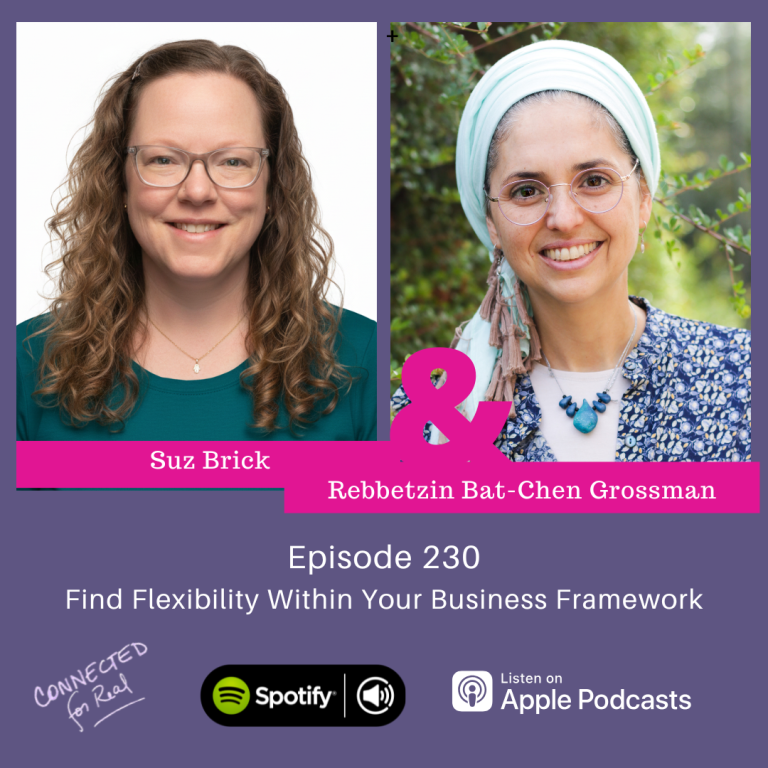
230. Find Flexibility Within Your Business Framework
Suz Brick leverages her background in business communications, information and knowledge management, program and project management, and operations management to help small businesses score big wins. Her products, services, events, and content can help you grow your biz skills, streamline your processes, and more. Rebbetzin Bat-Chen Grossman is a marriage coach for women in business. Join them as they discuss how to find flexibility within the structure of business.
Transcript:
Welcome to the Connected For Real podcast. I’m Rebbetzin Bat-Chen Grossman, a marriage coach for women in business. And my mission is to bring God’s presence into your life, into your marriage and into your business. Let’s get started. And we are live. Welcome everyone to the Connected for Real podcast. I am Roberton Bran Grossman. I’m a marriage coach for women in business. That means that I am constantly juggling the two things that are pulling everybody’s attention um, and two different directions. And I help you bring it all together and balance it by bringing God into it and really gathering all the energies that are going all over the place, up to one big main spot. So if you’re doing everything for God’s sake, then you are obviously in the right place. And today with me as an awesome guest to introduce yourself. Hi everyone. My name’s Suzanne Brick. Or. Everybody just calls me Suze and I run a business called SB SuccessFactor, helping small businesses like yours and mine with all their business communications, content creation and programming and copy work needs. And yeah, my background is in business management and program and project management with a lot of information and knowledge systems and solutions mixed in there. And you know, just a lot of communications related work and digital marketing type stuff thrown in. Yeah. Excited to be here. Thank you so much for having me on. I can’t wait to talk to everybody. This is going to be such a cool episode. You guys have to know. Sometimes I meet people and I’m like, oh, you gotta be on my podcast. And this was one of them. So I’m very excited. I have a lot of very excited energy right now. So you guys, if you’ve been listening for out and if not then welcome. I have four pillars. My business is one of four things that are really pulling my energy. God is at the core marriage business and you. So I believe that if you have all these four in place, then you are actually going to create flow because everything’s working together. Today’s episode is specifically about business. ’cause I have, based on the four pillars, the four different weeks of the month, and a main topic that pulls all of the month together is flexibility. So since we are in the month of flexibility and we’re in the specific topic of business, we’re talking about flexibility specifically when it comes to your business. Of course, we’re gonna talk about all the other pillars too. We could talk about anything we want ’cause it’s our podcast and I am having fun. But let’s talk about flexibility when it comes to having a plan and trying to communicate what you’re doing, like for mm-hmm. For a lot of the small businesses, it feels like we’re being told to say the same thing over and over again and repeat yourself and really hone in on the messaging and know what you’re saying and sharpen and pinpoint and then hold it and don’t move type of thing. Yeah. And it’s not flexible. It doesn’t feel very go with the flow and a lot of times things that you wanna do like, oh, I’m just gonna shape shift and just talk about what I feel like talking about doesn’t end up going so well when talking about, when we’re talking about messaging, when we’re talking about, communicating what you do, trying to get your business out there. Yeah. I think it’s really interesting too. I love the idea of the pillars because there’s this idea of the eight dimensions of wellness. And so I don’t remember all of ’em off the top of my head, but spirituality, occupational, social I don’t know. There, there’s all these different, they’re like pieces of a pie, right? Right. And they’re like levers you could push on one and it impacts the others, right? And I think that flexibility and communication really impact all of them. It’s like something that kind of, it’s not even lays on top, but just like an underpinning, right? And so I think that’s a really great thing to think about and a way to to frame it up in your mind. And the other thing you’re making me think about is, life is not like a stone tablet with, the runes etched in it, we live in a dynamic, time the markets like from a business perspective, are always changing. We as people are changing. We go through different seasons of life. Our businesses go through different stages. So you know, what you did five years ago or what was expected five years ago might not be the right thing for you or for your audience or for your business now or as you look into the future. And there’s a lot of stuff that’s out of our control, but there is so much that we can do that we have agency over to make impacts and, help drive some of those results. Yeah, it all dovetails together so beautifully. Yeah. Yeah. Yeah. I love that you said that there are things that are just timeless and universal that are going to help you. In all pillars, in all situations and all the things. And I like getting practical here. So I’d like to hear more about that and practically, how can we focus on the things that we can control and the things that are in, you know, the levers that we can pull so that we’re not sitting there going, what do I do now? Everything has changed again. Yeah. Yeah. And I think it’s definitely really timely too, because people now are just. We were running at breakneck speeds and feel like we don’t have the bandwidth mentally or schedule wise to do everything we wanna do. And the other thing that’s, and especially in my world is that’s a huge impact is AI, everything. I think we’re finally getting past the point where it’s everything to everyone for every reason. But the reason I mentioned that specifically is that I think we’re coming back to this idea of human connection experiential encounters or interactions. And just really doubling down on this idea of authenticity and being true to yourself. Building in flow, building in ease, building in a burnout free approach. So we started getting, talking about getting practical and like actual. Actionable, doable things that is gonna be central because you’re trying to build a business. You’re not building a business for your business. You’re building a business to support your life and lifestyle and what you want and deserve. So at least that’s my philosophy. I don’t know too many people who are like, I love working. They’re just like, I have to say I love working and yeah. I don’t like doing the hard stuff or the boring stuff, or the things that could be delegated or automated. So I do it smart. I, and like you said, yes, I like the human connection, which is what makes it so fun for me. I enjoy. That’s also what differentiates you though, right? Exactly. That’s the magic, right? There’s probably, I don’t know, thousands of people who do, let’s say, for example, copywriting or, so whatever. And why is somebody gonna choose me? It’s because of me, the, I don’t know the quo that, that makes me and my approach mine and how we’re all different people when we, depending on who we’re interacting with. So that’s what’s special. That’s the magic. And you absolutely have to, honor that and build it in and Yeah. To pride it. I have a great example for you. So we’re recording before my daughter gets married, but this episode airs after she gets married. So you guys are gonna have to do the math and, follow up on Instagram if you wanna see actual pictures. But, I have a really good example because I was looking for a photographer for a very long time, and it’s one of the reasons why I’ve been so stressed and every photographer I text, people are sending me referrals and I’m sending messages, hi, what’s the story? Are you available this day? What are your prices? And whatever. And everybody is texting back and forth with me. Some of them have automated responses, some of them don’t get back to you. Some of them are just like all over the place. And this one guy says, sure, can I call you? And I was like, wow. What a mind blowing concept. Yes, of course you could call me. And within 20 minutes we had a photographer. He knows what I want. He’s up, giving me the best price because he listened to my needs. He’s aware of what’s going on. He’s like, yes, I can do this. I can even get this and that, and whatever. The whole thing just fell into place as soon as he picked up the phone and he got the job because he had a human connection, I just could not get over the fact that texting everyone and running after everyone and trying to, keep tabs in my head about who answered and who am I supposed to follow up with and what’s going on with this. Yeah. And how much did this guy say and what did the other guy say and which one is more expensive and what is he giving for what? And then this guy just like, pull it all away, just, yeah. Completely swallowed everyone by making a real connection. Yeah. I think also the thing that stands out to me there is that he was responding to your particular need and he also streamlined the process. He cut out a bunch of the stuff that was mental clutter for you and just, shorten the, it’s great for him too. He shortened the buying cycle the customer journey. Of course. Yeah. And the benefit was, it was, that was good for you and it was good for him. So that was definitely and I’m sure it’ll be beautiful photos and there’ll be a win, win all around and it’ll be amazing. Yes. Yeah I’m excited about it. You know why? Because it feels so good to work with people who are like you. I am so human. I share a lot about my humanness on my podcast, and I like talking to people, and I’m willing to give them my time of day because I really believe that is the way to do business. Yeah. Yeah. I agree. It feels a little old school, but like you were saying, there’s, I, there are some. Classical moves or traditions that, they have staying power because they work, and they like, they’re in the sense that there’s true value there. I’m gonna give the other side of that feel so disconnected. Yeah. I’m gonna give the other side of that too. ’cause I don’t want people to think what’s the point of automating or what’s the point of having autoresponders or blah, blah blah. Actually, there is a point and it’s wonderful if you can make it human. So you could say this is an autoresponder, but instead of making it boring and whatever, you can be yourself I had someone who wanted to be on my podcast. She texted me on WhatsApp, Hey, I heard you have a podcast. I really wanna blah, blah, blah. This is how I heard about you. And I was like, oh, sure. She’s, I heard, I know who she is. I’m totally letting her on. So I gave her an autoresponder, like a, one of those like shortcuts, which I already wrote before, with all of the links that they need for podcasts. So if they need, if they need to fill out my form, they need to schedule a thing, and they need to know my rules about, not cursing and, being nice and having fun and whatever. I have a, a bullet thing. I sent it to her within two seconds. Yes, you could be on, boom. And she loved it. She’s like, wow. It’s all so organized. I love it. I’m so happy. And so like, as human as I am and as much connection as I love and all of that good stuff, I also am leaning into streamlining and being smart about things. I feel like there is a very big balance there. They’re definitely not mutually exclusive. There’s that, that, if you imagine a Venn diagram, there’s a really big piece in the intersection. ’cause the other thing about being like automated and streamlined that sort of thing, using really smart systems and using tools in a savvy way is that you can definitely incorporate the humanness in the way that you’re talking about, like really quick responses and that sort of thing. Having some personality or injecting some personality in there, but you can also use it to take care of some of the repetitive or grunt work type stuff. So you’re actually. Creating space in your schedule time, in your and space mentally to actually have interactions, to actually go to networking events, to actually host live workshops or what, like whatever your thing is. Or take time and do nothing. Work fewer hours and then go spend time with your family or friends or, taking care of yourself. And that’s another humanness aspect, so it’s not just injecting, still injecting the person into the automated stuff, but actually clearing out some of that clutter or lower value tasks so you have more space for these higher tasks or higher value, higher reward things that you might wanna be doing. That’s amazing. Yeah. I feel like I hijacked the conversation when I started talking about flexibility in business and what comes up for me. But I wanna hear what comes up for you, what comes up for you when we are talking about business and then staying flexible and communicating properly and just going. Yeah. I think the big thing to remember is if you are an effective and efficient communicator, then you are in many different ways, which I can get into. You are creating that space to ha to have the time and mental energy and other resources to focus on your yourself elsewhere in your business that you could be, or your life, whatever your need is. And when you have that space, then that’s the flexibility. You could use that space to do more in your business, to, maybe you wanna scale or go pivot or do more whatever, but maybe you’re, you need in that season of life, you want to spend more time with your family, you need to go find a photographer, you need to arrange a wedding, you need to, send your daughter off. Or maybe just want to go to you mentioned you like yoga, so maybe you wanna go to a weekend yoga retreat or a three day yoga, whatever. You wanna go on vacation. You wanna sleep in one day and do nothing you want every Friday in the summer off. Like you’re creating that space to be able to do that. And there’s so many things that go with it that at first blush might not seem like their flexibility, but in my mind they are. So I think when you’re a good communicator or, and you have good systems. In place supporting you. Then there’s all kinds of things you can be you could be maybe more able to get your message across in a meaningful way that resonates with your audience. You could be able to build confidence and momentum with whatever you’re trying to communicate or yourself as a communicator. And that can serve you everywhere in your life. In business, you could be reducing the amount of errors that you’re putting out, because you’re just more tuned in and you’ve got checks and balances in place which could then mean, if you’re not putting more error or if you’re putting fewer errors out, you’re spending less time doing cleanup work or follow up work, or, damage control or reputational repair whatever it means in your circumstances, you are able to be more agile and resilient, which means that ’cause change is always gonna come up, the best laid plans, right? So if you are an effective and efficient communicator, then you can be more agile and resilient, meaning that you can be more, hopefully you’ll be more prepared and proactive. And so these bumps in the roads will feel like bumps and not mountains or sinkholes. But yeah, you’ll be able to be more proactive. You’ll be able to be more thoughtfully or intentionally responsive when changes or unexpected things come up rather than reactive or random or just really trying to run around and save yourself, in a very disorganized, chaotic way. Yeah, and I think overall it can again, create opportunities help you really develop your strengths and focus where you want to be or need to be in your life and business. And yeah, I think good communication is also really foundational for any kind of good relationship and, you know, yes. Kind of Bring it back to your area. Especially with the business and relationships, in your business, you probably not necessarily going to be working with your spouse, but you are working with a lot of other people, or engaging with other people. You have to have good communication to keep those relationships strong. And when they’re strong and something comes up, you have people, you have this network that you’re tapped into. They get you, they understand they’re gonna be more willing to give you some grace. They’re gonna be more maybe engaging or responsive and try to help or yeah. Yeah. So let’s get into like specifics or examples. What type of people work with you and what are the types of issues that they’re bringing up that you think you’re able to help them with? Because I feel like a lot of people are listening, going, this is very nice, it’s theoretical. I want her to bring it down to practical. I wanna hear about Okay. Me sitting right here in my, wherever the listener is, yeah. Hi listener. I love you. A couple examples right off the bat one of ’em I’m actually living through right now. So I contribute to a lot of bundles and summits and I’m in one right now where it was not going well. And the host was trying to fix it. And so there’s this whole dialogue going on in, in Messenger, Facebook Messenger and this communication conduit has brought about this person changing the way midstream the bundle is. It’s still live. It’s changing how she’s doing the bundle. And it’s because of the feedback and conversation we’ve had within in the group of contributors. And I actually had a similar, similar experience with a bundle that I was hosting where my contributors weren’t getting enough signups. They weren’t generating enough leads, so I ended up changing. My bundle from being paid only to adding a free tier. And then people started getting a lot more leads and I had to leave it up to them to be the ones to go ahead and sell to those people if they’re maybe not as warm leads. So I think that’s a great example. ’cause I think in our businesses or in life in general, we’re always seeing things that are collaborative. And with these open lines of communication, we were able to first of all, recognize that there was an issue. Second of all, discuss the impact and meaning of that. Brainstorm some ideas of how to fix and ultimately fix it or make a change to hopefully fix it. And now people are starting to get more signups. So that’s a really like real life boots on the ground example. The other thing that comes to mind is that one of the things that I advocate for and. Help my people with is keeping a a communications or content calendar. And I know that a lot of people feel like that’s really tedious and it’s very rigid, but I actually advocate for an approach that is it’s more like a framework and you know, I can give you a template, but then maybe you don’t wanna track or fill in all the things so you make it your own. So there’s an idea of flexibility and making it work for you. And the reason I advocate for having a rolling content schedule or communication schedule is so that it coordinates really well with a a planning year. What do you wanna do or accomplish in during your year? It helps you make sure that you’re staying on task. Like you always know what’s coming up again, because if you could see what’s coming up, you could be more prepared. Or if something, you know, opportunity arises, like being on your podcast, I’m able to squeeze it in ’cause I know. What’s coming up? And it’s again, not carved in stone, right? So I can go in and I can adjust this. I wanted to squeeze in a promotion this week that I hadn’t planned on. So I was able to go and look what I had committed to and move things around. And now I was able to fit in a promotion that I wanted to do. So I have this it’s structured. I have my guardrails here, but it’s a hundred percent customizable, totally flexible, and it just makes it so that I can be, that’s just one, one thing, right? But it has the ripple effects in the rest of my business. And yeah, let’s talk about that more. ’cause I feel like every small business has to communicate what they’re doing, usually in the way of content, because how else are you gonna tell people what you’re doing? If not by feeding, it’s the. Feeding information into the world. And a lot of people say, I hate social media. I don’t wanna do it on social media. It doesn’t have to be on social media. No. It just needs to be communicated. So you could have a bulletin board outside of your house for all I care, but it has to keep changing and it has to tell people what it’s doing. If you’re, if you are using WhatsApp and you’re putting it on your status, here in Israel is very, yeah. Very successful and common to be using your status as a Yeah, I think that’s a good point. A lot of people use the word content, like it means social captions or, the dancing TikTok videos. No I’m not really on face social media very much just. I don’t know. It’s not speaking my language. I don’t know. It’s not for me. But it’s not for a lot of people. You’ll be surprised. Yeah. And I, to be honest, I don’t think that, for me, for my business, it, there’s the return on investment and the return on energy is just not there. Like my efforts are just much better spent doing email marketing more engagements like being in summits, bundles, podcasts, that sort of thing. Hosting events, that sort of thing. So that’s where I concentrate. But this is also content. So communications content is the vehicle for your communication. Communication is the the artifacts and the systems related to conveying information. Ideas, share this exchange of ideas. And the content is the thing that’s getting somebody from point A to point B. And so that could be a webpage, it could be a social post, it could be a image, it could be a video, a podcast it could be a sales page, it could be, your custom t-shirt and the banner you have up at the trade show, all of that. It could be your body language, right? Ask people to dress. I think I saw somewhere you were asking people to dress modestly. Definitely there’s flexibility in there with your communication, choosing the kinds of content and the platforms or channels you shared on, and the times of day and how you put it together, the format. Are you doing, long form text? Are you doing a video? Are you doing an image? That’s all space for you to have flexibility to some extent. Obviously if your YouTube is your platform, you’re gonna do a video but you also have the description, you have the community, you have the comments, so you have flexibility in that sense, and you can make it so that it feels good to you. And it’s the right fit for your business, for your needs, for your audience, where your audience is hanging out for the processes you wanna put in place so that you can make it all work for you. But I think it, when you’re doing something like that, you. It really helps having a schedule or a list of what you’re doing because you want to be able to you want things to make sense at this kind of ecosystem level. Like you don’t wanna say one thing on your website and then another thing on your sales page, for example, like having raw, conflicting information. Again, fewer errors makes you come across as more professional and like an expert and, yeah. Yeah. When I was a graphic designer, we would talk about consistency a lot. Just having the, the business card be very similar to the, magazine. Very, Very similar to the whatever. And you’re thinking this is boring. No, it’s not. It’s called consistent. You don’t go changing the font every time you’re trying to convey something. You get a consistent message and then you start sharing it. And I wanna talk about that a little bit. Also, I have another thing that’s coming up for me to talk about, so maybe I won’t confuse you with two things, but yeah, let’s talk about that for a minute. Yeah, absolutely. I as a business owner, I think it’s really important to have that consistency that ’cause it makes your, ’cause you’re trying to convey more comprehensive comprehensible. And I think it saves you time. It might take a little bit more effort at the beginning to create like a brand book or whatnot, but it will save you time, it reduces decision fatigue down the line. You’re not having to think about what colors do I use, what fonts do I use, how do I do the spacing? What kind of, copy style it’ll save you time and effort. It’ll help you come across looking more professional. And you can start templatizing things so that you know you’re not always starting from scratch. Invent. Yeah, let’s talk about that. Let’s talk about the messaging. If somebody is starting out or is already, long down the line, it doesn’t really matter. I feel like there’s certain things that you can help us ease when, the way you’re talking, making templates and like creating a book of rules about your business and how you communicate certain things. Tell me more about that. What specific examples or practical things you can get our listeners feeling all like, yes, that was what I needed to hear. Yeah. I have a couple things. Creating a brand book is a great idea and that’s just a document, a living document. ’cause it can change over time. It’s a flexible document. That just kind of records basic elements about how you’re presenting yourself. To your audience or to the world. And that could be, your brand colors. Like most people have some sort of palette that includes, I don’t know, three to 10 colors, let’s say. And they’ve got a few different kinds of fonts and how and when they’ll use them for a title or a subheading or for body text. And I, my background is more in the copywriting space, so I would personally come up with things like grammar or language usage rules like capitalization for titles or when not to use an ampersand. And it sounds really tedious and like you’re getting into the weeds, but my perspective is I’m sure you’ve seen like product ads or something where there’s like a misspelled word or. Like they use a possessive instead of the plural. And you might not know how to fix it, but something mentally, energetically catches on it. It’s a, it’s like a nail that you get snagged on. And it, even if it’s subconscious, I believe that you’re detracting from your message. You’re pulling people away from what you want them to do, whatever your call to action is. So I think things like that matter. You mentioned templates. Templates or having a swipe file. So a swipe file is just maybe a document or a spreadsheet where you keep little snippets of text that you wanna use. That could be testimonials from your clients. It could be bits of. Copywriting that you’ve used in the past that you really liked or that worked really well? Like a tagline or a motto? And just like a file where you where you keep all that corralled to reference back. And yeah so things like templates or swipe files could save you time. ’cause you’re not starting from zero when you go to do whatever. It’s, you do. So for example, I never write an email from scratch. I always go back to an old email and copy it or clone it or whatever your system calls that action of duplicating. And I start from that. I just update the pieces and need be updated, but it’s already got in my, my footer, my signature, and my logo thing at the top. And, it saves me a lot of time. It saved me a lot of effort that reduces the decision f fatigue. In the beginning when I was personally sending every one of my clients the agreement. I had a template where I would, change their name, change the date, change a little bit of this, whatever. And it was so good because as soon as I automated it, I bought into this like, you know, sign signature or something, or rather, and don’t ask me what it’s called, I don’t remember. But as soon as I set it up and I gave it the template, and then I said, name here, date here, blah, blah, blah here, and I didn’t have to do anything. It was already done, yeah. So I feel like, because I was thinking this way before I automated, then automating made it so much easier because I already knew what I was doing. Yeah. I think you have to have the, like the templates and the, these artifacts, like the templates the copy, the, reference docs, whatever, first, and then you have to have processes in place and then it processes and systems. And then that third piece is figuring out how to automate where you can, or delegate where you can. But you can’t, it’s really hard to automate something if you don’t have that something in the first place, exactly. ’cause any automation, you’re gonna have to map out that flow, that, that process. Hey, before we continue the episode, I want to ask you something. Are you ready to get answers from God directly, feel more in love with your husband and more supported than ever? Run the business of your dreams without having to sacrifice any other part of your life? That is exactly what my one-on-one private coaching is for, and I want to invite you, just you and me. For a free deep dive discovery call, this is a 60 minute free call where I ask you lots of questions and we extract the three main things that are holding you back. I then put together a personalized plan for you where I create a roadmap of recommendations. With practical steps, the call is free and so valuable in itself. So go book yours today. I’m Raina Balsam I live in Arizona, and I help women wake up to their own amazingness, their own brilliance, their self-confidence, and give ’em opportunities to connect with other women. I love your energy and the podcast. That’s really what called me to book the Discovery Call because you have so much vitality and energy in the podcast and there’s a lot of life energy and excitement and as a person who is super passionate and doing a lot of things I loved and was very attracted to that energy and excitement and natural zest for life, which I think is just so important to have, as women in Yiddish kite, we need that energy. And, and you had that, and that’s what called me to get some wisdom from you, which I definitely did. The discovery call was awesome and I really, really enjoyed all the different directions you led me in to realize something powerful that shifted within myself, which was really, really cool. I always gain from discovery calls. When I meet clients, and I like when I was in that season of being a life coach and meeting clients, like just the height of my day, like, you meet awesome people. So that’s from the, the coach’s perspective. And, and then from the, person booking the discovery. I never forget the idea I think it’s from the Arizal that says, sometimes, really the one that’s seeking, the one that’s yearning, the one that wants to grow, that wants to receive from the person that has more wisdom. Really, the secret in Hashem’s eyes is that they’re the greater one. And so don’t be afraid to seek wisdom. Don’t be afraid to reach out to people who are much older than you, much wiser than you have more experience than you, because it just shows that you’re a searcher. So I’m never ashamed to be the receiver and to be the person watching the show and applauding the audience because they’re sometimes even more important than the people on stage. Now back to the show. Yeah. Awareness is, I think, like they say, 80% of the work when you’re aware of what’s actually being repeated or what you’re being asked to say over and over again, then oh, that’s something that should go in there. Yeah. And it’s easy. Yeah. And you, you asked for actionable tips, and that’s actually the first thing I wrote down is documenting things. As an example writing a an SOP standard operating procedure or your policies writing your policies down. Every business should have that, and I, it might even be required, I think to have a for example, a terms and conditions or privacy policy page for your website. Or at least for your business somewhere. And writing and documenting things, writing it down is super important for a couple reasons. One, it makes it so you don’t forget and you’re more likely to fulfill those obligations if it’s written down. It’s kinda like a goal. You’re five times more likely to write down accomplish goal. You write down there’s the legal aspect, the potential legal aspect of it and it sets those expectations and it communicates with your audience so they know what to expect. They know the rules of the road. And when you, the next step from that, you can then leverage those pieces of documentation to do the things like the automation and again, create some space so you can do other stuff. Yeah, but that was the first thing I wrote down is SOPs policies and your testimonials or key messaging points or things that are really good to capture somewhere. If you’re not a writing type person, you can even capture some of that stuff in I don’t know, a little video diary or whatever. I, whatever is appropriate for the context, yeah. Wow. Testimonials all in one place sound like a dream because. I try to do that. I have a lot of testimonials, thank God. Yeah. A lot of people like me, and I’m very grateful for that. A lot of people to do, and what I actually have a, I might even have it in one of my bundles I’m doing right now, but it’s a messaging library that, a voice of customer and testimonial library where you can put in and it’s just a simple spreadsheet with different tabs. You can have a tab for your testimonials, a tab for the messaging pieces, a tab for snippets of responses and things, emails you might have gotten back from customers. And it’s just a, altogether it’s a little bank of these little pieces of text and ideas. Yeah, it’s really helpful for a lot of people to do that. That’s really cool. Maybe we can give that to all of our listeners. Will you give us the link? Sure. Yeah. I can give a code or something. Yeah. That’s so cool. Yeah. Okay, cool. So let’s talk about flexibility in business, especially you talked about having a plan for the year or thinking ahead and just seeing it as a framework and knowing what I’m up to, knowing what, what’s coming. Not being caught by a surprise by all these different things like holidays and so on. Yeah. In the past I remember myself in high school and my friend would be like, what do you mean tomorrow there’s no school? I’d be like, what? Because I was really not connected when I was there. I was like totally out. Yeah, I am so go with the flow in my nature that I just show up to school and be like, what are we doing today? And I’d be like, there’s a test. Oh, there is, so teach me something quick. And that’s how I was. Yeah. So when we’re talking about the full picture and trying to plan for the year. How do we do that in a way that actually feels responsible? Like so many things have thrown us off this year. Yeah. Last, whatever. It’s just been, I dunno what possibly mean. Yeah, I think that I’m gonna be straight out and say that the typical year long, set in December, sitting down and creating my goals and plan for 2026, I’m not that person. I, I’m in a season of life. I’m not in that sandwich generation where I am trying to help an aging parent. And so I need some flexibility around that in case I need to go. Some of our family lives abroad, so we have to, have some flexibility if we wanna go see them. And yeah, so I’d say first of all, you have to be realistic with yourself. Everybody has their own unique communication style, learning style, and work style. Okay? So what works? It’s not putting the square peg in a triangle shape hole, right? You can’t, shoehorn it in there. You got to figure out what works for you and your life. And it may change over time. ’cause we, the seasons of life and business evolve. So I would say, this is another practical tip. I have it, it doesn’t sound practical, but it’s true. You gotta experiment. There’s gonna be a little bit of trial error. And the thing I like about experiment, and actually I’m experimenting with using experiments rather than goals or resolutions this year for me it feels like a more flexible container and it feels lighter. It feels like there’s no such thing as a failed experiment. There’s just lessons learned. And then you take those lessons and you come up with your next experiment. And so that’s how I’m approaching my year. It’s actually working really great for me. It feels much more positive. And so I would say experiment with different approaches. Some people doing that year long plan works. Some, a lot of other people break it down. They do quarterly plans. I’m experimenting with experiments. And you might have a different approach depending on d for different aspects of your business. So for my communications component of my business, I have a rolling schedule, so it’s, it looks out like at least 30 days, but the idea is there, there’s up to 90 days at times for some aspects of what I’m doing. Communications wise in my business, and it’s just rolling. Like I might put on there these big things I have throughout the year or like recurring things, but these one-off things just get added in. But I try to add them in 30 to 60 days in advance. Where it’s possible. So yeah, experiment. Find something that suits your personal style and your life but that’s effective for your business. And in terms of communication and business, I think a lot of people don’t recognize this, but self communication is a thing that internalize talking yourself, the messaging you’re telling yourself, what are the messages you’re sending yourself are really important too. And they factor in because that’s how you’re gonna know if something’s working or not. Or something feels right. Or feels icky. And you can’t be flexible without first having some information to go on. ’cause flexibility brings the idea of change and you won’t know if or what to change if you’re not, coming up with I ideas and data points and insights and, figuring out where to flex to. Um. So, yeah, so, so That, yeah. I think, we’re, you were bringing up yoga before, and I’m thinking the most flexible things you do usually involve relaxing into it and not stressing about it, or, just like being aware of where you’re at and being aware of where you’re going and what’s going on around you, and what your ability is and can I breathe into it and can I hold the space? There is something very powerful about what you just said. That flexibility isn’t this like thing that’s disconnected from everything else, but it’s really important for you to take the minute to notice what’s around you, what’s going on? Why am I being asked to be flexible and what’s available to me. It’s very powerful. Yeah. It’s also that the idea of there’s different levels in terms of you can look at your business from this 30,000 foot. Perspective, but then you can zoom down and get ultimately to a three foot level. So at this 30,000 foot level, it’s much more about strategy, mission those really fluffy stuff per se. And then at the three foot level, you’re talking tactical, you’re talking about tasks, activities, steps that you’re doing to make all this stuff happen. And there’s, it’s not everybody, but it’s like that’s able to do this. But to be able to cultivate this ability to go from up here and then zoom down and you’re telescoping in and out is a great way to help yourself to build a skill, to be able to be more flexible. ’cause you’re able to. See how something you’re doing down here impacts up here and vice versa. Oh, I love that. And I also think it has everything to do with what you said about communicating with yourself. Because if you can collect the evidence of what you’re doing now and how it affects the big picture, yeah, you’re going to be a lot more motivated to do the boring stuff because you’re going to think Yeah, and I’m not sure, I’m not sure if that self-talk is way up here or if it’s down here or if it’s throughout, but so the other thing I wanted to mention is that, so it’s not just self-talk, so you have different kinds of communication, right? Depending on who the audience is. And I like to think of it in three tiers. So you have this self communication where it’s your dialogue with yourself, your conversation with yourself, the messaging, the, all that jazz. And then you have what I call internal or organizational. Communication. And that’s if you’re in a big corporate setting, that might be, HR is sending a message out to everybody, or it’s the message your team leader is sending to. That’s, amongst the team or within your organization. That could be the SOP that you’re creating, right? The policy document that you’re creating. Your little product creation checklist that you do, that’s an internal communication. It’s not something you’re sharing with prospects or clients or investors or whatever. And then you have external communications, which is anything that you’re communicating, any content you’re sharing outside, which is it could be public information, like something you post on social media, or it could be private information, like something you’d send to, graphic, I don’t know, I was gonna say graphic designer, but that’s not true. But to, to your customers, or a client in a portal or something. You have different kinds of communication tiers or brackets however you wanna call it. But yeah. And they each work at the different levels of 30,000 foot and the three foot. And I feel like it sounds really complicated, but it’s, if you think of it distilled down to a framework, are you talking to yourself? Are you talking to your team or are you talking to people outside, like customers or whatever, is this something that, that is really like a task or is it something that’s more strategy and planning level? It simplifies a little bit and you can see how different pieces fit together and it’s, it can be like a puzzle, you can combine different pieces in different ways. There’s flexibility in there. It’s a framework, but there’s flexibility, right? Because you’re operating from a perspective of a place of understanding that there’s moving parts and they can fit together in different ways that fits you and your business and your life. That’s amazing. I was looking at the calendar and I realized that this episode drops right after Passover when there’s this like sense of relief because now I have some time to work on my business or in my business or whatever it is. And there’s also this sense of dread because August and the summer are very near and there is my, having to stop everything again. There’s a little bit of pressure to get something done in this season, but also this like shadowing summer vacation and then there’s the holidays and so there’s a lot of. This feeling of helplessness during this season on one hand, you know? Mm-hmm. ah, it’s finally I could sit down and work. And then when you sit down to work, you’re like, I don’t know what to do first, because I don’t know how much time I’m gonna have or what my schedule’s gonna look like. There’s a lot Yeah. Of this feeling. And I, I’m talking from Passover, framework or whatever, but I feel like a lot of people have this, and it could be in every business where you sit down to work and you know you have time to work now, but you’re stressing about how much time I’m going to actually be able to sustain this. What am I gonna be able to do? How am I gonna know what to do first? Give us a little bit of that. ’cause I feel like it’s gonna be something that’s really helpful for the listeners. Yeah. I think everybody goes through that and, whether Passover is their valve point or, not I think that’s just natural in life. And so first I think the first thing is just accept it. Acknowledge it. It’s one of those things that you don’t really have control over. So I think that’s a good starting place. And then take stock of what you do have control over and then build something to support you at those moments. So I know a lot of people do they call ’em like what do they call ’em, like energy maps or energy menus? So from, as an example for communications, let’s think of it in terms of a grid where you have across the top high energy, medium energy, low to no energy. So like on a high level energy level day you might do, write a blog post, do a video, and so you give yourself some options. The medium energy day, maybe it’s write an email. To your list. And on the low energy day, maybe it’s comment on somebody else’s social posting, so you’re giving yourself a few options at each energy level, and you could do that across different functions in your business. I’m giving an example of communications things that you can do for, to get some content out into the world if you’re at a high, medium, or low energy level. And the great thing about that is you prepare it in advance and then when you’re sitting down to work, you can be like, okay, I’m feeling super energized right now. Here’s something I can do. You’ve just gotten rid of any decision making that you really need to do. ’cause hopefully alongside that, you’ve got, if you’re a high energy test that you could do or write a blog post or create a video or record a podcast. Hopefully you’ve got some topic ideas. Banked somewhere, or, already in mind and you can just go to work. So I’ve definitely heard of people doing that as a strategy. One of the things I like to do is I actually have just a running to-do list in my, it’s part of my email client. It’s sucked in my Google, what do they call it? Google Task list. And so I just have a running list of things I could do or need to do, and then I take that each week or at the end of each day or the end of each week, and I actually block time on my calendar for the time to work on those to-dos. And they move around. I’m not gonna lie. And it generally takes me longer to do anything that I ever allocate time for. It’s there. So it’s in my mind. And I’ve reduced some of the decision fatigue. I’ve reduced some of the planning because I have it. There. And when I’m ready to go to work, I can just jump into that task. And the last thing I will say is that I recently watched a video from Daniel Pink, and he was saying that I think it was Daniel Pink. No, it was somebody else, and I can’t remember his name, so I’ll find it and I’ll send it to you. It was Daniel Pink had some great ideas too, but this other video is saying that if you stop a task, not at a point of a stopping point, but in the middle of it it creates some, something in your brain, like a hook or something, so that when you jump back into it, you’re able to start up faster. It’s a cognitive thing. I don’t know what it’s called though, but yeah, I’ve heard this in regards to writing a book. People who are writers are told to stop mid sentence not to finish your sentence. Anyway. Did that what, hemingway did that. Yeah. Is so you gave in the video. It is so cool. You stop something midway. I just told my daughter this yesterday. She said, let me finish writing this thing and then I’ll call the whoever she needed to call. And it was like this dreadful call she didn’t wanna make. So I said no, you stop right now. Mid-sentence, whatever you’re writing, you go call. And then when you come back from the call, you’re gonna feel really energized to go back into it because you’re not gonna sit there and have this like drop of energy. I just did something hard. It’s gonna be more like, okay, I’m done with that. Let me go back to, yeah, and then you know what you’re doing. Of course that assumes you have a good memory. I do not. So I’d be like, oh, that train is totally derailed. But for some people that might be a tactic to try. Again, I, it comes back to this idea of trial and error, experimentation. It’s really hard to be prescriptive with something like that ’cause it’s so personal. Of course. But yeah, I think there’s things you can do to set yourself up, like having a bank of ideas, having an, outlines putting lists, lists together of things that possibilities of things to go work on. And then giving yourself the grace to work on what feels right in that moment, because you’re not, just so you can’t get everything done if, especially if you’re a small team or a solopreneur or whatnot. You just can’t get everything done. So you have to show up where it makes the most sense. Both, for you and what feels good and sustainable is you don’t burn out, but also to drive the results. And one of my other practical tips that I have here is, and again, it sounds not really tangible, but it’s the idea of prioritizing setting your tasks out in terms of urgency and importance. Rank ordering ’em, so that based upon a goal, so if your goal is increase sales, then you’re gonna prioritize tasks or commun pieces of communication that support increasing sales. You’re not gonna worry about perfecting your TikTok video dance or I don’t know, I don’t know. Changing the font and the footer of your website or something. I don’t know. You’re gonna put the high results. Things, closer to the top. So Yeah. And there’s lots of tools that can help you prioritize. I have found that I need super simple because when I try using these tools that tell you, okay, how priority is this and how urgent is it? And what are, and where do you have to and now okay, plug it into your, I’m like, oh no man. And I never go back to those tools because I just feel overwhelmed. But I’ve found that, like you said, just having a place to put all of the things you need to do in one place so that it’s not in all these different notes all over the place. Also having frameworks as opposed to specific systems. Yeah. So for example, my podcast is a framework. I know that every single month I’m gonna talk about the four pillars, and then I just have to pick a topic. So I just solve myself having to pick, 52 topics by having to only pick 12. But the beauty of that is that you still have complete ability to be so creative, right? And responsive to what is going on and what’s in you in the world, or in your life, right? It’s creativity to the guardrails. That’s how I feel like, like frameworks are or outlines. And you know what’s amazing? I’m gonna refer back to a couple of months ago in the podcast flow. But right now, the season we’re in is stress. So stress and god, stress and marriage, stress and business. Mm-hmm. Stress in you. I got stress in business and stress in you right away. I had guests and it was amazing, but I could not find a guest for stress and marriage for the life of me. And I could not find a guest for stress in God. Even though I did find the guest. He wasn’t available at the time. I needed to record so that we can go live on time. So I skipped two weeks of my podcast because I myself was stressed out getting this wedding planned. And I feel like that is a hundred percent flexibility in my business. Yeah. I cannot stress over too many things and. Knowing that these were the topics and we haven’t addressed them, maybe we’ll come back and, figure them out. I also think that, I also think that we are our own worst critics. Our own biggest critics. And they used to say that with advertising, a person needed to see an ad three times to have this concept of this thing that’s being advertised go from out here in the nebulous space to be internalized and register in the brain. And I would argue that now because we have such shortened attention spans and media cycles are so short and there’s so much that’s like algorithm driven, that we actually need a lot more exposures to something before it, it clicks in general, generally speaking. So the idea that we are own worst critics and biggest critics, and this idea of needing more exposures. It kinda leads me to believe that it, for example, if you miss a week of, if you have a weekly newsletter or monthly podcast, whatever, and you miss one, most of the time you’re probably gonna be the only person who realizes it. You know what I mean? Probably. And as much as I say you should proofread everything. So you come across really professional. I have typos and mistakes in my own emails once in a while, or I miss a word or whatever. It’s no big deal. Nobody notices, nobody cares. Like you do, half the people are not gonna see it. And other people, the rest of the people are gonna be like, okay. Yeah. It’s just, I yeah, definitely you have the flexibility and you can give yourself grace without guilt, you know? yeah. So yeah. I love how you pulled that all together for us towards the end. It’s so powerful. ’cause the truth is, nobody did notice nobody wrote me an email going, are you okay? Is everything okay? Is your business falling apart? Because two weeks in a row you haven’t released an episode. And no, I, my goal is to then, record a short explanation of why I am, I’m feeling so ironic about the fact that the two stress weeks have been missed because I am stressed and how I’m dealing with my stress anyway. So go back and listen to that. It’s probably very entertaining. Where could people find you? Is there anything else you wanna speak about to wrap it all up? Is there something you feel like we missed talking about? I would just say that yeah, give yourself grace. You don’t have to be perfect. In fact done is better per than perfect. Perfection is the enemy of progress. And I think that the idea of being flexible is to help you down your path towards success making progress, prosperity, abundance, and that sort of thing. And everything is changing all the time, so you just kinda have to go with a little bit and be okay with that. We’re all just doing the best that we can. So do the best you can, be true to yourself. And I think that will open you up to opportunities and, this prosperity that you are hoping for and working towards and being a, an efficient and effective communicator just greases the wheel. I love that. And again, using tools and systems that are appropriate for your context that support your goals and audience and business needs will just help make all that fall into place hopefully. Yeah. And then in terms of connecting with me offline, I will give you that link to get the messaging and testimonial library so people can click through and get that and as a gift for me. And that would put them on my email list and then they’ll be able to get my weekly, I’ll say bits of wisdom, but there’s a little bit of, commentary and other stuff in there too. Yeah. And that’s a great way to stay in touch. So thank you so much for having me. I really enjoyed our conversation and, yeah, it’s been so fun. You guys make sure you look at the show notes and get the link. It’s really so fun. All of your links and social and everything is gonna be linked down below also. Huh. Amazing. Great job. Thank you for being here. Thank you for listening. You guys are awesome. I love you. I’m proud that you are listening to this ’cause it’s something that I’m so passionate about, so grateful for, and I am very grateful that you’re with me today. Don’t forget to be connected for real, and I’ll see you next time. And that’s it! Thank you for listening to the very end. I would love if you can leave a review and subscribe to the podcast. Those are things that tell the algorithm this is a good podcast and make sure to suggest it to others. Wouldn’t it be amazing if more people became more connected for real? And now take a moment and think of someone who might benefit from this episode. Can you share it with them? I am Rebbetzin Bat-Chen Grossman from connectedforreal. com. Thank you so much for listening and don’t forget you can be connected for real.