
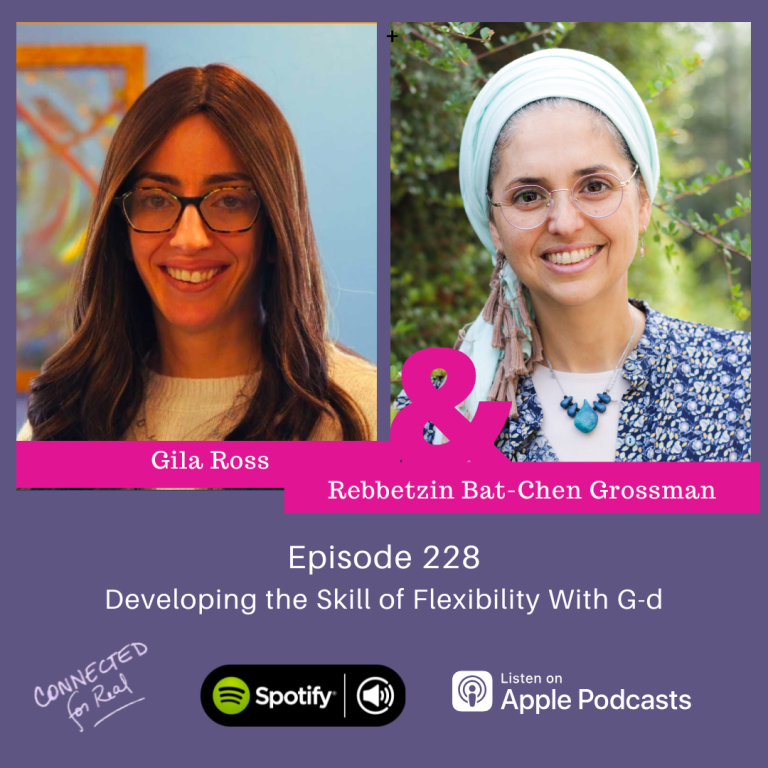
228. Developing the Skill of Flexibility With G-d
Gila Ross is an acclaimed educator and coach who has impacted lives across Germany, Canada, the UK, and the US with her vibrant, positive approach to Judaism, relationships, and positive parenting, and her Power Up! podcast was named a top Jewish podcast worldwide. She is also the author of Living Beautifully, where she draws on the wisdom of Pirkei Avos to offer practical tools for living a meaningful, balanced, and joyful life despite modern pressures. Rebbetzin Bat-Chen Grossman is a marriage coach for women in business. Join them as they discuss the topic of flexibility and G-d.
Transcript:
Welcome to the Connected For Real podcast. I’m Rebbetzin Bat-Chen Grossman, a marriage coach for women in business. And my mission is to bring God’s presence into your life, into your marriage and into your business. Let’s get started.
And we are live. Welcome everyone to the Connected for Real podcast. I’m Rebbetzin Bat-Chen Grossman, and today with me is Gila Ross. And I’m so happy ’cause Gila has been on my list for a long time and we’re finally making it happen. So today’s PO topic is flexibility and God and Gila introduce yourself and then we’ll get right into it.
Thank you. Thank you so much for having me. I’m excited to be on your podcast. The energy ready I can feel is amazing. I’m Gila. I am the mother of eight kids and I am right now living in Denver. I’ve lived in Israel in Berlin, Germany, in Canada, in the uk, and now in Denver, Colorado, I’m the author of a book called Living Beautifully and a second book coming out shortly, which is called Unbroken.
And I’m also a podcast host, so an educator, a coach, and I’m excited to be here with you. Yeah, tell everybody what your podcast is called ’cause it’s really great. Thank you. So I actually have two podcasts. I have a podcast called Power Up, which takes Jewish wisdom and brings it into our lives, right?
Like, how can we, take our lives today are like busy and connected and this, there’s so much going on. How can we take this wisdom that we get from Judaism and bring it into our lives in a meaningful way. So that’s my first podcast. My second podcast is called The Confident Parent, and that focuses on parenting.
So those are my two podcasts, and you can find them anywhere you listen to. Podcasts. Yes. Cool. So let’s get into our topic. Let me just give everybody an overview here at Connected For real we have four main pillars, God, marriage, business, and you, God is always at the core of everything we do.
Marriage and business are, we hope trying to work together to create one of those balanced lives. And then you are the container that holds all of it. So you can’t forget any of those pillars because if you leave one out and eh, make it not as important as the rest, then you’ll get all wonky.
And because here everything is all about integrating and balancing we want to address every topic from those four pillars. So this is the first of the flexibility series, and the first thing we address is always whatever we’re talking about in relationship with God. So flexibility is a really cool topic and it’s going to be the topic for the entire month.
And I guess we should start with what comes up for you when we say flexibility and God. So firstly, I love talking about flexibility. I don’t remember when I was first introduced to the topic of flexibility as a skill that we can work on, but I think that it was life changing, right?
And I try not to use that word life changing so many times because like, how many times can your life be changed? But although the truth is our life can be changed a lot of times, right? The skill of flexibility. For me, flexibility is a skill, right? And it’s a skill that we can develop and it’s a skill that we can teach, especially when we are, we’re in an A position that we can influence others, and it’s a skill that is usually hugely important in our life.
Like really important. I think it’s one of the most important skills, if I’m thinking about it in my mind, like the ability to be flexible because I think we all come into this world and as we grow up, we have an idea of what our life is gonna look like and how life is gonna play out for us and what’s gonna happen.
And, when we’re gonna meet someone, when we’re gonna get married, what type of job we’re gonna get, and then when we’re gonna have kids, if we’re gonna have kids, whatever, right? Like we have this picture of what we. Think our life is gonna look like. And I can almost guarantee you that something is not gonna go according to plan.
And sometimes it’s the small things, but for a lot of us, I think we grapple with the big things. And the flexibility I think is a huge key to getting through that. And it’s interesting that you paired flexibility with Gods ’cause I think. For me, when I think about flexibility in God, I think that the more we bring God into our lives, and the more we build our relationship with God, the more we’re able to have flexibility.
So like I see that, having God in your life, having a relationship with God is a huge foundation to having flexibility. It makes having flex flexibility a lot easier. Yeah, let’s talk about that. What does that mean? How does having God in your life add more flexibility? Because I am just gonna say this straight out.
Most people listening are like, listen lady, God is strict, he’s very square, and there’s a lot of rules and you have to follow, and it’s very rigid. So how are you talking about flexibility if God is so rigid? And I know in my life. I can tell you that I went through this with one of my coaches early on when I was working with her through, I don’t like systems.
I don’t like being told what to do. I wanna be flexible and I wanna do all the things my way. And she made me realize that when I have structure, when I have frameworks, when I have things that are supporting me, I could be flexible within that because it allows me. To not have to think about the basics or think within certain frameworks.
I’ll give you a perfect example. This podcast was like mishmash of all these guests and, oh, what are we talking about? And let’s make up a theme and let’s make up a topic. And, we would work a lot and spend a lot of time on just the basics. As soon as I created my framework of four pillars, we’re gonna use a topic per month and then address it from all.
It made my life so simple. I can meet anyone and figure out together in less than five minutes what pillar they wanna talk about, what topic they wanna talk about, what they have to do with each other. And boom, we have flexibility. To just be alive, to do our thing, to not have to overthink it.
And that all came, you say like life changing. I’ve had a lot of things that were life changing and this was one of them. It’s just the understanding that what I thought. Was going to make it more rigid and more like suffocating for me as a butterfly ended up being more freeing and more flexible.
So that’s my. Background to the question. Give us more information. I wanna hear what you mean. Yes. So firstly, I think it’s an incredible question and I love the way you like even already started to answer it. And it’s interesting ’cause I’m gonna share two stories with you. It was just yesterday I was sitting at work and this question came up, right?
Like in a work environment. I know we’re not supposed to be talking about business, but let’s go there for a second, right? There’s this, like the pull between, on the one hand, to run an organization smoothly, and especially the more you grow and if you wanna scale the business, you need processes, right?
And you need like systems. And on the other hand you need the flexibility. And I think it’s important for a second to stop and just define what does flexibility mean. So I’m gonna define it and weigh in what you think. But I’m gonna define it as the ability to respond to things when they don’t quite go as we want. I’ll give you an example, right? There’s two types of kids. There’s the, and they both come down to breakfast and their favorite cereal is finished. So there’s two responses. There’s oh my gosh, I hate this. I want my cereal. I want my cereal. And there’s the other response, which is, oh my gosh, I hate this.
I’m disappointed, and I’ll choose a second choice. So you have those feelings and whatever, and there’s an ability to say, okay, what’s plan? So that’s to me what the skill of flexibility is. It’s not about oh, everything’s fine, everything’s great. In some of the things in our life, it could be devastating.
It could be devastating. And there’s an ability to recognize that I can get through this and I can do this and I that’s where you know, God comes in and especially like the Jewish approach to God, Judaism teaches us that God created us for a purpose and he put us into this world for a purpose, and everything that happens to us is for that purpose.
And we have a soul and our purpose is to grow our soul. So it’s like we’re put into this world and life is a soul curriculum. And I remember when my oldest was much younger and I was a younger parent, and I don’t know if this happens to anyone else, sometimes you’re like, why is my kid pushing my buttons?
And when I had that switch and realized that, hold on a second, life is a soul curriculum. This child is given to me, not just to push my buttons and to annoy me, but to develop something within me. Then it totally switched how I could be flexible with my kid, because all of a sudden, instead of it, it’s oh my gosh, this kid is so annoying and I have to teach him X, Y, Z.
It’s oh my gosh. This kid is triggering something in me, right? Even if the word’s not triggering, this kid is bringing something up in me and how do I wanna respond? Maybe this kid has given to me for me to develop my patience and it’s like small switch, but it’s an incredible, incredible mindset switch because then when you realize that, hold on a second, there’s.
There’s a purpose for this, and we don’t always know the purpose. Many times we don’t know the purpose. And yes, it makes it harder that we don’t know the purpose, and I’m gonna suggest that we don’t need to know the purpose Often. Just knowing that there is a purpose is enough for us to say, okay.
There’s a reason why this is given to me. I can get through it. And then that helps us open it up to be more flexible. Yes. I also wanna elaborate also on what you said about like that structure and the flexibility. And it’s, this is what came up in our work meeting yesterday is that, what’s that balance between the structure and the flexibility?
And one of my coworkers said something like, if you have 80% structure, it gives you the ability to deal with the 20% of flexibility, right? Because there’s always gonna be things in life that’s. Come up and we have to deal with, right? But if you have, if you think about it go back to the kid that comes in and finds the breakfast cereal gone.
If the kids. Has a bedroom that’s organized and he or she knows where their clothes are and they know what the routine is in the morning. So they’re gonna approach it very differently than a kid who wakes up in the morning, can’t find their clothes because their clothes are not in, in the thing, doesn’t really know what happens.
Like sometimes we have breakfast, so first sometimes we right like there. Bandwidth is already so much taken up that it’s much harder for them to be flexible so you are so right. That like structure helps us with that flexibility. And the other thing that I would also say, and I’m obviously I very good accounting ’cause I think we’ve did more than two.
The other thing that I wanted to say is that when you learn. Judaism and you, when you learn what God wants from us, you actually learn how nuanced it is, right? And that again is flexibility. For example, there’s a law in Judaism you’re not allowed to talk bad about other people.
Now that’s a root and it’s rigid, right? But here is where the flexibility comes in. What happens if I have a friend who’s dating someone and I know that the person they’re dating is abusive? Judaism says, you’re not allowed to talk bad. What do I do? There are laws within that law that say if these seven conditions are met, then not only are you allowed to talk about it, but you have to talk about it.
So there’s this structure of. Be sensitive to other people. Be aware of how your words are going to impact other people and have the flexibility to look at each situation and say, what does this situation need from me? Yes.
I love that you brought that example of the two kids that come down to breakfast because. First of all, it shows that we all get annoyed when our expectation isn’t met and it’s normal. And today in the car I was talking to one of the people I gave a ride to. We were talking about the self-judgment and how we are so hard on ourselves for wanting the thing we think we’re supposed to want, and then it doesn’t have, all the inner blah blah that’s going on in our brain when the image isn’t as it’s supposed to be.
You know, Rav Kook talks about in one of his books about. The painting that was shattered. You have this painting like you were describing before, how many kids I’m gonna have, who I’m gonna marry, how my life is going to work. Everything is going to go as planned, and then it shatters. And there is a process that you go through to be able to even pick yourself up and gather the shatters and recreate yourself.
Then it obviously is much more expansive and you’re able to contain a lot more. The shattering it happens for you to expand you to create more space. It’s all for your good, but in that moment it feels really icky. So the flexibility doesn’t mean that you can’t be normal and human and have emotions.
You go down, you find there’s no cereal, you’re annoyed. You’re allowed to say, oh man, there’s no cereal. But then. The difference where you gave is so beautiful. Am I able to think ahead, think outside the box, think of plan B, think of, other options. Or am I now throwing a fit? Do I let my brain go into the loop of, ah, there’s nothing to eat.
You know, that’s such a huge thing. I think a lot of people that think of themselves as very rigid, oh, I’m not that flexible. I’m not really that type. They don’t realize that it’s learned. In the beginning of our conversation you said it’s something that I can model to my kids. It’s something that I can help them learn because it is a skill is totally something that you can become more fluid in.
Yeah. And I think I wanna say, you said that not only we can be human. I actually think that recognizing the disappointment, acknowledging the disappointment, acknowledging it actually helps us be more flexible. I see this with my kids, right? I, I had a situation this morning where my kid was like, I don’t wanna go to school.
And my initial response is, yeah, but you gotta go to school. But when I took the moment to be like, oh, you don’t wanna go to school, how come what’s going on? Like he was able to say, it’s boring. And I’m like, yeah, I get that, school sometimes is boring. And because he had been acknowledged, he was able to then go on and be more flexible.
And I think the same is with ourselves, right? Like sometimes we get so caught up and I think sometimes this can come up in our relationship with God, right? I should accept whatever God is giving me, and I should have faith, and I, I like, I, it shouldn’t hurt so much.
And I wanna share with you an incredible teaching from the Talmud. The Talmud talks about that there is a Mitzvah Judaism. To pray when you have a challenge, when something goes wrong in your life, there’s a mitzvah to pray to God, and the Talmud talks about what is considered a challenge, and it says something fascinating.
It says if someone puts their hand in their pocket to take out a $5 bill and they take out a $1 bill. That’s considered a challenge, right? Which, if you think about it, it’s incredible. ’cause what it means, it means is that how, like how big of an inconvenience is it to put out the wrong thing? It’s a minor inconvenience.
Minor. But God wants our lives to be perfect and all those little things are there for a reason, right? That you pull your hand in your pocket and it’s that minor irritation. Acknowledge it, turn to God. Say, oh, that was frustrating. Because our emotions are there to help us connect to God.
And I think we do have to it, it’s easier to be flexible when we acknowledge it, whether it’s for other people or whether it’s for ourselves. When we acknowledge, this is hard for me, it’s easier to then say, okay. Because otherwise we’re just in a space where there’s a part of us that’s fighting to be heard, right?
But this is not what I wanted, but you should want it, right? God gave it to you. You should have faith. That’s not what faith is. Faith is a relationship, right? It’s about acknowledging I wanted this right and God has given me something else, and I can trust that there’s a reason that, God gave it to me and I can trust that it’s for my good and it can still hurt, right?
Yes.
We were talking about in the car, the CALM method and my, my car guest was asking questions about step one, which is connect to yourself. And she says, it’s very nice to say connect to yourself, but I don’t know how to put that in an actual skill. I don’t know how to connect.
That’s what she was saying. And I said, of course you’re going into my whole program and everything. This is what I teach, is how to connect yourself, how to connect to God, how to connect to, your husband and other people. But when I said the main thing with step one is, what do you really want?
Because your will was put there by God to guide you. To know what to do next. And she says, but I don’t trust my will because what if I want the wrong thing? And that’s exactly it. When you start judging what first impression, the first thing that comes up, your intuition, that gut feeling. What do you really want?
I want this, but I’m not supposed to want it. That’s where you go wrong. That’s where you lose that, that you just got a gift, the want. It just came up. You know what you want, but you’re pushing it away and you’re saying, no, that’s not what I’m supposed to want. I’m supposed to want something different.
And you just lost that step one. Of how to get out of this situation. How to move out of this challenge is connect to yourself. What do you really want? And you got the answer. And instead of following it, you stopped it. If we’re talking about flexibility and a flow, this is where the flow stops is when you start judging your will.
When you start judging the thing that is coming naturally up from the depth of who you really are, of your soul. It’s trying to say this is really what I want. And it’s no, it’s too materialistic or it’s not the right thing to want.
Yeah, why not? And it’s like I, I just wanna say for anyone who’s listening to it and has a similar response I don’t know what I really want. I think it can be hard to know what we really want because we’re taught to not listen to that voice. We are taught to kind of squash it and there’s so much shame sometimes around the things that we want and of course we have to listen to it and it’s, again, it’s a skill that can be learned.
I think a lot of these things are skills that we can learn. And science teaches us that our brain is so adaptable. Talk about, God and flexibility God’s creators in a way that neuroplasticity our brain, has the capacity to change over time. Doesn’t mean it’s easy, but the potential is there.
And I think it’s, something very encouraging for us to remember that these skills, the skills of getting to know ourselves a little bit better, the skills of flexibility are skills that we can develop over time. And then while we’re developing it, we have to have the flexibility to know that it’s not gonna be an overnight process.
It’s not gonna be like, yesterday I was rigid today I’m thinking, like the, you know, like, I want patience now. Right. Gotta have patience. To have patience. . I had a thought when you said that, and I wanted to. Back and now I lost it and I’m gonna be flexible with it and allow it to come back when it’s ready.
Yes. Yeah. But that’s a perfect example of flexibility, right? Like it’s a little thing. And I personally think that how we develop that flexibility muscles is by the little things, right? And also by noticing the times where we’re flexible. Right Now. You forgot it, you easily could have said, oh my gosh, like whatever, I’m stopping this interview right now.
But you weren’t, you were flexible. You were like, okay, fine we’ll see where this takes us. And I think, it’s interesting ’cause I, I keep bringing up kids and I’m not, sure, whatever, if there’s listeners without kids the reason why I keep bringing it up is ’cause I think that just like we would do for a small child, we can do for ourselves as well.
One of the ways that I encouraged my kids to have flexibility is by noticing it. You wanted the red candy and all the red ones are gone and you were like, I’ll take the green one. Thank you for being flexible. And we can do that to ourselves as well.
Notice, because we all are already very flexible. We have to be, life demands it from us. You go into the grocery store and your favorite brand is not there, and you go and choose another one. You are being flexible already. And the more we notice it and the more we focus on it, the more we’re gonna grow it.
So I think it it’s also important to look at our lives and to see already how we are being flexible because. You have to be right. Everyone has flexibility in life, right? Even the most rigid, young child, right? I’m using a young child because the flexibility grows as we grow older.
I’m telling you, there will be times where you will notice their flexibility because we have to be flexible in life, right? Life constantly throws opportunities at us to be flexible and notice it. Notice that you already have this skill. Yes. Okay. So everything you’re saying, it brings up a podcast from a while back with Orly Waba, where she talks about.
Noticing and catching it so that you can strengthen it. And it’s so powerful what you’re saying. When you catch yourself being flexible, when you catch other people being flexible, you are training your brain to notice it. And the more you collect evidence for something that you want, the more your brain will be creating that and allowing you to see it more and more.
It is so powerful, and I remembered what I wanted to say before, which was about the neuroplasticity. It is so beautiful how flexibility is built in to our body and our brain, the way that they, in the past they used to think that’s it. You have a cap you’ve reached it. You can no longer, grow any blah, blah, blah.
After the age of whatever. No. It’s all out the window. It’s amazing how God can recreate the world every second. Anytime. And you can lean into that. Yeah. I find that incredible. It, yeah. It’s literally wired into us, right? This flexibility that we can have and we do already have. And the more we focus on it, the more it will grow.
Hey, before we continue the episode, I want to ask you something. Are you ready to get answers from God directly, feel more in love with your husband and more supported than ever? Run the business of your dreams without having to sacrifice any other part of your life? That is exactly what my one-on-one private coaching is for, and I want to invite you, just you and me.
For a free deep dive discovery call, this is a 60 minute free call where I ask you lots of questions and we extract the three main things that are holding you back. I then put together a personalized plan for you where I create a roadmap of recommendations. With practical steps, the call is free and so valuable in itself.
So go book yours today. Now back to the show.
Yeah. It’s just available to you. And it’s so refreshing because for somebody who thinks of themselves as very rigid or I’m not that flexible, or it’s hard for me to go with the flow, this is. Available for you. And it’s easier than you think to start leaning into it. All you need to do is start to notice it.
And like you said, I don’t need to know exactly what’s going on behind the scenes. I just need to trust it, trust the process. And I would also say I would also add onto that is that I think sometimes we. And I think this is something that comes up especially when you get into the more religious, faith-based world that we see the end results without the process, right?
So we see, the stories are told of this person who went through this horrific tragedy and has faith, or this person that went through the horrific tragedy and, built something beautiful from it. What we don’t often see is the process. So what happens, I think, is when we are going through something and it’s hard, we’re like, what’s wrong with me?
Why don’t I have enough faith? I think what we don’t realize is who said it’s supposed to be easy? It’s supposed to be hard, right? It feels hard because it is hard. There’s not ’cause you’re doing something wrong. It’s because it is hard. It is hard to be flexible. It takes humility, it takes a, especially when we’re talking about like big life things, it’s it’s about bringing God into my life and saying there’s a higher power than me.
And that higher power knows better than for me, than what I need. It takes a tremendous amount of humility. We have the skills and we can grow the skills. And just because it feels hard doesn’t mean we’re bad at it. It just means we are working on it and that’s how we are gonna get better at it.
I don’t think it’s supposed to be easy, especially when we’re talking about the big life things that, that, require flexibility. It’s one thing when you go into the store and you don’t find your favorite brand of toothpaste, but it’s quite another thing when. You lose a job that you were hoping for or you don’t find your life partner or you faced with a medical condition, right?
These are big things. Just because you’re upset and disappointed and struggling with it doesn’t mean you are not flexible and you don’t have faith, right? It means that. You are, you are working through it. And like the two are not exclusive. It doesn’t mean that, oh, it’s flexible.
It’s all easy and thingy for me, it means I have the ability to get through this. I have the ability to be resilient. Yes. You’re talking about humility and I think there is a lot of false humility that we need to get out of the way. Humility is. Being able to understand that, like you said, there’s a process and I am human and for me to have the faith and be flexible and get through this, I need to let myself have the emotions, feel the emotions, go through the emotions, and get out on the other side.
It also forces us to ask for help and get a lot of support, which is we’re not used to when we are super women doing it all, figuring it out. When something is really hard, it usually pushes you to be human to have humility and to say, I need help. Just like it’s nice when I give others help and I feel good about it, I’m going to allow other people to help me, and that’s something that is so important and is not talked about enough.
How vital it is for you to get the support you need when something is hard, especially. When you’re being forced to be flexible, you know when your image of what life is supposed to be like just got completely shattered. It’s okay. And not only is it okay, it is vital for you to be able to then grow and become who you need to become through this thing.
I love how you said, we like to jump to the conclusion, be like and they looked back and said, that was the best thing that happened to me in my life. That’s very nice. And there’s a process, and part of that process is having the ability to. Be present with your emotions, with the situation, with that humility of just being okay with where you are right now.
Yeah, and I also I think that need for help from others is something that we often struggle with because especially in the Western world, it’s a very independent culture. Yet that’s not how God created the world. God created the, we, human. As human beings, we are wired for connection, right?
Babies come into this world, they need connection. Not just do they need, food and to be kept warm. They actually need connection. And that doesn’t stop, right? We are wired and actually in the after blessing that we see, we thank God after food in, in. Joshua. We thank God for creating us with our lacks.
Why? Because again, we are wired for connection. We need each other. It’s not a weakness to need other people. It’s a strength. It’s, I recognize I can’t do it with my own. I re You’re not supposed to do it on your own. We are in a world with other people and we have to connect with other people.
And it is a give and a take. And sometimes we’re given and sometimes we take and. We’re wired for that connection. Yeah. A while back I had my father on the show and it turns out to be the most viral video of all of my videos because Cool. He talks. Yeah. My father is amazing.
He talks about needs and wants and how God created you with everything you need, and if there weren’t any wants and there wasn’t lack, and things that you saw beyond your needs, then there would be nothing for you to do. Everything you need, you have, and everything you have you need.
And that’s it. It’s all great. And then God gave you this opportunity to want so that you can go after and fill the world with your part, like co-create. That’s where it gets really good because we look beyond the need into the want. It’s very beautiful. And something you said just reminded me of that.
Yeah, let’s talk about practical ways to get more flexible to become, a little bit less tight. So that’s, that is a good, it’s a good question. And I always like to think that it starts in the small things, right? It starts by, whatever again, everyone’s gonna have a different challenge, but if, let’s say.
You always take the same route to work and one day the road is closed, you take another one. Notice that you’re being flexible. Maybe it’s something you even wanna challenge yourself with, right? Let me try something different. Again I do believe that we are already flexible. We are already being flexible in our lives and we practically have to start noticing it.
’cause a lot of this is so much driven by the stories we tell ourselves about ourselves, right? Because if you’re telling yourself the story of I’m not rich I’m rigid, or I’m not flexible, your brain’s gonna believe that you’re gonna act that way. And when you notice, hold on a second, I’m flexible here.
Again I challenge any listener, right? Find me someone who does not have any flexibility at all. We can’t, I don’t believe there’s a person in the world that doesn’t have any flexibility at all. It demands it from us, and when we notice it, we can grow it. And notice the opportunities for flexibility.
Notice the times where you are already flexible, and it’s simple things like asking yourself like, okay, that was disappointing. Now what can I do? I was just imagining, it’s so funny you said there is nobody who’s not flexible, who has zero flexibility, and I’m thinking of those like robots that they, they’re told to go straight and then there’s like something in their way and there’s like boom, boom, boom, boom.
Because they have no programming to look to the right and the left and try to figure out what to do next. So yes, AI is getting better and better at. Noticing other options and trying to figure out, but still this is something that is built in us and it is something to really not take for granted.
So I like that you said that. I was thinking of a practical way to become more flexible is to try saying yes before no. And seeing how yes can work even when your answer. Wants to be. No. So like, you know, mommy, can we watch a movie? Yes, we can watch a movie. Not today though. Like things like that you’re forcing yourself to think creatively.
Maybe you wouldn’t say it exactly like that. Obviously I would make it a lot more creative if my kids were here ’cause they would catch me right away if it sounded too simplistic. But trying to get into a different way of speaking, it will force you to also start to think differently.
Having to, saying yes to things, trying new things going a different way. Even just like you were saying, if you can’t go through this route, go a different route. What if you picked the different route to begin with? Chose the different ways intentionally so that you get to discover new things.
Maybe find something that you didn’t know was there. Those are things that open you up and expand a little bit of your horizon in very small ways, but give you more things to think about. Yeah. And I love what you said about trying to say yes and I think something that I’ve found particularly helpful is like, we are so often.
Someone ask us something and we think we have to give them an answer, right? So we like yes or no. And, but the truth is the majority of the time it’s not an emergency. We can slow it down and just say, let me think about it, right? And that ’cause also a lot of flexibility is developed when you know, when something happens.
Our brain is like in that fight or flight mood. But when we have time to say pause. Let me think about it then it allows us to think it through. And majority vast majority, unless you’re dealing with an emergency, most things can wait. Right? Kids wanna know if they can watch a movie, and if like some people initially would say no.
Some people initially would say yes, it’s hard to go all the way the other way, right? So maybe start with, let me think about it. And then you have the time and the space to slow down, to think it through. Think about how I can make it work for everyone, how I can be flexible, how you know, how I can make it work.
Yeah. You’re saying it’s not an emergency. And I have this such a clear memory. I was a teenager and we went to visit these friends all the way across the country and my parents’ friends, and they were both doctors and the father was living with them, and he was very old.
He must have been like 90 something. And he wasn’t feeling well. And his blood pressure went down and you know it became an emergency. And you see this couple who are both doctors sitting down completely calm, zero stress. Talking about should we take him to the hospital? Should we just get him some this or whatever that, and I was like, it’s an emergency.
You’re supposed to call the ambulance. Whatcha doing? Sitting down and having a conversation. And they were so calm about it because they realized even within an emergency when you know how to, you know how to deal. Everything’s very calm. Like they are trained. They’re trained to not go into fight flight because that’s their job and they have to make decisions from a calm place and a very creative place.
They’re not allowed to go into, tiny brain mode. They need to be nice and grounded. It was just fascinating to watch that, and I, and it was the first time in my life that I realized that we can do that. That you can create that pause, that space even in the middle of anything crazy. I think another time that is, different but similar in that think clearly even in a crazy situation is my automatic is to just leave everything and run, in any situation.
So if there’s like a fire or an alarm or something, I’m like, leave everything and run. Which is obviously the right thing to do, but my husband would be like, shut off the fire and then get out. He like thinks about the things that should not stay on when we are running and it, it started, training my brain.
To scan first and then run, think first and then run those split seconds can save your whole life, your whole house from burning down while you’re running to a shelter or, something like that. And I didn’t think about it ’cause I’m very like, oh, whatever, happy go lacking, just do the thing.
But I am very grateful that my husband is very grounded and very structured so he doesn’t get into these ha which, is very helpful. It’s also cool to see that I’ve become more aware through his awareness. It’s something that, again, you can grow. And it is interesting ’cause I think like different people react to we naturally react to emergencies in a different way and we.
We had an emergency over the summer, which was a real emergency. And I’m more one of those people that like when emergency happens, like my brain goes into this is what needs to happen. But going through that emergency taught me most other things are not emergenc. Your kids wanna know if they what to eat for breakfast.
You’re gonna be late for school. It’s not an emergency, right? When you go through a true emergency, you recognize how like, it’s fine. It can wait and I think, we, I don’t know, like I think people, we live in a world which is so fast paced, right? We’ve got this urgency. Urgency, but most things are not urgent, right?
It can wait. It can wait. Take the stress of yourself, it can wait. Yes. You know what’s amazing? I was listening to a podcast and she was saying the older she gets and the richer she gets, it was a money podcast. Okay? The older she gets and the richer she gets, the slower life goes, and the more time she has for things, and the more calm she is when she’s doing things because you just, you realize that what you thought was.
End of the world is no longer end of the world. And she says, it’s not because I have more money, it’s because of the mindset shifts I had to create and, change to get to where I am now. That was a very amazing point that she had. She’s like, how slow life gets when you’re no longer in that emergency mode.
Everything’s an emergency and people who attract drama tend to always be running around, putting out fires, everything’s an emergency and. You know who I’m, you know how that feels because we all have been there at some point, I think most people have had, seasons in their life when they’re like, ah.
And then slowly you put yourself together and you start getting into a rhythm. And of course that’s when you need to be the most flexible because something’s gonna always throw you off your rhythm. Yeah. Yeah. Yes. Yeah. Yeah. It’s so funny that you said that. ’cause I reached out to a friend for recommendation for, for one of my kids, and she’s she messaged me back. I’m, I’m so sorry that you’re going through the stress. And I’m like, there’s always something. And she’s yep, that’s the truth. And again, some of that is, is mindset shifts, right? Is, I remember we, we moved two and a half years ago, to Denver from England.
And it’s a big move. And I remember talking to my sister-in-law about it and she’s like, just remember that even if you had stayed, you would still have challenges. Your kids will still have a transition. Some of it is the mindset shift. Like we, the expectation, we expect things to go as we want them to.
We expect life to be easy. We expect, but when you grow up a little bit, I think. And you’ve been through more stuff, you’re like, oh, yeah, it feels hard because it is hard, right? And then we’re not so blindsided by it because yes, there is always going to be something going on, right?
We are not here for a smooth, easy ride, right? Life is challenges us and that’s how we grow. Right. You know, We moved on average every two years. My father’s a rabbi, my mother’s a teacher. We moved a lot. We lived in Venezuela, Argentina, Houston, Texas, Detroit, Michigan, New York Israel, you name it.
Wow. I used to joke that I’ve never been in China and one day I will be. And then eventually I almost was, and I chose not to be because I’m like, I’m done with the moving and the whole, you know? So it’s okay. I’m really happy to be nice and stable now. But while we were growing up, people would tell my mother, oh, it’s a terrible thing.
Your kids don’t have stability and blah, blah, blah. How are you dealing with that? And my mother looked at them and said, what do you mean they don’t have stability? We have such a stable home. They have the same parents who love each other and are, always here. And they have each other.
And there are things that never change. You always believe in the same God and you’re always keeping the same. Commandments and you have your same life and it’s just in different places. Just because the location changed does not mean that you are not stable or that your life is out of stability.
If anything, I think we had much more stable life than some of my friends who had, never moved and went through, major shakeups. So it just, it reminded me when you said you moved and it’s always going to come with its challenges, but also don’t let that create a belief that isn’t necessary.
Yeah. And again, I think it’s both things can be true at the same time. When I look at like. When we moved recently, so my kids were already a bit older and I felt guilty about it and it’s hard and like it is hard to move and. It develops flexibility, right? Like it develops certain skills.
You are forced to go out and make new friends. You are forced to adapt to a different environment. Not that that’s why we did it, but recognize that within what’s happening right now, there is an opportunity for me to be flexible, for me to learn flexibility, right? Yeah. I love that. When we moved, one of the things that I realized is that you not only get to introduce yourself again, but you also get to choose what you’re going to introduce.
There are things that you don’t need to bring along, or you can choose a new side of yourself that you have never really leaned into. And that’s who I am. Now I have an easier time doing it. Obviously I grew up and I’m a lot more mature and I have a lot more skills and I’m doing this.
So it’s it’s this real gift to be able to just lean into something new that you’re interested in. And. Look into it and really it’s very fun. It’s exciting. I think that flexibility could be a really exciting thing if you let it be and a scary thing if you decide that’s what you want it to be, right?
Yeah. Yeah. And I think, yeah. It’s so funny ’cause you talk about moving and I’m like, you know what? My favorite thing about moving is. I get to declutter like every so often. I’m like, the house is such a mess. Should we move? It’s, it is, like you can find that thing in the glimmer of something in most, in a lot of things.
And again, like I think if flexibility is like something we all already have a skill we can develop. And just because it feels hard doesn’t mean we’re doing it wrong, right? Like I think that’s the thing. Like we, we sometimes think flexibility should feel easy. No it is gonna feel disappointing and whatever, all those other emotions and you can be flexible at the same time.
Yeah. And I’m thinking about flexibility and God and our relationship with God, and it brings me to prayer, and a lot of times the prayer itself is very structured and we get into this routine and route and just go through the motions without actually thinking about what we’re saying or being intentional.
And even there, there is a gift that you can pause, you can start to think about, you can look into what some words mean. You can prepare ahead of time, or you can just get into like a flexible discovery mode while praying to actually see, wait, how do I feel when I’m saying this thing? What’s going on through my body?
How am I showing up? There’s so much that you can do when you slow down. It’s pretty fascinating. Yeah. And it reminds me of the conversation we started with it, with that, the structure versus the flexibility and it’s like the structure is so helpful, right?
Imagine if every single day you had to decide completely from new, what do I wanna wear? When should I eat what? You know? Where should I go? Where should I take my kids? Imagine if you didn’t have that set up structure, it would be overwhelming. And yet the structure can be a place where we get into the groove of things and we forget why we’re doing it.
Like I find that it’s very helpful often to go back and be like, just remind yourself like, why am I doing this? I had, a meeting yesterday with my committee and we sat down and we were going to plan the calendar of events for the upcoming year.
I run a women’s experience in Denver, like a women’s programming. And I think like the first thing I did was step back, what are our goals, right? What are we trying to achieve? And I think it’s the same thing, like if we can just step back and say what is my goal? And we can’t do all the time, but the more we can do it right, like what is my goal?
What is the point of prayer? And if you don’t know, learn it. What is the point of this interaction with this other person in my life? What am I trying to achieve? What am I right? What do I hope to get out of it? And ’cause if you’re hoping to get out of it, connection, it’s gonna be very different than if you’re hoping to get out of it control. I’m doing it because I want this person to do what I said. It’s very different than I wanna work together with this person. So stepping back and asking yourself like why, what’s the goal? Yes. Oh, I love it. And that’s, the whole idea of being flexible. Within your relationship with God, within life in general with your awareness that God gave you flexibility and that it’s built in is so that you can connect to God, show up, be intentional and that’s what we’ve been really honing in on.
It’s the fact that the more default Andy and robotic you become, the less intentional, the less alive you are. And flexibility is here to show you that you can snap out of it at any moment and choose something different. Try something different, think something different, and then see what happens. Be okay with whatever happens, be okay with the result because it never, nothing bad is ever gonna happen.
When you try to be flexible, you’re gonna always, catch yourself and move back to what you know. That’s always, safety is always available. Yeah. Yeah. You win or you learn in line. Yeah. Yeah. Oh, this was so fun. Gila, tell us how people could find you and work with you. Thank you so much. So you can find me on social media.
I’m on Instagram at, its Gila Ross on Facebook, Gila Ross. You can also email me, gilaRoss@gmail.com. My book is available on Amazon. My podcast is available on. All the podcast listening apps, and if I can help you in any way, please be in touch. That’s awesome. Ah, thank you so much. And, thank you.
I have a freebie and I think it connects here, so I’m going to say it. It’s the Guide to Unravel Overwhelm and it’s at Connected for real.com/guide. It’s all about picking one thing. And sticking to it, creating that rhythm that allows you to be more flexible and gives you the freedom to then do other things that take you out of your comfort zone.
It fits so well here because in a way, you’re creating the structure that then allows you to be more free, to be more flexible. So go check that out. You’re going to love me for it because it’s really a great guide. I’m looking forward to sharing that with you. Is there anything else you wanna tell us before we close?
That is a great question. I want everyone who’s listening to just deeply integrate within themselves that you are ready, are flexible, and you can become more flexible through practice. So notice it. Focus on it, and it’ll grow. Yes. Take a deep breath. I love it. This is beautiful.
This is great. Thank you so much. Thank you listening so much for having me. This was so fun to talk to you. A pleasure. A pleasure. And make sure you guys subscribe ’cause there is flexibility all month long. And then you know you’re gonna get to hear flexibility in marriage. Flexibility in business and flexibility in you in the coming weeks.
And of course have a wonderful Passover and I will see you in two weeks ’cause we’re skipping next week. Thank you so much. And don’t forget to be connected for real.
And that’s it! Thank you for listening to the very end. I would love if you can leave a review and subscribe to the podcast. Those are things that tell the algorithm this is a good podcast and make sure to suggest it to others. Wouldn’t it be amazing if more people became more connected for real? And now take a moment and think of someone who might benefit from this episode.
Can you share it with them? I am Rebbetzin Bat-Chen Grossman from connectedforreal. com. Thank you so much for listening and don’t forget you can be connected for real.